Tunnel diameter against room size: what 250mm and 350mm give
Aperture area rises with the square of the diameter, so the step from 250mm to 350mm is larger than it sounds — but no honest installer will convert a diameter into a floor area for you.
Of everything you can choose about a sun tunnel, diameter does the most work. It sets how much light enters, how far that light can travel before it has been bounced to death, and how big the disc in your ceiling will be. It is also the specification most often decided by what the fitter had on the van.
The two sizes that dominate domestic work are nominally 250mm and 350mm. This page is about the real difference between them, what your house will physically accept, and the one calculation we will not perform for you.
Why diameter is the lever
People arrive at this decision having already worried about length. Length matters, and it has long can a sun tunnel be, but length is usually fixed by the house. The distance from your roof to your ceiling is what it is. Diameter is the thing you can actually choose.
It works on the result twice over. A wider tube collects from a larger opening at the top, so more light enters in the first place. A wider tube also lets a beam travel further along the run before it meets a wall, so fewer bounces are spent getting the light to the bottom. Those two effects pull in the same direction, which is why a step up in diameter tends to do more for a disappointing tunnel than any other single change.
The geometry, which is arithmetic rather than marketing
The area of a circle rises with the square of its diameter. Multiply the diameter by 1.4 and you have roughly doubled the area; 350 divided by 250 is 1.4, so the aperture of a 350mm tunnel is about twice that of a 250mm one. That is not a performance claim, it is the same sum that tells you a 300mm pizza is not half again as much dinner as a 200mm one.
What it is not is a promise that your room will be twice as bright. Delivered light depends on the bounce count as well as the aperture, on the diffuser, on the wall and floor colours in the room and on what the sky is doing. The geometry tells you the direction and the rough scale of the change. It does not tell you the outcome.
What separates the two sizes in practice
| Consideration | Around 250mm | Around 350mm |
|---|---|---|
| Aperture area | The baseline | Roughly twice the baseline |
| Tolerance of a long run | Falls away sooner | Holds up noticeably further |
| Tolerance of a bend | A corner hurts more | More light survives the turn |
| Fits between 400mm joist centres | Comfortably | Tight, sometimes not at all |
| Fits between 600mm rafter centres | Yes | Usually, with the flashing checked |
| Disc size in the ceiling | Reads as a downlight grown up | Reads as a feature |
| Typical use | Small bathroom, cloakroom, short landing | Hall, kitchen corner, longer or turned runs |
What the ceiling will take
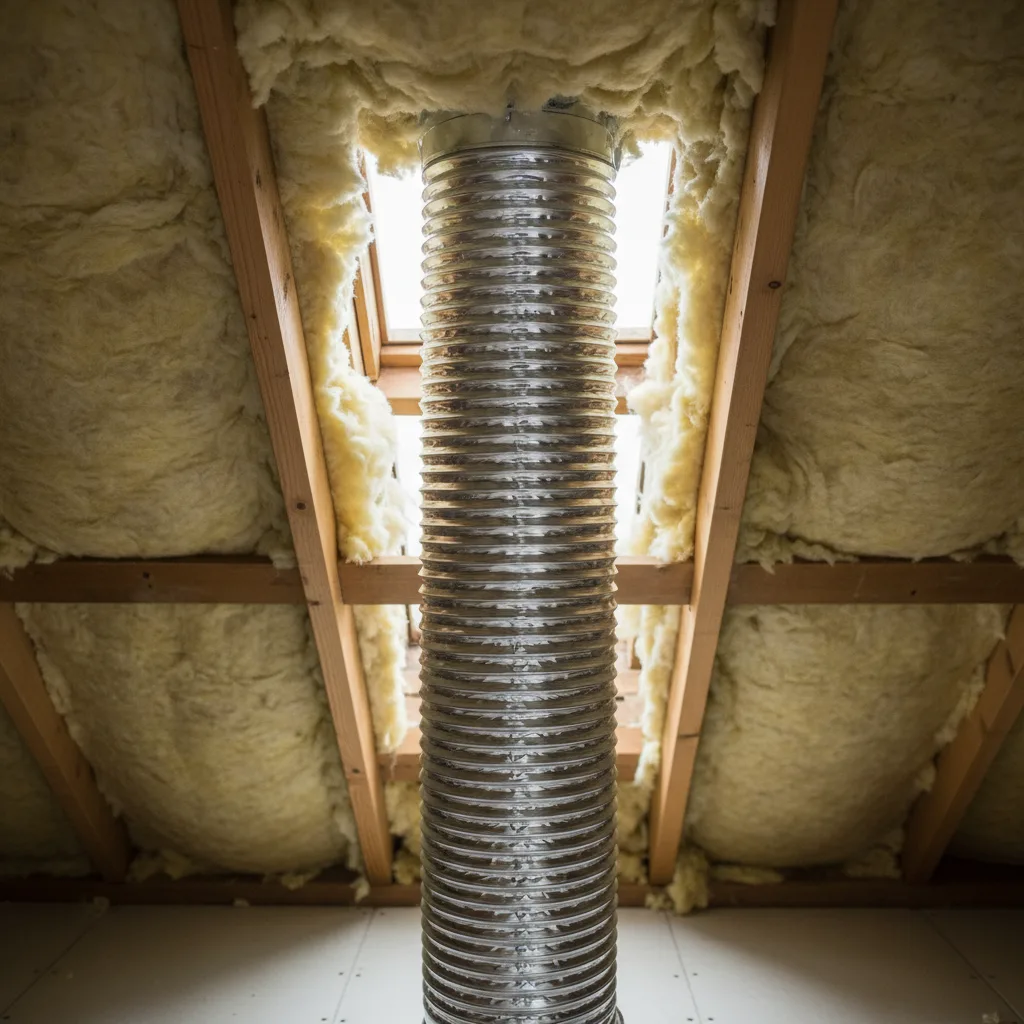
The ceiling is usually the binding constraint, and the number that decides it is joist spacing. Interwar and post-war houses around Poole commonly run ceiling joists at 400mm or 450mm centres; trussed roofs put their ceiling ties at around 600mm. Subtract the timber thickness and the clear gap between them is less than the centre-to-centre figure suggests.
A 250mm tube slips between 400mm centres without argument. A 350mm tube into the same ceiling means either finding a wider bay, moving the diffuser to a position where the bay is clear, or a trimming detail around the opening — and trimming a ceiling joist is a small structural alteration, not a nothing. In a trussed roof it is not available at all, because the ceiling tie is part of the truss and nothing in a truss gets cut.
There is a decorative constraint too, and it is worth being honest about. A 350mm disc in a modest cloakroom ceiling is a large object. Some people like it and call it a feature; others find it dominant. It is easier to have that conversation before the hole exists.
What the roof will take
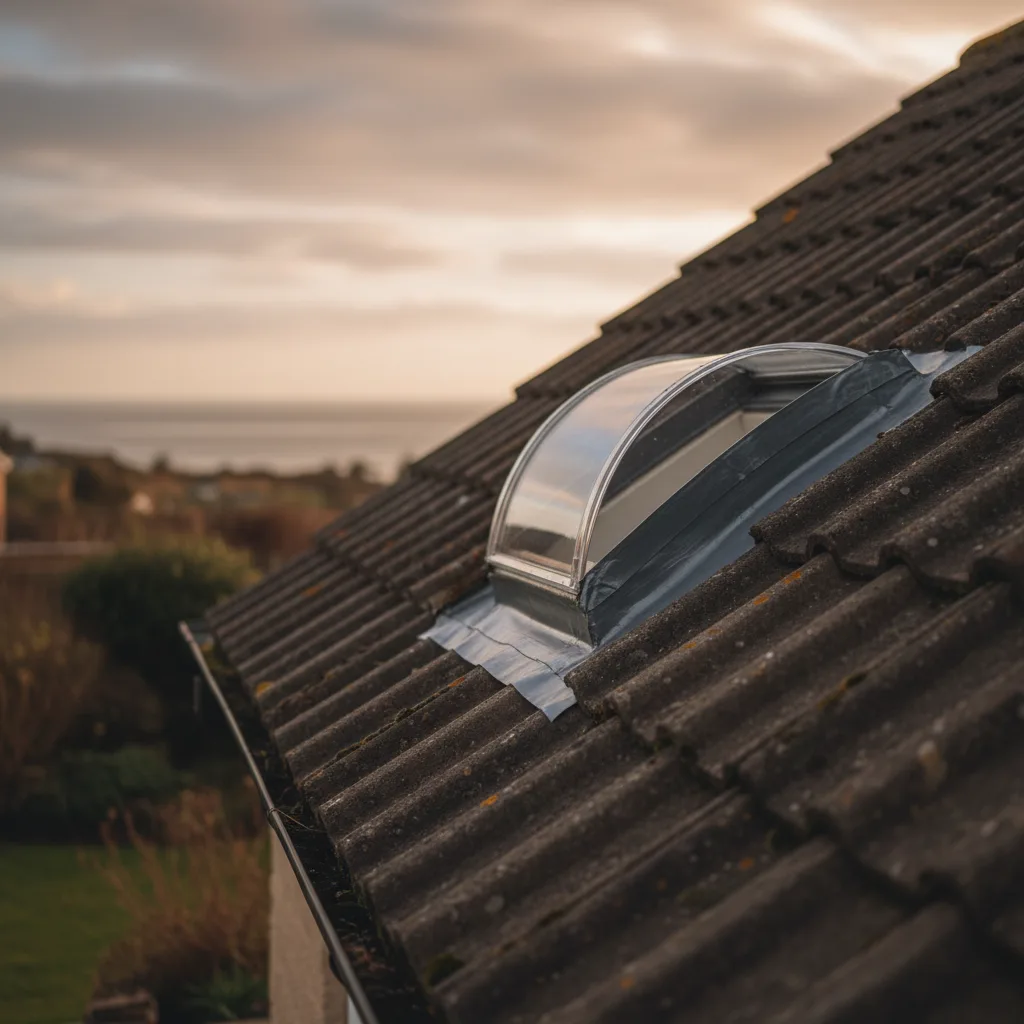
At the top end the limits are the rafter spacing and the flashing kit. A dome sits in a specific size of opening, and the flashing made for it is designed to dress into a given covering over a given module of tile or slate. Going up a diameter can mean the flashing skirt now spans more courses than the standard kit allows for, which is a detail to settle at survey rather than discover on the roof.
Coverings differ in how forgiving they are. Profiled concrete interlocking tiles, which cover a great deal of the interwar and post-war suburbs here, take a larger skirt without much drama. Small-format plain tiles and natural slate need the laps thought about. Purbeck stone is a different problem altogether and has a sun tunnel be fitted into a Purbeck stone slate roof. The comparison across coverings sits on the flashings page.
The rule we will not give you
There is no honest diameter-to-floor-area conversion
Nobody can tell you that a 350mm tunnel lights so many square metres. Any firm that offers you a tidy conversion of that kind has invented it, because the answer depends on the run length, the number and severity of bends, the roof pitch and orientation, what the dome can see past a chimney or a neighbouring gable, the diffuser fitted, the height of your ceiling and the colour of your walls.
What exists and is worth reading is the manufacturer’s own published performance data for a specific product in a stated configuration, almost always a straight run. That declaration governs. We will tell you which product we are proposing so you can read the sheet yourself, and we will describe in plain words what we expect the room to feel like. We will not dress a guess up as a calculation.
Smaller and larger than the common pair
Tunnels exist below 250mm and above 350mm. The small ones have a genuine use in a very short, very straight drop into a tiny space — a cloakroom immediately under a ridge, say — where the run is so brief that the aperture is the only variable and the ceiling cannot take anything bigger.
Above 350mm you are into sizes that ask real questions of the ceiling structure and the roof opening, and at that point the sensible thing is usually to stop and ask whether the room should be having a skylight instead. Which is the next section, because it comes up constantly.
When going bigger is the wrong answer entirely
If you find yourself specifying up because the room is not going to get enough light from a tunnel, check first whether the room has a roof plane of its own. A sun tunnel is not a substitute for a rooflight where a rooflight would fit, and a large-diameter tunnel is an expensive way to approach something a modest roof window would have done better, with a view and an opening sash thrown in.
The tunnel is the right product where there is genuinely no route for a skylight: an internal room, a room under another storey, a space buried in the middle of the plan. Where the roof is right over the room, we will say so and lose the tunnel job. The full comparison is on the page that sets the two products against each other.
Diameter or route: which to fix first
- Shorten the run. Free, if the dome or the diffuser can move. Always worth exhausting before anything is bought.
- Remove a bend. Also usually free at design stage, and a bend costs more than an equivalent length of straight tube.
- Go up a diameter. The most reliable purchased improvement, subject to the ceiling and the roof allowing it.
- Change the tube type. Rigid over flexible where the route permits, which matters most on the longer runs.
- Add a second tunnel. For a long hall, two well-placed shorter runs beat one large badly-placed one.
- Stop and reconsider the product. If none of the above gets you there, the room is asking for something other than a tunnel.
The Poole condition that changes the sum
Canford Cliffs and Branksome Park, under the pines
Diameter governs how much of the available light gets in. Under a mature pine canopy there is simply less available light to begin with, and evergreen shade does not lift in winter the way a deciduous canopy does.
A small dome under those trees is also a small target for needles and resin, and a fouled dome loses light before the tube gets a chance to. Where the canopy is heavy, going up a diameter is more clearly worth the money than it would be on an open roof in Creekmoor — and it is also more likely that the honest answer is a rooflight on a clear part of the roof, or an accepted electric contribution as well. Tree preservation orders are common on those roads, so pruning your way out of the problem is frequently not available.
How we settle yours
The diameter is decided at the survey, after the route is known, because it depends on the route. We measure the clear bay in the ceiling, the rafter spacing, the run and the deflections, look at the covering to check the flashing kit, and then specify the largest tube the house will comfortably take along the route we have drawn.
You get that in writing with the product named, a fixed price after survey, and a ten-year workmanship guarantee that is our own and is not insurance backed. What you will not get from us is a lumen figure or a square-metre claim. Ring 01202 923272 if you would rather have the honest version.
Related reading
1930s Poole semis with internal bathrooms and no wall to reach
The interwar semi built across Parkstone, Winton, Penn Hill and Oakdale has a recognisable problem: a bathroom in the middle…
Adding a light kit so the tunnel works after dark
A sun tunnel goes dark when the sky does. In a bathroom or a hall that had no daylight at…
Are sun tunnels warm or do they lose heat?
A sun tunnel is a hole through your insulated ceiling, so yes, it loses some heat — and a properly…
Broadstone bungalows where the loft void is shallow and wide
Broadstone, Creekmoor and the bungalow runs out towards Corfe Mullen were built low and built wide. Every room sits on…
Can a sun tunnel be fitted in a bathroom?
Yes. A windowless internal bathroom or en-suite is the single most common place a sun tunnel earns its keep, and…
Can a sun tunnel be fitted into a Purbeck stone slate roof?
Yes, but not with a kit. Purbeck stone slates are thick, heavy and laid in diminishing courses, and there is…