Rooflight and Skylight Installation Barton on Sea
Rooflight and skylight installation at Barton on Sea, where direct Channel exposure and a documented history of ground movement both belong on the specification.
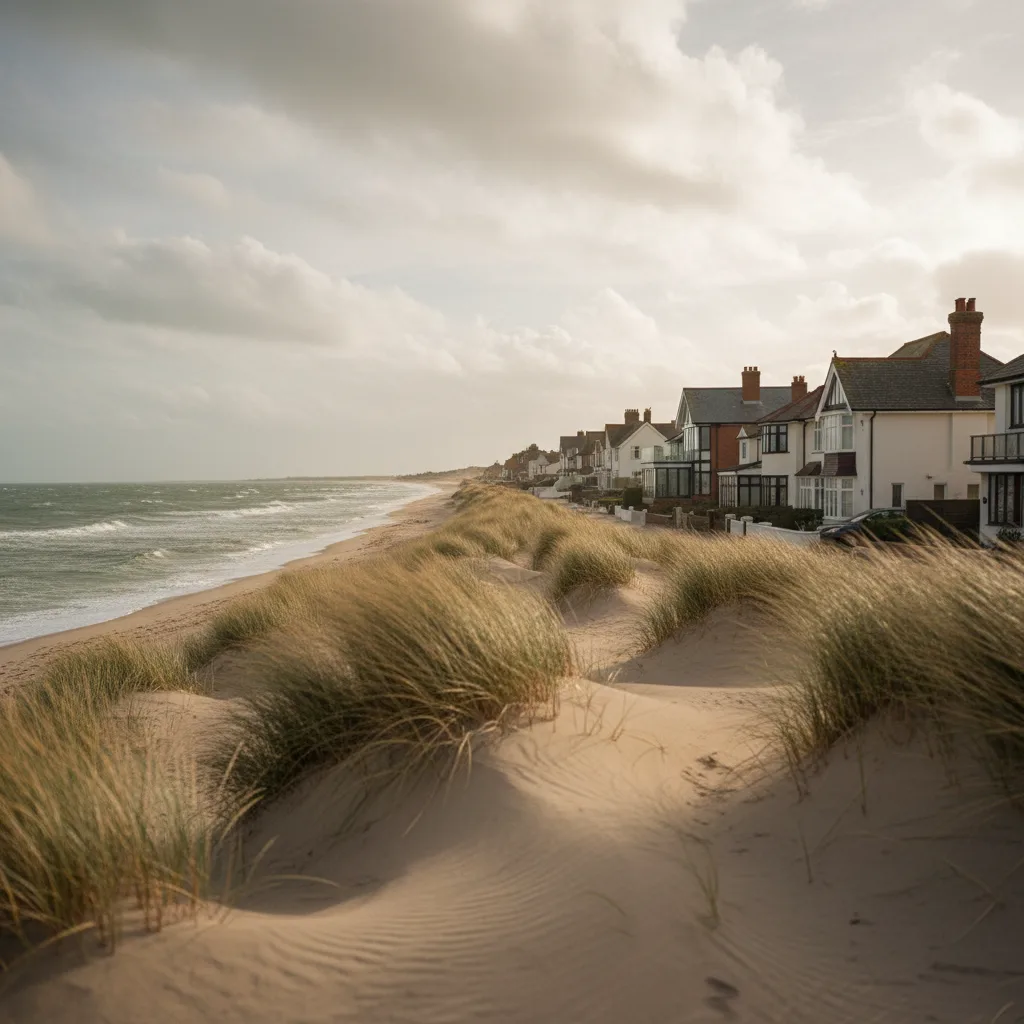
Barton on Sea is a cliff top with a clear view of the Isle of Wight and absolutely nothing between it and the Channel. It is also one of the most closely studied stretches of moving coastline in southern England. Both facts belong on a rooflight quote, and on most quotes neither appears.
No harbour, no headland, no shelter
Everything else we do on this coast has something in front of it. Poole Quay has the town behind it and Brownsea in the way. Lymington has the Isle of Wight across the water. Wareham has four miles of reed bed. Barton has open water to the horizon and a prevailing south-westerly that reaches the cliff having crossed the Channel without touching land.
What that delivers to a roof is not simply “sea air”. It is three separate loads arriving together: sustained wind with real uplift pressure on anything projecting from a roof plane, chloride-bearing spray carried well inland on a gale, and, in winter storms, fine grit that scours coatings and glass the way light sandblasting does. A specification written for a sheltered harbour roof does not fail dramatically here. It fails slowly, and by the time it shows, the guarantee has usually expired.
Exposure zone: exposed coast. Marine-grade coating to a stated standard on the frame — ask any firm which standard, because “marine grade” on its own is a sales phrase, not a specification. A4 (316) stainless throughout on exposed fixings, including the ones nobody will ever see again. Fixing centres taken from the manufacturer’s wind-load schedule for the exposure category, not from the standard drawing. Seals and gaskets specified for UV and salt rather than accepted as supplied.
The cliff is moving, and it is not our place to pretend otherwise
Barton’s cliffs are well known to geologists and to everybody who lives here. The clays beneath them hold water, the water drives slipping, and the frontage has a long documented history of landslip and of engineering works intended to manage it. Coastal change here is a matter of public record rather than rumour.
We are skylight installers. We are not structural engineers, coastal engineers or surveyors, and this page is not going to imply we can assess your ground. What we can do is be straight about where ground movement touches a rooflight job, because it does, and the connection is not obvious.
Why movement matters to a piece of glass
Glass is the least forgiving component in a house. Masonry cracks and carries on. Timber racks and stays up. A large fixed sealed unit in a distorting frame is where movement shows first — as a seal failure, a misting, or in the worst case a cracked pane with no impact to blame.
So on a property with a known movement history we ask what is known before specifying a large fixed unit, we prefer a designed opening with a proper trimmer over a minimal one, and we will say when we think a structural opinion is needed rather than quietly building around a question.
And we do not give ground advice. If there is cracking, historic underpinning or a movement history in the file, that belongs to a structural engineer. We will wait for their view rather than talk you past it.
What is on the roofs here
The cliff-top stock is mostly twentieth century: inter-war and post-war houses and bungalows, a good number of chalet bungalows, and apartment blocks along the frontage taking the view. Behind them, Barton runs into New Milton without much of a seam. There is very little historic fabric, which removes one problem and leaves the weather as the whole job.
| Property | Roof | Rooflight approach | Exposure detail that changes |
|---|---|---|---|
| Cliff-front houses and bungalows | Concrete interlocking tile, often shallow pitch, frequently re-covered at some point | Roof windows to the pitched slopes, or flat units over rear extensions | Full marine build-up, tightened fixing centres, and attention to how the flashing terminates on the windward side |
| Chalet bungalows with existing dormers | Tile with dormer cheeks and valleys already in the slope | Positioning is constrained by the valleys before it is constrained by the room below | Valley junctions take concentrated water in driven rain and are the place a wind-driven leak starts |
| Apartment blocks on the frontage | Flat, felt or single ply, communal | Rarely an individual decision — the freeholder or management company owns the roof | Consent from the freeholder comes before anything technical, and we ask for it in writing |
| Rear extensions, town-wide | Flat deck, 1970s onwards | Kerb built with a fall, weathered, then the unit measured to the finished opening | Upstand height is not the place to economise on an exposed roof; driven rain climbs further than still rain |
Glass, uplift and the things that actually break here
On an exposed-coast roof the failure modes are different from the inland ones, and they are worth naming because they drive the specification rather than the other way round.
- Coating chalking. A standard architectural powder coat exposed to chloride and UV on this frontage loses its finish. It is cosmetic at first and then it is not.
- Fixing corrosion. The most expensive thing on a coastal roof is a cheap screw. Mixed metals plus salt equals galvanic corrosion, and the failure is hidden inside the detail until something moves.
- Uplift at the perimeter. Wind load on a roof is worst at edges and corners, which on a small bungalow is most of the roof. Fixing centres come from the schedule, not from habit.
- Gasket degradation. UV and salt age seals faster here. A unit specified with better gaskets costs slightly more once and saves a callout later.
- Driven rain at the flashing head. Rain does not fall vertically on this cliff. Flashings are detailed for water arriving sideways and upwards, which is a question of how the kit is installed as much as which kit it is.
On glass, the honest position: toughened and laminated combinations are available and there are good arguments for laminated on an exposed frontage, particularly overhead. We will talk you through what the manufacturer offers for the unit that suits your roof, rather than quoting a specification we have made up a name for.
How a job is sequenced when the weather is the main risk
Inland, a roof being open for a few hours is an inconvenience if it rains. On this cliff top it is the whole risk of the job, because the rain arrives sideways and the wind will find anything temporary. So a Barton job is programmed around weather rather than around the diary.
What that means in practice
We do not open a roof into a forecast gale. We would rather move a start by two days than have a hole in your roof on the wrong afternoon, and we say that at the point of booking so it is not a surprise later.
Each opening is watertight the same day. A single unit into a pitched slope is formed, set and flashed within the day. Where that is not possible — a large lantern, or a kerb that has to be built first — the temporary weathering is a proper detail, fixed down for wind, not a sheet and some blocks.
Scaffold is designed for the exposure. Tied and sheeted appropriately, because debris netting on a cliff-top scaffold behaves like a sail in the wrong conditions.
None of this is heroics. It is the ordinary consequence of working somewhere the weather does what it likes, and it is worth asking any firm quoting here how they intend to handle it.
Who decides, and what the coastline has to do with it
Planning here is New Forest District Council. Barton on Sea is outside the New Forest National Park, so the Park Authority is not involved, and Barton is in Hampshire, not Dorset — a distinction worth making because Highcliffe, a couple of miles west along the same beach, is BCP Council. Same bay, same weather, two authorities.
For an ordinary rooflight in an existing slope the usual permitted development position applies: not projecting more than 150mm beyond the plane of the roof, not above the highest part of it, with building regulations applying separately and always. What is worth knowing at Barton specifically is that properties close to the cliff can carry conditions or constraints connected to coastal change, and a condition attached for any reason can remove permitted development rights as a side effect. It is a ten-minute check on the planning history, done before anything is ordered.
Questions we get asked in Barton on Sea
Is a marine specification really necessary, or is it an upsell?
Here it is necessary, and we can tell you exactly why: no shelter, direct south-westerly fetch, documented salt load and real uplift. The test of whether a firm means it is whether they also decline to quote it inland — we do. Ask us about Ringwood or Burley and the answer is standard coating and no marine premium.
Does coastal erosion stop me altering my roof?
Not by itself. It can mean conditions on the property, and it means a property with a movement history deserves a structural opinion before a large fixed unit goes in. We check the planning history and we say when something is outside our competence.
Will a rooflight leak in a storm here?
A correctly specified and correctly flashed one should not. Most coastal leaks we are called to are either a flashing detailed for vertical rain, an upstand that was kept low to save money, or condensation being mistaken for ingress. All three are avoidable at the specification stage.
I am in a flat on the front. Can I have a skylight?
That depends on your lease and your freeholder, not on us. The roof is almost always communal. Get the freeholder’s written consent first and we will happily survey after that.
How often will I be cleaning it?
More often than someone inland, and salt film is the reason rather than dirt. Self-cleaning coatings work better here than under trees because there is plenty of light and rain, but no coating removes salt haze entirely. Position the unit where it can be reached safely.
What we promise, and what we will not say
We fit and replace rooflights and skylights. We are not roofers, engineers or coastal consultants, and on this frontage the boundaries of what we do matter more than usual.
Ours to promise
A ten-year workmanship guarantee on our installation, and it is not insurance backed — stated plainly, because on a coast where firms come and go that distinction is worth understanding before you rely on it.
A fixed written price after survey. One itemised figure. Where opening a roof reveals something nobody could have seen, we stop, show you and price it separately.
No borrowed credibility.The firm is new and it says so.
To hear the exposure specification we would write for your Barton address — the coating standard, the fixing grade and why — ring 01202 923272. You are welcome to take that specification and ask somebody else to price it. That is rather the point of publishing it.
Related reading
Rooflight and Skylight Installation Alderney
The Alderney question is not what it is made of. It is whether it opens Most of the calls we…
Rooflight and Skylight Installation Bere Regis
Cob, and why we ask what your walls are made of Cob is earth. Subsoil, water, straw and sometimes chalk…
Rooflight and Skylight Installation Blandford Forum
A town rebuilt all at once, and what that does to roof work Most English towns grew in layers, so…
Rooflight and Skylight Installation Boscombe
In Boscombe, the roof is usually not the shape people think it is Ask someone what their roof looks like…
Rooflight and Skylight Installation Bournemouth
Bournemouth is not one exposure, and neither is its roof stock Bournemouth runs from a clifftop down a set of…
Rooflight and Skylight Installation Bovington
Rows of the same roof, and why we still survey yours Bovington is unlike almost anywhere else we work. It…