Roof pitch limits: what happens below 15 degrees and above 55
The mechanisms behind a roof window's shallow and steep pitch limits, and why the two ends of the range fail in completely different ways.
Two limits, and they fail in opposite directions
Every roof window carries a pitch range, and both ends of it are real. What is less obvious is that the two ends are nothing like each other. The shallow limit is about water: below it, the roof stops shedding and starts holding, and the flashing runs out of physics. The steep limit is about mechanics: above it, the sash gets heavy in a direction the hinges were not asked to deal with, and the thing that fails is the way the window works rather than the way it keeps rain out.
The bands themselves are covered on what roof pitch you need. This page is about the mechanisms underneath them, because understanding why the limit exists is what tells you whether a roof at 14 degrees or 58 degrees is a hard no or a different specification.
The minimum pitch is a test result, not a manufacturer’s mood
A flashing kit’s minimum pitch comes out of weathertightness testing: the assembly is sprayed with water at a defined rate while air pressure is applied to one face, and the pitch at which water stops being reliably shed is where the number lands. It is not a warranty dodge and it is not padding. Fit below it and the assembly is being asked to do something nobody has demonstrated it can do.
What fitting below the minimum actually costs you
Three things happen at once, and the third is the one people forget. The assembly may leak, which is obvious. The manufacturer’s warranty on the unit and the flashing no longer applies, because the product is outside its declared range. And no competent installer will guarantee their own workmanship on it either, because the failure is designed in rather than built in. If somebody offers to fit a pitched roof window onto a 10 degree roof, ask them to put the pitch and the product’s minimum on the same piece of paper.
Below the shallow limit: water stops running and starts sitting
On a steep roof, water leaves. On a shallow roof it lingers, spreads sideways and finds its way along a lap rather than over it. Four separate mechanisms come into play as pitch falls, and they compound.
| Mechanism | What is happening | Why the flashing cannot fix it |
|---|---|---|
| Reduced run-off velocity | Gravity’s component down the slope falls away with the sine of the angle. At 15 degrees it is about a quarter of vertical; at 10 it is under a fifth | Slower water dwells longer at every lap, and dwell time is what finds a way through |
| Capillary action | Water climbs a narrow gap between two smooth surfaces against gravity | The shallower the slope, the further it climbs before gravity wins. Laps sized for 30 degrees are simply too short |
| Lateral spread | Run-off fans sideways instead of tracking straight down, so it arrives at the side flashing along its length rather than at the bottom | Side flashings are designed to escort water past, not to receive it broadside |
| Standing water and debris | Silt, moss and pine needles settle in the head gutter above the window and hold a wet strip permanently | A permanently wet lap is a different test from an occasionally wet one |
There is a further cruelty specific to the coast. Wind-driven rain does not arrive vertically; it arrives at an angle, with momentum, and it is perfectly capable of travelling up a shallow slope. The exposure maps put a broad swathe of the south coast in the severe category for driving rain, and the sand spit at Sandbanks and Studland, with open water on both sides and no fetch break, is as exposed as this service area gets. A pitch that would be marginal in a sheltered inland street is not marginal there, it is wrong.
The shallow roofs we actually meet in Poole
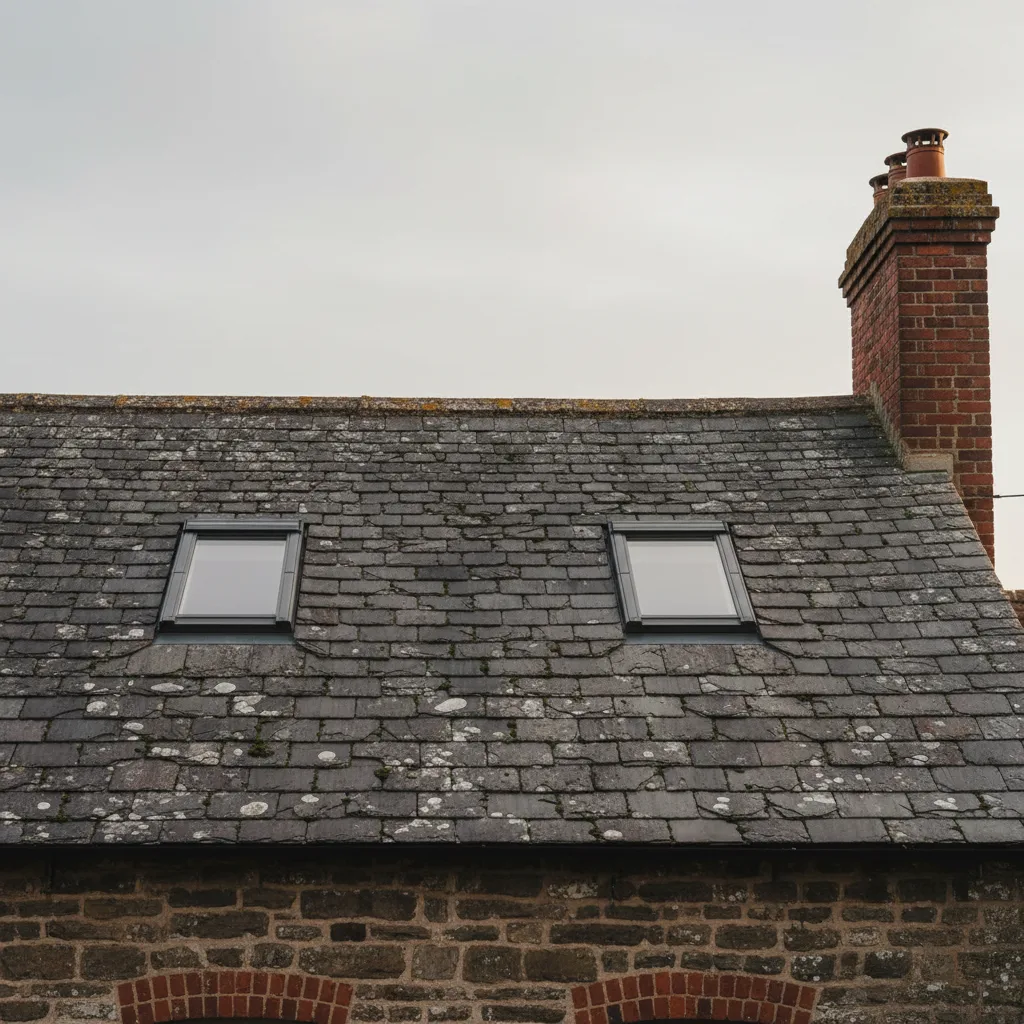
Very few main roofs in the area are under 15 degrees. The shallow pitches turn up almost entirely on additions: 1960s and 1970s rear extensions, garage roofs, dormer tops, porches, and the low lean-to over a utility room. Occasionally a whole bungalow roof from the 1960s comes in around 17 or 18 degrees, which is inside the range for some products and outside it for others.
Interlocking concrete tiles are what made shallow pitches possible at all. A great many of the low-pitch extension roofs around Creekmoor, Canford Heath and Broadstone were laid in a big single-lap concrete tile precisely because it could go down to around 15 degrees when a plain tile roof needs something closer to 35. That is a covering limit, not a window limit, and it matters: a roof can be at a pitch its own tiles are happy with and still be below the minimum for any roof window flashing kit made for that tile.
Where the roof is genuinely too shallow, the honest answer is a different product rather than a different attitude. A kerb-mounted rooflight sits on a raised upstand above the deck and is weathered by the membrane dressed up that upstand, so it does not depend on slope at all. That is a proper solution and not a downgrade. What it is not is the same job, and it should be quoted as what it is.
Above 55 degrees: the sash gets heavy the wrong way
Steep roofs weather well. Water leaves fast, capillary action is beaten by gravity, laps are generous in effect even when short in measurement. Nothing about the shallow-pitch list applies. What changes instead is how the window behaves as an opening object.
On a centre-pivot sash at 30 degrees, the weight of the glass is mostly bearing down into the frame and the friction hinges only have to hold a modest turning moment. As the roof steepens, more and more of that weight is trying to swing the sash rather than press it into the seal. By the time the slope is approaching vertical, the sash behaves like a heavy door hung on its side: it wants to fall open or fall closed, and whichever way it wants to go, it wants to go there fast.
| What steepens | What it does to the window | What the specification has to do about it |
|---|---|---|
| Turning moment on the hinges | The sash no longer stays where you leave it; it drifts open or slams | Hinges rated for the pitch, or a product whose declared range covers it. Not an adjustment on site |
| Opening geometry | A top-hung sash swings further out from the roof plane for the same opening angle | Check projection against anything below: a footpath, a conservatory, a neighbour’s boundary |
| Cleaning rotation | Rotating a centre-pivot sash to clean it needs clearance inside the room, and at a steep pitch the sash swings into head height | Set the head height with the rotated sash in mind, not just the closed one |
| Blinds and gravity | A blind that ran happily across a 30 degree slope now hangs almost free | Side-guided or tensioned blinds rather than a simple roller |
| Rain on the glass | Less self-rinsing than a shallower unit, because drops leave rather than sheet | Expect more streaking, particularly under a pine canopy at Canford Cliffs or Branksome Park |
Mansards, and the point where it stops being a roof window
Push past about 70 degrees and you are no longer really glazing a roof. The lower slope of a mansard, the steep face of a dormer, and some Victorian turret roofs run close enough to vertical that the unit behaves like a wall window that happens to be surrounded by tiles.
That changes which rules apply. Glazing at low level in a near-vertical plane brings safety glazing and guarding into play in a way that a 35 degree roof window never does, because a person can now fall against it rather than merely stand under it. It also changes the weathering: at that angle the covering is often hung tiles or slates on a near-vertical face, and the detail around the opening owes more to a wall than to a roof. It is a legitimate job. It is a different job, and it should be surveyed as one.
Both ends share two problems
Debris and snow bracket the range from either side. On a shallow roof debris settles and stays, so the head gutter above the window silts up and the self-cleaning coating on the glass never gets the sheeting run-off it needs to work. Under the mature pines at Branksome Park that happens within one autumn. On a steep roof debris leaves readily, but what does settle tends to be in the head flashing where the slope is interrupted, and it is harder to reach to clear.
Snow is the reverse. It rarely troubles a shallow roof in Dorset, where falls are light and infrequent. On a steep roof it slides, and it slides as a slab, and the thing it slides against is the projecting head of the window. Roofs above about 45 degrees in areas that get real snow use snow guards for exactly this reason; here it is a once-a-decade consideration rather than a design driver, but it is worth knowing why the head of the frame is the part that takes the hit.
What we confirm, and what we decline
- The actual pitch of the slope the window is going into, measured on site, not taken from a drawing or a neighbouring slope.
- The covering and its own minimum pitch, which may be a lower number than the window’s and is not the same question.
- The declared range of the specific unit and the specific flashing kit, which are two separate declarations.
- The exposure zone, because a marginal pitch at Broadstone and a marginal pitch at Sandbanks are not the same risk.
- For steep slopes, the operation type, the projection when open, and the clearance for cleaning.
- Whether a kerb-mounted unit on a small upstand is the better answer, and if so we say so and quote it as that.
Where a roof is below the range, we do not fit a pitched roof window on it and call the difference a detail. There is a product that suits a shallow deck and it is a rooflight on a kerb. Where a roof is steep, we specify for the steepness rather than discovering it on the day. Homeowners search for a skylight, the trade writes rooflight, the manufacturer prints roof window, and none of the three words changes the angle of your roof.
Our work carries a ten-year workmanship guarantee, stated plainly as not insurance backed, with a fixed written price after survey naming the pitch and the reason for the specification. Ring 01202 923272.
Related reading
1930s semis in Poole: rafter spacing and the window sizes it allows
Half of suburban Poole was built to one drawing Between the wars the town spread outwards fast, and it spread…
Batten gauge, tile course and lining a window up with the roof
You can see a badly set out window from the pavement Stand on any residential street in Poole and look…
Can a roof window be fitted above a staircase?
Yes, and a stairwell is often the best place in the house for one A roof window over a staircase…
Can a roof window be fitted from inside the loft?
Part of it, yes. All of it, no. A roof window cannot be fitted entirely from inside the loft, and…
Can a roof window be fitted over a bath or shower?
Yes, and a bathroom is one of the best rooms in a house for daylight from above. Three things change…
Can a roof window be fitted to a slate roof?
Yes, with a flashing kit made for slate Slate is one of the easiest coverings to put a roof window…