Sandbanks roof terraces and glass that takes salt and bare feet
Marine specification for a walk-on rooflight on the Sandbanks spit: fixing grades, coating systems, blown sand, barefoot use, access and the rinse routine.
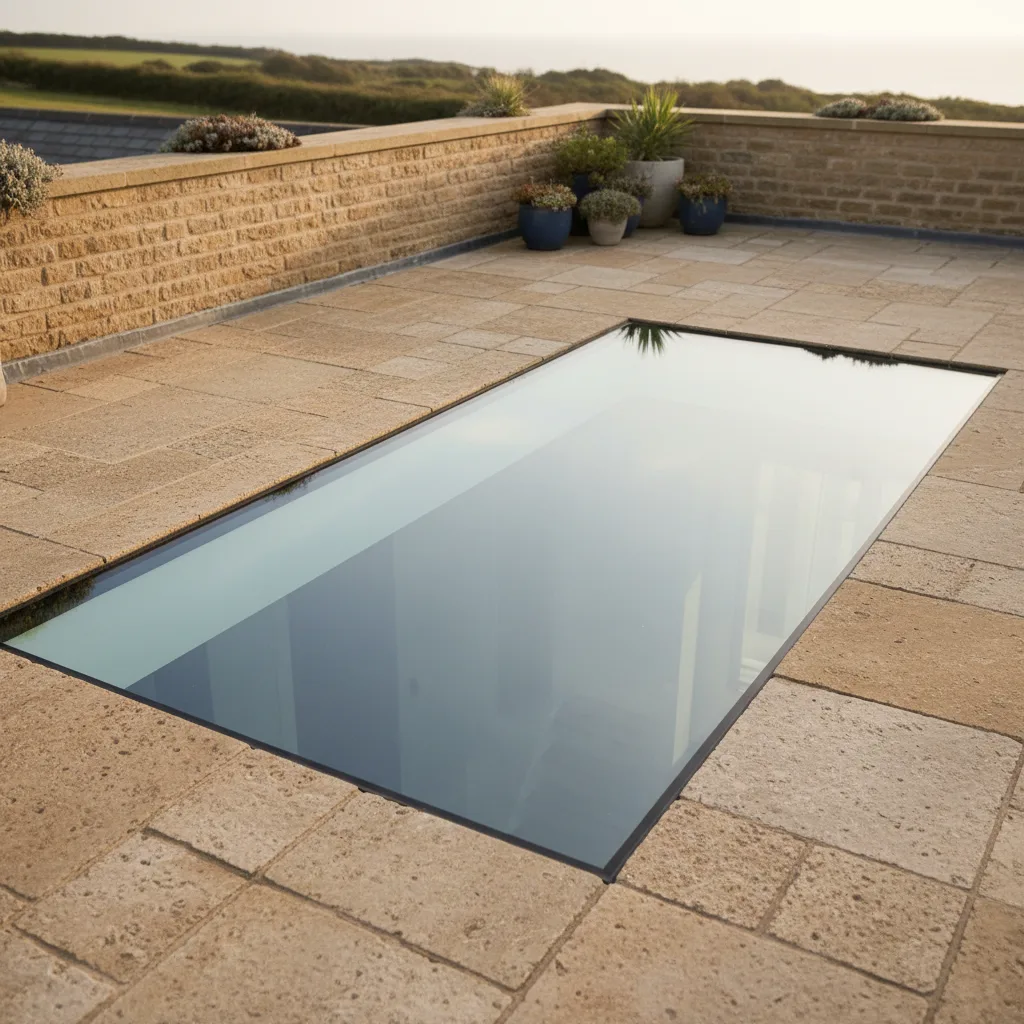
A walk-on rooflight on a Sandbanks terrace is asked to do two jobs that pull against each other. For six weeks of the year it is a floor crossed barefoot by people carrying drinks. For the other forty-six it sits in the most aggressive exposure in our service area, taking salt-laden air off open water on both sides with nothing to break it. Neither job is hard on its own. Together they decide most of the specification.
The walk-on rooflight service page covers the product generally, and the build-up guide stays inside the glass. This page is about one place, and what a skylight fitted there has to be made of.
The spit is not the same exposure as the rest of Poole
Exposure is usually described as a gradient running inland from the sea. On a sand spit that gradient does not exist. Sandbanks has water on the harbour side and water on the Channel side, and the strip between them is a few hundred metres wide in places. A prevailing south-westerly crosses open sea, reaches the peninsula and has nothing to slow it down or strip the salt out of it. Studland across the harbour mouth and Mudeford further east behave the same way.
What that produces is not occasional spray. It is a continuous film of salt deposited on every horizontal surface, replenished faster than light rain can wash it off, and a walk-on pane laid flat is the most horizontal surface on the building.
Zone: spit. Sandbanks, Studland and Mudeford sit in it. Marine-grade fixings and coatings are the baseline here, not an upgrade. Four miles north at Broadstone the same specification is money spent on a problem the site does not have, and we will say so rather than sell it.
What salt actually attacks
Salt does very little to the glass itself and a great deal to everything holding it. Knowing which component is at risk is what separates a marine specification from a marine-sounding one.
| Component | What the salt does | How it shows | What we specify on the spit |
|---|---|---|---|
| Exposed fixings | Pitting and crevice corrosion, worst in shaded damp joints | Rust weep down the frame, a head that will not undo | A4 grade stainless throughout, isolated from dissimilar metal |
| Aluminium frame | Attacks the coating at cut edges and drilled holes first | White powdery bloom, then blistering paint | A coating system qualified for marine exposure, cut edges sealed |
| Steel support below | Ordinary paint fails where moisture sits in the roof build-up | Nothing visible until the ceiling stains | Galvanised and coated before it goes in, as set out in the steel guide |
| Laminate edge | Salt-carrying moisture works between the plies over years | A cloudy fringe creeping in from the edge | Generous edge cover under the frame and a perimeter that drains dry |
| Gaskets and seals | Nothing chemically; ultraviolet and heat do the damage | Chalking, hardening, a gasket that no longer springs back | EPDM where it is exposed, and a sealant rated for the movement |
| The glass surface | Deposits rather than etches, then bakes on in sun | A haze that survives rain and returns within days | Nothing in the specification — this one is solved by rinsing |
Two metals, one wet joint
The corrosion that catches people out on the spit is not usually a cheap fixing rusting. It is two perfectly good metals in contact with salt water between them. Stainless steel and aluminium sit far enough apart electrically that, in a permanently damp saline joint, the aluminium gives up material to protect the stainless. The fixing stays immaculate. The frame around it swells, cracks the coating and eventually loosens the fixing it was holding.
The answer is not exotic. It is a nylon or EPDM isolating washer and sleeve at every stainless-into-aluminium connection, sealed so water cannot stand in the hole, and no swarf left behind from drilling on site. Steel filings dropped onto an aluminium frame during installation and left there will bloom into rust spots within a fortnight on a spit terrace, and once they have pitted the coating they cannot be polished out.
The same logic governs anything anyone adds later. A stainless balustrade base bolted straight down onto a coated aluminium upstand, with no isolation and no sealant, is a corrosion cell someone built on purpose without meaning to.
Blown sand is an abrasive, and it arrives sideways
Inland, the grit that reaches a rooflight arrives on shoes. On the spit it arrives on the wind, at speed, continuously, and there is a beach on each side supplying it. Sand does three separate things to a walk-on unit and only one of them is the obvious one.
It abrades the top surface, which is what the sacrificial ply exists to absorb and which the scratching answer deals with in full. It collects in the perimeter drainage channel and in every recessed fixing head, where it holds moisture against the joint long after the surface has dried. And it works into a textured slip finish, filling the pattern until the surface is smoother and dirtier than the day it was fitted.
The last of those is the one that matters most and gets noticed least. A slip-resistant surface is a measured property of a clean surface. The anti-slip guide makes the technical case; the practical consequence on a spit terrace is simply that the interval between washes is shorter here than anywhere else we work.
Coatings, gaskets and the parts that are not metal
The word to test on a quotation
“Marine grade” is not a defined term and appears on quotations for everything from A4 fixings to ordinary paint. Ask instead for three specifics: the fixing grade, the coating system and the exposure it is qualified for, and whether cut edges and drilled holes are treated after fabrication. A frame powder coated in the factory and then cut to length on site has an untreated edge in the wettest part of the assembly, and that is where the first failure starts.
Polymers on the spit are damaged by sunlight and heat rather than by salt, which is why a horizontal pane is harder on them than a vertical window. Exposed silicone on a flat roof takes direct summer sun all day and reflected light off the water on top of that. Expect it to need attention before the glass or the frame do, treat a chalky, hardening bead as a maintenance item rather than a defect, and keep the handover paperwork so the next person knows what was used.
Self-cleaning coatings deserve one sentence of honesty here. They work by using ultraviolet light to break down organic film and then letting rain sheet it away, and salt deposit is not organic film. On the spit a self-cleaning surface will still carry a salt haze, and the owner who was told it never needs washing will be disappointed within a season.
Bare feet change what the terrace is for
A Sandbanks roof terrace is used barefoot in a way an inland one is not, and three details follow from that which nobody raises at quotation stage.
Surface temperature is the first. Horizontal glass in full July sun gets hot, and a dark or heavily patterned surface gets hotter than a pale one. If the pane sits on the route between a door and a pool or a stair, that route is going to be crossed by bare feet at two in the afternoon. It is worth walking the terrace at that hour before choosing a finish.
Texture is the second. A slip pattern that feels reassuring in shoes can feel harsh underfoot, and the coarsest available option is not automatically the right one for a private terrace where the users are known and the traffic is light. That is a decision to make by standing on a sample, not by reading a classification.
Sand underfoot is the third, and it is the reason a spit terrace wears faster than its inland equivalent. Grit carried onto the glass on wet feet is dragged across it under a person’s full weight. An outside tap and a mat at the head of the stair does more for the long-term appearance of the glass than any specification decision.
Getting the unit onto the terrace
A walk-on unit is a heavy object with a fixed shape, and access to the spit is genuinely constrained. This is settled at survey, before anything is priced, because it occasionally changes the design.
| Constraint | Why the spit makes it harder | What it can change |
|---|---|---|
| Road access | One road on and off the peninsula, plus the chain ferry, and narrow private frontages | Crane size, delivery timing, whether a road closure is needed |
| Crane standing | Sand and made ground under driveways; limited space between buildings | Mat requirements, reach, occasionally a split into smaller panes |
| Wind | A large flat pane on vacuum lifters is a sail; lifts get stood down | Weather windows, contingency days in the programme |
| Neighbours and parking | Dense frontages and heavy seasonal parking pressure | Working out of season, permits, early starts |
The honest version is that a lift on the spit is planned around the weather rather than the diary, and a programme that pretends otherwise will slip.
The rinse routine a spit terrace actually needs
- Rinse with fresh water, generously. Salt is removed by volume, not by scrubbing. A hose run over the glass and the frame, including the perimeter channel, does the work.
- Do it more often than feels necessary. Through the winter a spit terrace benefits from a rinse every few weeks. Inland, twice a year is plenty. The difference is real.
- Wash the frame, not only the pane. The fixings and the coated edges are where the damage starts, and they are the parts nobody points a hose at.
- Clear the channel before autumn and again in spring. Sand and salt together form a paste that sets hard in a slot drain.
- Use a soft brush and a mild detergent, never an abrasive pad or a blade. A scouring pad will flatten a slip finish and a blade will scratch it.
- Look at the fixing heads once a year. Any rust weep, any white bloom around a bolt, is worth a photograph and a phone call while it is still cosmetic.
What we specify on the spit, and where we say it is not needed
On a spit address we specify A4 stainless fixings with isolation at every dissimilar-metal joint, a coating system qualified for marine exposure with cut edges treated after fabrication, generous edge cover to the laminate, a perimeter that drains rather than holds, and EPDM where a gasket is exposed. We put the coating system and the fixing grade on the order in writing so the specification is a document rather than a conversation.
We do not put a load figure on any of it. The structural engineer names the use category for your building and the glass maker designs the pane to that category and your measured span, and no amount of marine specification changes that division of labour.
And we do not specify any of the above inland. A walk-on skylight at Creekmoor or Canford Heath gets a standard specification, because the exposure that justifies the marine one is not present and charging for it would be a fee rather than an engineering decision.
Our work carries a ten-year workmanship guarantee, stated plainly as not insurance backed, and a fixed written price after survey. Ring 01202 923272 or ask for a survey.
Related reading
Anti slip surfaces and the frit pattern that stays grippy when wet
Slip resistance on a walk-on rooflight is not an opinion about texture. It is a measured number, taken with a…
Are walk-on rooflights noisy to walk on?
No, not in the way people fear. A properly supported walk-on pane is one of the quieter surfaces to cross…
Are walk-on rooflights slippery when wet?
Clear polished glass is dangerously slippery wet, which is precisely why no walk-on rooflight is supplied with one. The top…
Balustrades, edge protection and where a walk-on panel changes the rules
Most of the difficulty in a walk-on project is not the glass. It is what happens at the edge of…
Can a car be parked on a walk-on rooflight?
Not on a domestic walk-on rooflight, no. Glass that carries vehicles exists, but it is a different product designed to…
Can a Quayside flat have a walk-on rooflight on its terrace?
Often yes, and the reasons it might not are rarely technical. On a Poole quayside flat the deciding factors are…