Rooflight and Skylight Installation Studland
Rooflight and skylight installation at Studland, on the sand spit at the mouth of Poole Harbour, where exposure, National Trust ownership and a single ferry route govern the whole job.
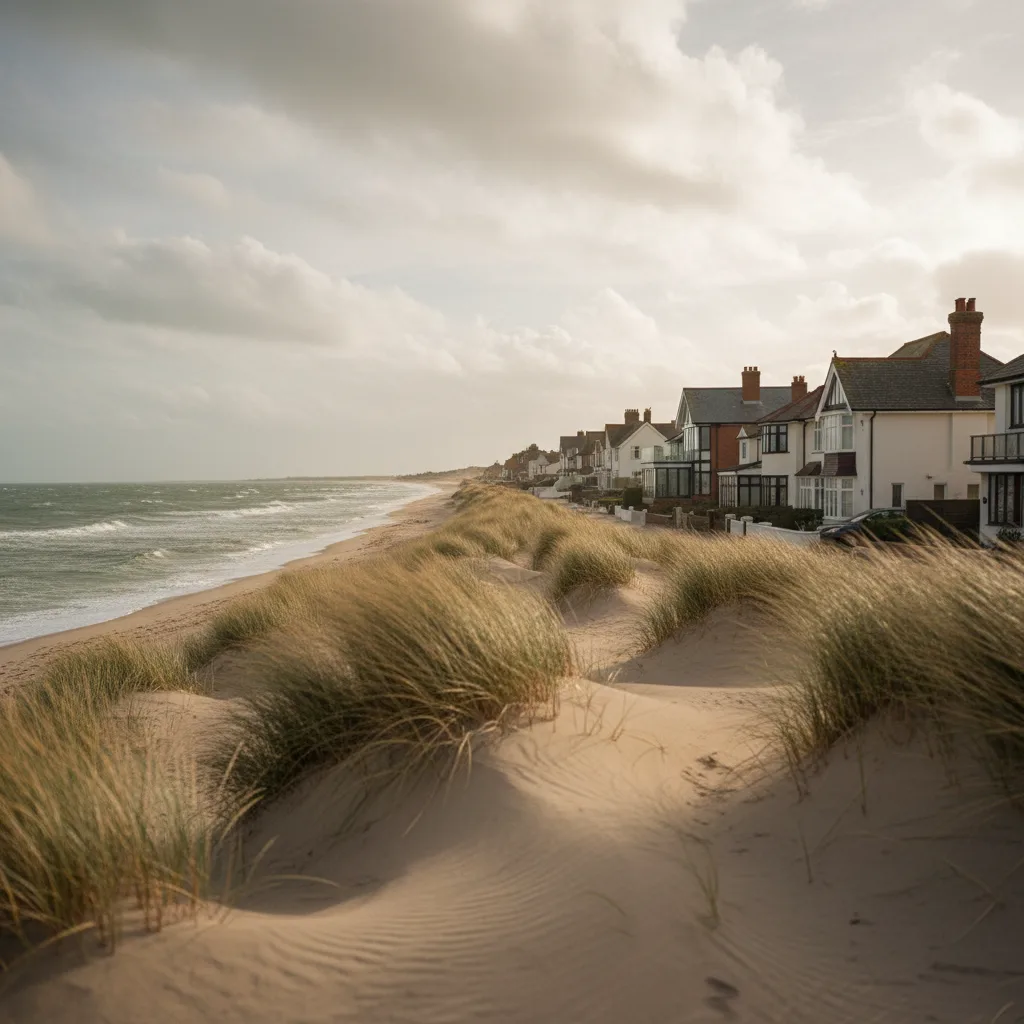
Four hundred metres from Sandbanks, twenty-five miles by road
Studland sits on the southern side of the mouth of Poole Harbour. Sandbanks is directly across the water, a few hundred metres away, and you can see the houses. Getting a van, a scaffold and a pane of glass from one to the other is either a chain ferry crossing or a drive round the whole of the harbour by way of Wareham and Corfe Castle — around twenty-five miles of road to cover a gap you could shout across.
That is not a colourful detail. It is the single biggest scheduling variable on any Studland job, and it is why we settle access at the survey rather than on the morning of the fit.
| Route in | What it is good for | What can go wrong with it |
|---|---|---|
| The chain ferry from Sandbanks | Short, direct, fine for a van and a two-person team | Vehicle weight and length limits, maintenance closures, weather stoppages, and summer queues measured in crossings rather than minutes |
| The road via Wareham and Corfe Castle | No limits, no queue, and the only realistic route for a long delivery or a scaffold lorry | Around twenty-five miles each way, and the Corfe gap and Wareham causeway are both pinch points in bad weather |
| Ferry Road itself | The one approach from the north to the village and the beaches | Single road, heavy seasonal traffic, and very limited places for a lorry to stop and unload legally |
The practical answer is usually to bring the unit and the scaffold round by road on a booked day, and to run the fitting team on the ferry. We price the access honestly on the quote instead of burying it, because the alternative is a firm discovering the problem later and asking you for more money.
The hardest exposure we specify for anywhere
Our whole method rests on saying which exposure zone a roof sits in, and most of the time that means telling someone their specification can be lighter than they expected. Studland is where the argument runs the other way.
A sand spit at a harbour mouth has water on both sides. The prevailing south-westerly crosses Studland Bay and the open Channel approaches with no fetch break at all; an easterly comes straight in off Poole Bay; and the harbour side is open water too. There is no sheltered elevation on a Studland roof in the way there is on a roof in Wareham or on the landward side of Swanage. Every face of the building is the design case.
| Location | Distance from open water | Shelter from the prevailing wind | Zone we specify |
|---|---|---|---|
| Studland and the spit | Metres, on two or three sides | None worth counting | Severe marine on every elevation |
| Swanage bay front | Metres, on the seaward side only | The Purbeck ridge breaks the south-westerly | Severe marine seaward, sheltered marine landward |
| Wareham and the harbour head | Several miles of reed, marsh and shallow water | Wareham Forest and heath in the way | Sheltered marine |
| Lytchett Matravers | Inland, over the ridge | Exposed to wind, but not to salt | Inland — marine grade would be wasted money |
Sand is the second abrasive, and it gets forgotten
Salt is the one everyone knows about. On the spit there is a second thing in the air that most coastal specification ignores, because most of the south coast is shingle: dry, fine, wind-driven dune sand.
Sand does two things to a rooflight. It abrades — a soft powder coat facing the dunes wears rather than simply corroding, and over years a glass surface facing into blown sand loses some of its optical clarity at the exposed edge of the pane. And it packs. Modern frames drain through small channels and weep slots, and those slots were designed with rainwater in mind rather than a fine granular solid. A drainage channel full of sand is a rooflight that ponds at the head of the frame and then reports itself as a leak.
Exposure zone: severe marine, all elevations, with a sand allowance. Marine-grade coastal powder coat, A4 (316) stainless fixings throughout, non-ferrous flashing clips, upgraded gaskets, and drainage detailing we can actually get at. On the spit we specify frames whose weep paths can be cleared by hand, and we say at handover that clearing them twice a year is part of owning glass in this location. Anyone who tells you a skylight here is maintenance-free is selling you the first callback.
Who owns the land, and who you have to ask
Two consents, and they are not the same consent
Planning. Studland is in the Dorset Council area — not BCP, even though Sandbanks is visible from the beach and is. Dorset Council is your planning authority and your Building Control route. The village and its surroundings sit inside the Dorset National Landscape, the heath behind it is a national nature reserve, and the eastern end of the Jurassic Coast World Heritage Site is at Old Harry Rocks a short walk along the cliff. Those raise the bar on how a proposal is assessed where consent is required.
Ownership. A very large part of Studland — the village, the beaches, the heath — is National Trust land. If you are a Trust tenant or leaseholder, landlord consent is a separate matter from planning permission. Neither one substitutes for the other, and getting planning permission does not entitle you to cut an opening in a roof you hold on a lease.
What no one can promise you is the outcome. Applications are decided on their merits and consent is never assured. We will tell you which designations attach to your address and which type of rooflight usually sits most comfortably inside them. We do not make the applications for you and we will not predict a decision.
Glass, gain and the glare off the water
A Studland roof has a quality of light that inland roofs do not: reflected daylight off sand and off two stretches of water, on top of direct sun. Rooms under glazing here are brighter than the same room would be three miles inland, and in July they get hotter.
That is a glazing decision rather than a blinds decision. The g-value is the number that governs it — clear double glazing sits near 0.6, neutral solar control pulls it to about 0.4, and high-performance solar control to about 0.3, each step trading a little visible light for a good deal less summer heat. On a south or west-facing Studland roof we would normally be at 0.4 or lower and would rather explain why than quote the cheapest unit.
Toughened outer and laminated inner is our default on anything fitted above head height, which in practice is every rooflight and skylight we install. Laminated glass holds together if it is broken. Above a room where people stand, that is not the place to economise.
How a Studland job is programmed
- Survey, on site, including the access. Covering, structure, orientation, and a walk of the actual route the glass will take from the road to the roof.
- Zone and specification in writing. Severe marine on all elevations, coating, fixing grade, gaskets and drainage detail named on the quote with the reason attached.
- Consents identified. Building Control through Dorset Council or an approved inspector; planning and landlord consent flagged where they apply, before anything is ordered.
- Delivery routed and booked. Long items by road round the harbour; team and tools by ferry. Dates chosen against the season and the tide of traffic, not against convenience.
- Weather window agreed. Handling a large pane on an exposed spit roof in a blow is where jobs go wrong, so a fitting date moves for wind. We will explain a delay in preference to an accident.
- Fit, in a day where the roof allows it. Opened, formed, glazed and made weathertight the same day. The roof is not left open overnight in this location under any circumstances.
- Hose test, weep paths shown to you, handover. Written specification, named zone and guarantee handed over, with the maintenance points explained rather than printed and forgotten.
What we promise, and what we refuse to claim
Written, not implied
A ten-year workmanship guarantee on our installation work. It is a workmanship guarantee and it is not insurance backed. We say that in plain words because on an exposure like this one the guarantee is the thing people lean on hardest, and it should be understood accurately.
A fixed written price after survey, with the access, the ferry or road routing and any roof repair itemised separately rather than absorbed into a single number.
The firm is new. It has none of those and will not imply that it does.
We install and replace rooflights and skylights across Poole and about thirty miles around it. We are not general roofers, and on a spit roof that needs its covering attending to before anything is glazed into it we will say so plainly. To talk through access, exposure and what your Studland roof actually needs, ring 01202 923272.
Related reading
Rooflight and Skylight Installation Alderney
The Alderney question is not what it is made of. It is whether it opens Most of the calls we…
Rooflight and Skylight Installation Barton on Sea
Barton on Sea is a cliff top with a clear view of the Isle of Wight and absolutely nothing between…
Rooflight and Skylight Installation Bere Regis
Cob, and why we ask what your walls are made of Cob is earth. Subsoil, water, straw and sometimes chalk…
Rooflight and Skylight Installation Blandford Forum
A town rebuilt all at once, and what that does to roof work Most English towns grew in layers, so…
Rooflight and Skylight Installation Boscombe
In Boscombe, the roof is usually not the shape people think it is Ask someone what their roof looks like…
Rooflight and Skylight Installation Bournemouth
Bournemouth is not one exposure, and neither is its roof stock Bournemouth runs from a clifftop down a set of…