Adding a light kit so the tunnel works after dark
Specifying the electric half of a sun tunnel: where the module sits, what colour and control to choose, what a wet room demands, and when the kit is the wrong purchase.
A sun tunnel goes dark when the sky does. In a bathroom or a hall that had no daylight at all before, people sometimes forget this until the first winter evening, when the room that has felt transformed for three months reverts to needing the switch at four in the afternoon.
The answer is a light kit: an electric light source fitted into the tunnel itself, usually just above the diffuser, so the same disc in the ceiling serves as daylight by day and as the room light after dark. It is a good product when it is the right one. This page is about specifying it properly, and about the cases where it is not what you want.
What a light kit actually is
In the common arrangement, a low-profile light source — almost always an LED module these days — is mounted inside the upper face of the diffuser assembly or in a ring around it, inside the sealed run. Its output passes through the same diffuser the daylight does, so the room sees one lit surface rather than a lit disc with a separate fitting next to it.
There is a second, cruder approach: a separate ceiling fitting installed beside the tunnel. It is cheaper, it is sometimes the only option on an older tunnel, and it looks like exactly what it is — two holes in a ceiling where one was intended.
Where it sits, and why that matters
| Mounting position | What it gives | What to watch |
|---|---|---|
| Integrated at the diffuser | One lit surface, no visible fitting | Must be a kit made for that tunnel |
| Ring around the diffuser rim | Even wash, easy to reach for service | Slightly larger trim in the ceiling |
| Higher up inside the tube | Very soft, entirely hidden source | Loses output to the tube run, as daylight does |
| Separate fitting alongside | Retrofit answer on an existing tunnel | Two objects in the ceiling instead of one |
The higher the source sits in the tube, the more of its own light it wastes on the way down — the same losses that apply to daylight apply to a lamp. Close to the diffuser is usually the right answer for that reason alone.
Specify it at the same time as the tunnel
The single most useful decision here is chronological. A kit designed for the tunnel being installed, fitted while the ceiling is open and the tube is being assembled, is a neat job with the cable run tidily and the seal at the ceiling made once. The same kit retrofitted two years later means opening a finished ceiling, finding a cable route through a loft that has since been boarded and filled, and remaking a seal that was working.
Even if you are not sure you want the light now, it is worth asking for the cable to be run and left capped while the loft is open. That costs very little at the time and removes the worst part of the job later.
Colour, output and control
Three specification choices matter and none of them is difficult.
Colour temperature. A tunnel spends the day delivering daylight, which is cool and changes through the day. A warm lamp behind the same diffuser at night is a deliberate contrast and most people prefer it in a bathroom or hall; a neutral lamp reads as more continuous with the daytime effect. Neither is wrong, but choosing by accident usually produces the one you did not want.
Output. A light kit is a room light, not a token. In a small internal bathroom it may be the only light there is, which means it has to be specified for the room rather than as an accessory to the tunnel. In a hall that already has fittings it can be modest.
Control. A plain wall switch is fine. Dimming needs a driver and a switch that are compatible with each other, specified as a pair rather than assumed. Where the tunnel is the only light in a windowless room, a sensor or timer is worth thinking about, because a bathroom with no window is a room people walk into with their hands full.
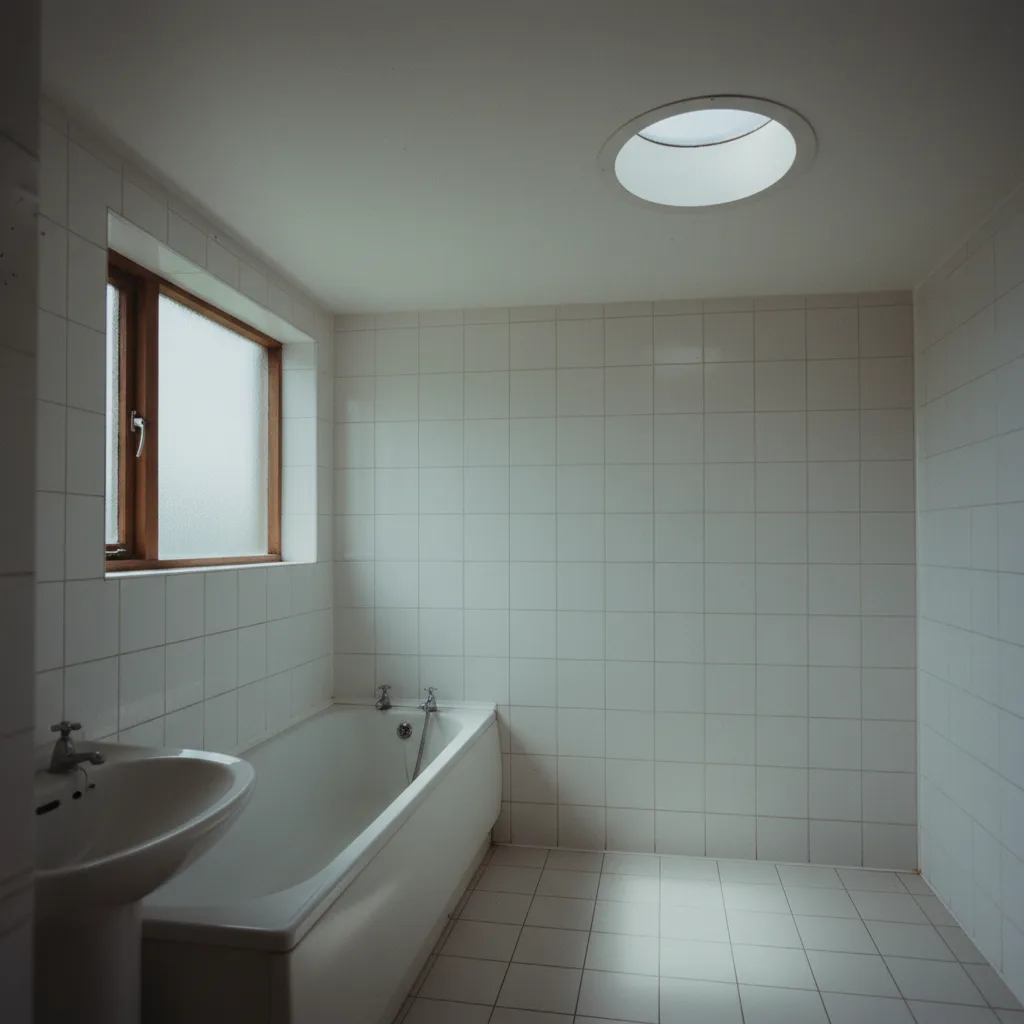
Wet rooms change the rules
Bathrooms are zoned, and the zone decides the fitting
Electrical work in a room containing a bath or shower is governed by zones, and a ceiling-mounted fitting above a bath or within a shower enclosure falls into a zone with its own requirements for ingress protection and for how the circuit is supplied and protected.
That is not an obstacle — ceiling lights in bathrooms are entirely normal — but it does mean the fitting must be the right one for where it is going, and the installation has to be carried out and certified by someone competent to do it. It is not a job for enthusiasm and a pair of pliers.
Whether your particular job needs an electrician at all, and what gets notified, is set out on the electrician answer. The short version: daylight only, no. Light kit, yes.
What it does not solve
A light kit makes the tunnel useful after dark. It does not make a poor tunnel a good one. If the daylight performance is disappointing because the run is long, the tube is corrugated or the dome sits under a pine canopy, an LED module at the bottom masks the symptom in the evening and changes nothing about the afternoon.
It also does not ventilate anything, extract anything or warm anything. In an internal bathroom the extract fan is a separate and non-negotiable item, and a tunnel with a light in it is not a substitute for one.
The order the work goes in
- Route agreed at survey, including where the cable will come from and which circuit it joins.
- Tunnel installed, tube sealed at every joint, sleeve through the insulated zone as the condensation detail requires.
- Kit fitted at the diffuser end before the ceiling collar is finally made good, so the seal is made once and stays made.
- Cable run and terminated by the electrician, switch position agreed with you rather than assumed.
- Tested and certified, with the paperwork handed over, not promised.
- Checked at night. Obvious, frequently skipped, and the only way to find out whether the colour and output are what you wanted.
Retrofitting one to a tunnel you already have
It can usually be done, and the first question is what you have. A tunnel from a manufacturer that still makes a compatible kit is straightforward. An older or unbranded tube may have nothing available, in which case the realistic options are a separate fitting alongside, or replacing the diffuser assembly with something that will take a module.
The practical constraints are access above the ceiling and a cable route. In a boarded and insulated loft over a hall, neither is necessarily easy, which is the argument for running the cable at first fix even when the light is a maybe.
Where this comes up around Poole
The rooms that need the kit most
Interwar semis with internal bathrooms, which is a great deal of Parkstone, Penn Hill and the Winton and Moordown streets. That bathroom has never had a window, so the tunnel is its only daylight and the light kit is its only light. Specify the output as a room light, not as an extra.
Post-war hallways in Canford Heath, Creekmoor and Broadstone. Usually already lit, so the kit is a convenience rather than a necessity — and worth declining if the existing fitting works.
Under the canopy at Canford Cliffs and Branksome Park. Where evergreen shade caps the daylight, people reach for a light kit to make up the difference. It is an honest partial answer, but the better conversation is often whether a rooflight on a clearer part of the roof would have delivered the daylight in the first place.
When we would talk you out of it
If the room already has a perfectly good ceiling light two feet from where the tunnel will go, a kit is buying something you have. If the tunnel is going into a hall with wall lights, the same. And if a room is dark enough to need both a tunnel and a strong electric light at all hours, it is worth checking whether it has a roof plane of its own — because a sun tunnel is not a substitute for a rooflight where a rooflight would fit, and no light kit changes that arithmetic. A skylight in the slope above delivers the daylight the electric fitting is being asked to stand in for.
Where the kit is right, we specify it with the tunnel, name the product, and quote a fixed written price after survey. Workmanship carries a ten-year guarantee, which is ours and is not insurance backed; the electrical work is certified separately by the electrician who carries it out. Ring 01202 923272 to talk through what the room actually needs.
Related reading
1930s Poole semis with internal bathrooms and no wall to reach
The interwar semi built across Parkstone, Winton, Penn Hill and Oakdale has a recognisable problem: a bathroom in the middle…
Are sun tunnels warm or do they lose heat?
A sun tunnel is a hole through your insulated ceiling, so yes, it loses some heat — and a properly…
Broadstone bungalows where the loft void is shallow and wide
Broadstone, Creekmoor and the bungalow runs out towards Corfe Mullen were built low and built wide. Every room sits on…
Can a sun tunnel be fitted in a bathroom?
Yes. A windowless internal bathroom or en-suite is the single most common place a sun tunnel earns its keep, and…
Can a sun tunnel be fitted into a Purbeck stone slate roof?
Yes, but not with a kit. Purbeck stone slates are thick, heavy and laid in diminishing courses, and there is…
Can a sun tunnel be fitted through two floors?
Physically, yes — a tunnel can be run from a roof, through a loft, down through a first floor and…