When a fixed rooflight can take a motor and when it cannot
The short answer is usually no, but the useful work is in the survey that establishes why, and in the handful of cases where the answer changes.
People ask this in two different ways. “Can you put a motor on mine?” is a question about one specific unit on one specific roof. “Can fixed rooflights be motorised?” is a question about products in general, and it is answered briefly on whether a fixed rooflight can be upgraded to an opening one. This page is the first version: what a surveyor stands on a roof and checks, in the order they check it, and what each finding actually decides.
The check that usually ends it in ninety seconds
Before anything else, look at how the glass is held. On most fixed rooflights the sealed unit is bonded directly to the frame with structural silicone, or glazed into a frame that was assembled around it in a factory and never intended to come apart. There is no sash. The glass is not sitting in a separate moving leaf waiting for hinges.
If that is what you have, the conversation is over as a conversion and becomes a replacement. Everything below assumes the answer to this first check was not obvious, which is the minority of cases.
What a survey actually works through
- Frame construction. Is there a distinct sash and outer frame, or one bonded assembly? Only the first can ever hinge.
- Manufacturer and model. Does the maker publish an opening version on the same frame section, with a retrofit kit or an exchange sash? A very small number do. Most do not.
- Glass weight and make-up. Thickness, whether it is laminated, whether it is triple. A drive has to lift that mass repeatedly at an angle, and a fixed unit’s glass was specified with no thought for that.
- Seal type. Fixed units usually seal by compression under permanent load or by bonding. An opening unit needs a gasket designed to be compressed and released thousands of times and to reseat wet.
- Drainage. A fixed unit sheds water off the glass. An opening unit needs a drained and vented frame, because water will find the gap at the sash line and has to have somewhere to go that is not the ceiling.
- Kerb and structure. Can the upstand take a point load at the hinge line and another at the drive bracket, applied thousands of times? A timber kerb built to carry a static panel has not been asked that question.
- Swing and obstruction. Is there clear air above the unit for the sash to move into? A parapet, a neighbouring slope, a flue terminal or a satellite dish ends it.
- Cable route. Is there any way to a supply without opening the ceiling? This is often the deciding cost even when everything above passes.
- Exposure. Spit, harbour front or exposed coast: even a mechanically feasible conversion may be a poor idea on a roof where an open sash carries real wind load.
What each failure actually means
| What the survey finds | Why it matters | Verdict |
|---|---|---|
| Glass bonded to the frame | There is no separate leaf to hinge and the bond is structural | Replacement, not conversion |
| No opening variant on that frame | Hinges, gaskets and brackets would have to be improvised | Replacement. An improvised sash is a leak with a motor on it |
| Frame not drained or vented | Water reaching the sash line has nowhere to go but inwards | Replacement |
| Kerb undersized or soft | Hinge and drive loads concentrate on a few fixings | Kerb rebuilt, which means the unit comes out anyway |
| Obstruction in the swing path | The sash physically cannot travel, or fouls at wide angles | No opening unit here, or a different action such as parallel lift |
| No cable route without opening the ceiling | The cost moves from the roof to the room below | Feasible, but price it honestly against a solar unit |
| Frame sound, opening sash available from the maker | Every load path was designed for this from the start | The genuine conversion case |
The frame is not the only thing carrying the load
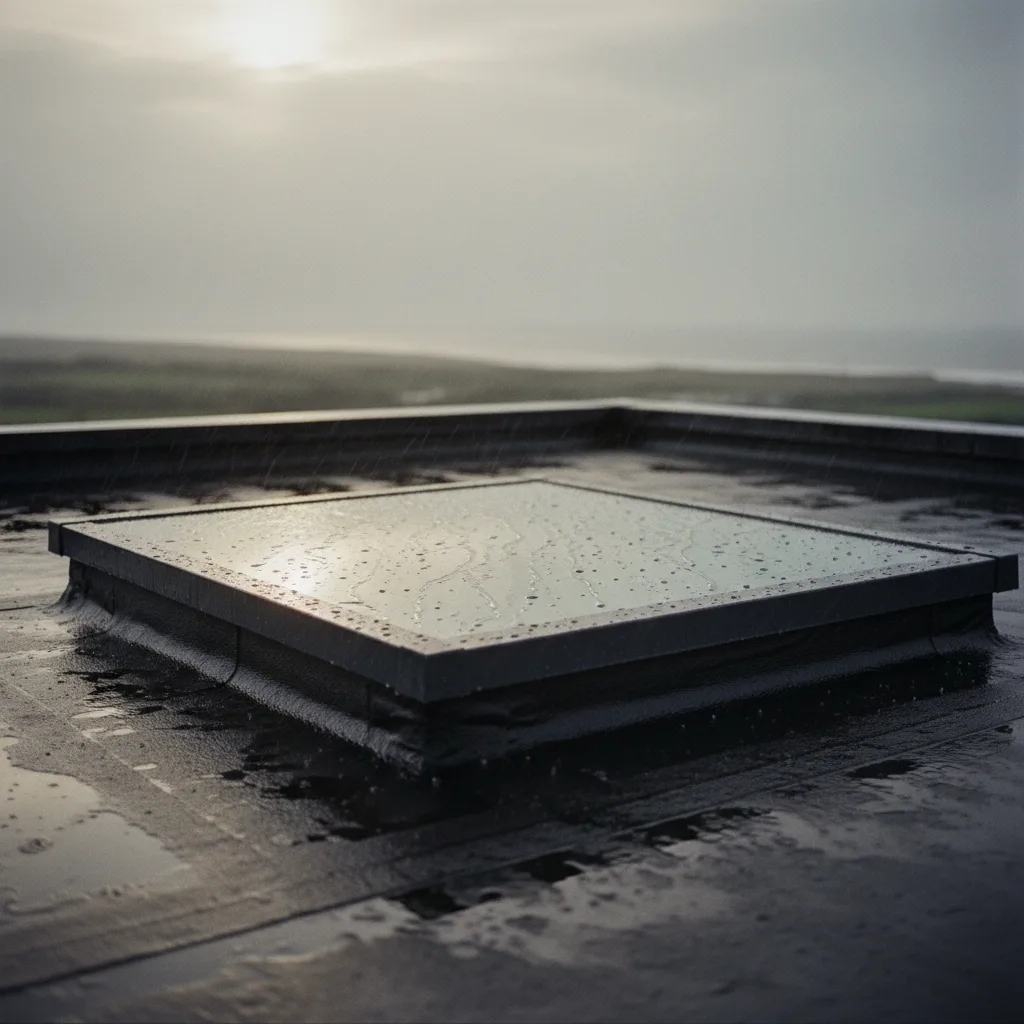
A conversion that passes every check on the unit itself can still fail on the structure below it. The kerb or upstand takes the hinge reaction on one edge and the drive reaction on the other, and both are cyclic. Timber that has carried a static panel happily for fifteen years can be perfectly adequate in that duty and inadequate the moment the loading starts moving.
What we look for is fixings into solid timber rather than into a deck board, an upstand that is properly triangulated back into the structure rather than just standing on the deck, and no softening at the base from historic water. On older flat-roof extensions around Poole — and there are a great many of them, from the 1970s onwards — a soft kerb base is common enough that we expect to find it rather than hope not to.
Guarantees, and the sentence that costs people money
Modifying a sealed unit ends its warranty
A rooflight is warranted as an assembly. Cut into the frame, drill a bracket into it, or introduce a hinge, and the manufacturer’s cover on that unit is finished — including the cover on the sealed glazing unit, which is the part most likely to fail. Anybody offering to motorise your existing fixed skylight should be telling you this before they quote, and putting in writing what they are guaranteeing instead. Our own workmanship guarantee runs for ten years and is not insurance backed; it covers our work, and it cannot restore a product warranty somebody else has voided.
The cases where the answer does change
There are roofs where a conversion is straightforward, and they share a pattern. The unit is a current model from a maker who lists an opening version on the identical frame. The frame is drained and gasketed for an opening sash because the manufacturer builds both from the same sections. An exchange sash or a factory kit exists. The kerb is sound, there is clear air above, and a cable route is available without wrecking a ceiling.
Where all of that is true, the work is a sash exchange and a drive fitted on the maker’s own fixing centres, which is a different proposition entirely from improvising hinges onto a fixed frame. It is worth asking the question if your rooflight is recent and you can identify the model. It is rarely worth asking if the unit is old, unbranded, or plastic.
Heritage roofs, and a constraint that bites before the mechanics do
On Purbeck stone-slate roofs the conversation stops earlier. Around Corfe Castle, Swanage and Langton Matravers the covering is thick, heavy, irregular stone, and no standard flashing kit fits it. An opening unit sits proud of a fixed one and moves against its surround, which changes what the weathering detail has to do. Add a conservation area or a listing, and the appearance of a raised sash becomes a planning matter as well as a technical one. Consent is assessed on merit and never assured. On those roofs the specification is settled with the authority before the hardware is chosen, not after.
Where a solar unit sidesteps the whole problem
If the reason for wanting a motor is that the rooflight is out of reach, and the obstacle to converting it is the cable, a solar-powered opening unit removes the second problem entirely. There is no supply to run, no ceiling to open, and no electrical notification to arrange.
It is still a replacement rather than a conversion — you are buying a new opening skylight, not adding a motor to the old one. And near the water the panel and battery are components in salt air like any others, with the maintenance implications that carries. But on a sound kerb, in a room where opening up the ceiling is the objectionable part, it is very often the sensible answer.
What we tell you, and when
We will look at an existing fixed rooflight and say which of the nine checks it fails, because “no” without a reason is not much use to anybody. If it fails at the first check — bonded glass, no sash — you will be told that on the roof rather than in a quotation a week later.
Where a replacement is the answer, the survey moves on to what should replace it: the opening action suited to the exposure, whether the kerb needs rebuilding, and the cable route settled before the ceiling closes rather than after. For a straight assessment of an existing skylight in the Poole area, ring 01202 923272.
Related reading
Are electric rooflights noisy when they open?
No. A correctly installed unit makes a low hum for the twenty or thirty seconds it is moving and is…
Cable routing through a warm deck without breaching the vapour layer
The electrical side of getting power to an actuator is a settled matter, and it is set out on wiring…
Can a fixed rooflight be upgraded to an opening one?
Almost always this turns out to be a replacement rather than an upgrade, because a fixed rooflight has no hinge,…
Can a rooflight be set to close automatically at night?
Yes. A timed close is the most useful automation an opening rooflight can have, and unlike most of them it…
Can a smoke vent rooflight be used for everyday ventilation?
Technically, often yes — many certified automatic opening vents include a comfort ventilation mode, and it works. Practically, it is…
Can an electric rooflight be controlled from a phone?
Yes — either through a gateway that bridges the rooflight controller onto your home network, or through a manufacturer’s own…