Maintenance access for an actuator once the ceiling is closed up
Every opening rooflight will one day need its drive reached, and the cost of that visit is fixed by decisions made months earlier with a sheet of plasterboard in hand.
An opening rooflight has one moving assembly and it is the only part of the installation certain to need attention. Everything else — glass, frame, flashing, kerb — is there to be left alone. The drive is there to be reached. Almost nobody designs for that, and the bill for not doing so arrives years later, in the form of access equipment rather than parts.
Where the drive lives, and what that decides
| Drive position | How it is reached | What that means in practice |
|---|---|---|
| Concealed inside the frame section | From below, once the sash is open, through the frame’s own cover | Tidiest to look at and generally the best for access. Needs a tower or ladder inside, nothing on the roof |
| Surface mounted on the internal reveal | Directly, from inside the room | Easiest of all to service. Visible, which some people mind and most stop noticing |
| On the kerb, outside the line of the ceiling | From the roof, or from inside if an access panel was formed | Out of sight until it fails. Then it is a roof visit, with whatever that costs on your building |
| Buried in the ceiling void beside the opening | By cutting the ceiling | The arrangement to refuse. It turns a component swap into plastering and decorating |
The first two are questions to ask before a unit is ordered, because they are properties of the product. The third and fourth are questions about how it is installed, and they are decided on site by whoever is holding the plasterboard.
What actually needs reaching, and how often
Not much, which is exactly why it gets forgotten. Over the life of an installation the realistic list is: the sensor pads wiped and rinsed, the hinges cleaned and lubricated dry, gaskets checked and eventually replaced, travel limits reset after a drive has been disturbed, and at some point the actuator itself changed.
Three of those five are from outside or from the open sash. Two of them — limits and the drive swap — need hands on the mechanism. Design for those two and the rest look after themselves.
The access panel, and where it goes
- Decide whether you need one at all. If the drive is inside the frame or on the reveal, you do not. This whole section applies to kerb-mounted drives and controllers sitting in a void.
- Put it beside the opening, not above the drive. Working through a panel you are standing under is possible. Working through one directly overhead, at arm’s length, is not.
- Size it for a forearm and a tool, not for a torch. The usual mistake is a panel large enough to look through and too small to work through.
- Put the controller and transformer within reach of it. They are the components most likely to want attention, and they are the ones most often placed wherever there was room.
- Label it, and note it on the handover sheet. A painted-over access hatch in a plain ceiling is invisible within one redecoration.
A hatch in a plasterboard ceiling is a cheap thing during a build and a disruptive thing afterwards. That asymmetry is the entire argument.
Getting to the roof is often the real cost
People assume the expensive part of a failed actuator is the actuator. On most of the roofs we look at it is the access. A drive that can be reached from a step ladder is a short visit. The same drive on a third-storey roof with no rear access is a different job with different equipment, and the part is a rounding error against it.
Around the harbour and on the spit, access is a planning problem in itself. On the Sandbanks peninsula and along the quay, plots are narrow, gates are tight, and there is frequently nowhere to stand a tower or bring a platform without arrangement. In Canford Cliffs and Branksome Park the constraint is different again: mature pine canopy, tree preservation orders, and no cutting back to get equipment in without consent from BCP Council. On those roofs the question “how will anybody reach this in year eight” deserves an answer before the unit is chosen, because it may point at a drive inside the frame rather than one on the kerb.
Design so the routine work needs no equipment at all
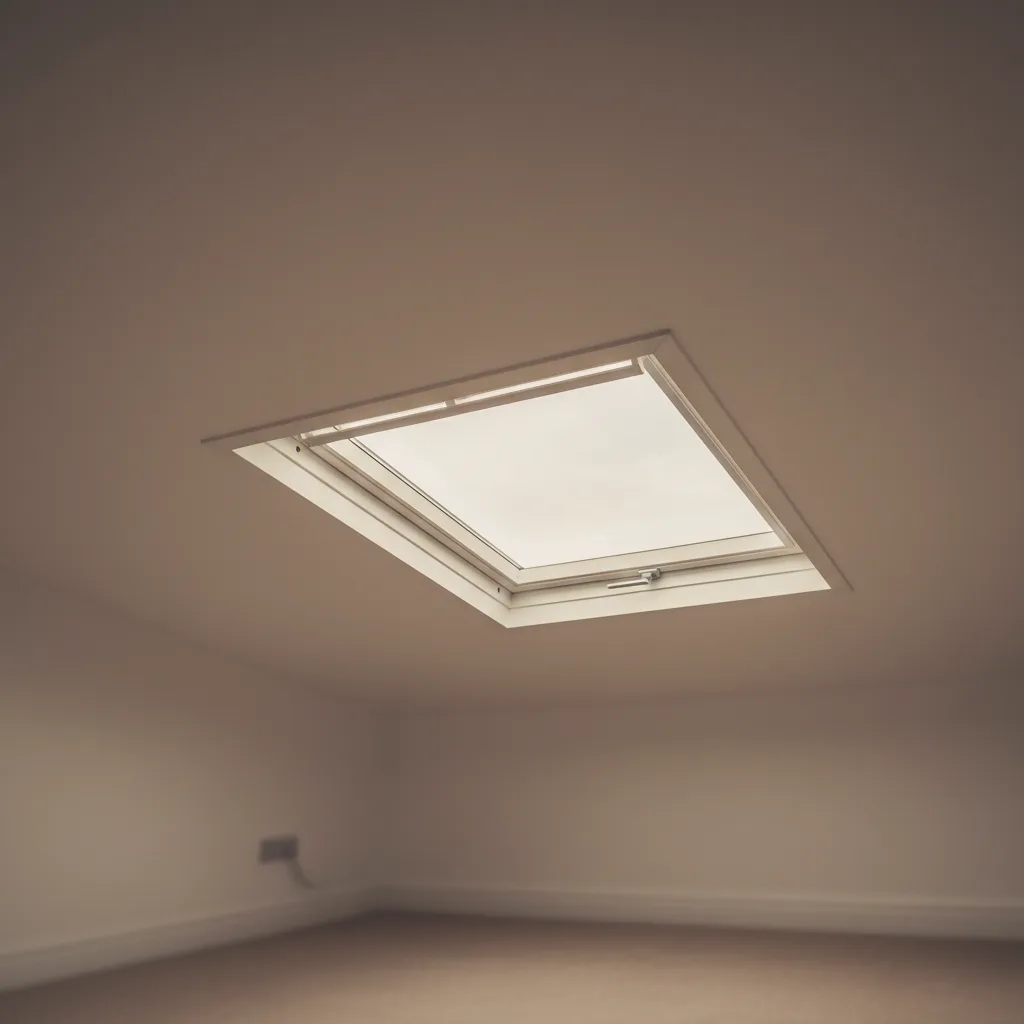
The single most useful thing you can do for a skylight’s maintenance is to make the sensor pads and the hinge line reachable from the open sash with a pole or from an adjacent window. Not because that work is difficult, but because work that requires booking equipment does not get done.
Near the water this is not a nicety. A sensor pad carrying a salt film reads permanently wet and the unit stops opening, which owners report as a dead motor. A rinse fixes it. A rinse that needs a platform booked does not happen until somebody is already paying for a call-out.
Clearance around the drive, which costs nothing to leave
An actuator needs room to be unbolted and withdrawn along its own axis, not just room to sit. A chain drive needs clear length behind the housing for the chain to retract into. Pack a drive tight against a kerb liner or a plaster return with a few millimetres of clearance and it will run perfectly well and be impossible to take out without breaking something.
The check that takes thirty seconds at first fix
Before the reveal is boarded, ask whoever fitted the drive to demonstrate removing it. Not to actually take it off — just to show the route it would come out along and the tool that would reach the fixings. If that cannot be shown, the installation has a problem that is about to be covered in plasterboard. It is the cheapest inspection on the whole job.
Cable and connections: the part that decides a swap
A drive that can be reached but not disconnected is only half accessible. The connection wants to be a plug or a terminal block at the unit, within reach of the same access, rather than a joint buried somewhere in the run. Where the supply is in conduit with a draw cord left in it, a damaged cable is a pull-through rather than a ceiling job.
The same goes for the controller and any transformer. Putting them in the middle of a sealed ceiling void because there was space there is the decision that turns a fifteen-minute fault into a day. Inside a cupboard, above an accessible hatch, or in the reveal itself — all of those are better, and none of them costs anything at the time.
Records, and why they are part of access
Knowing how to reach a thing is useless if nobody knows what it is. Six things belong on paper, and they take one page between them.
- The drive. Make, model reference and the fixing centres it sits on, so a replacement can be identified without taking it down first.
- Where the controller and transformer are. In plain words a stranger could follow, not “in the ceiling”.
- Where the access panel is, if there is one, and what is behind it.
- Travel limits as set, and whether any restriction was deliberate. Otherwise the next engineer reads a reduced opening as a fault and resets it.
- Sensor positions and types, so the rinse regime lands on the right components.
- The handset battery type, because it is never one anybody has in a drawer.
Ten years is long enough for a house to change hands twice. The pack is what stops the next owner being told their whole rooflight needs replacing because nobody can identify a drive that is still made.
What we do about it on our installations
Access is part of the survey rather than an afterthought. We ask how the roof will be reached in future before specifying where the drive sits, we prefer a drive that can be serviced from inside on any roof that is awkward to get to, and we leave a draw cord in the conduit as a matter of course.
Where an access panel is needed we agree its position with you before the ceiling boards go up, not after. Our workmanship guarantee runs for ten years and is not insurance backed, and part of making that meaningful is making sure the work can actually be revisited. For a survey that settles access before anything is ordered, ring 01202 923272.
Related reading
Are electric rooflights noisy when they open?
No. A correctly installed unit makes a low hum for the twenty or thirty seconds it is moving and is…
Cable routing through a warm deck without breaching the vapour layer
The electrical side of getting power to an actuator is a settled matter, and it is set out on wiring…
Can a fixed rooflight be upgraded to an opening one?
Almost always this turns out to be a replacement rather than an upgrade, because a fixed rooflight has no hinge,…
Can a rooflight be set to close automatically at night?
Yes. A timed close is the most useful automation an opening rooflight can have, and unlike most of them it…
Can a smoke vent rooflight be used for everyday ventilation?
Technically, often yes — many certified automatic opening vents include a comfort ventilation mode, and it works. Practically, it is…
Can an electric rooflight be controlled from a phone?
Yes — either through a gateway that bridges the rooflight controller onto your home network, or through a manufacturer’s own…