Control options: wall switch, remote, app and hard wired scene
Four control methods, only one of which is difficult to add later, and a hierarchy that decides which input wins when two of them disagree.
Almost every conversation about controlling an opening rooflight starts with the app and ends up somewhere else. The useful way round is to start with the one decision that is genuinely hard to reverse — where a cable goes before the ceiling closes — and let everything else follow from it. Three of the four control methods below can be added on a wet Tuesday in year four. One cannot.
The four methods, side by side
| Control | How it reaches the drive | Strength | Weakness |
|---|---|---|---|
| Wall switch | A cable from the switch plate to the controller | Always there, needs no battery, no pairing and no explanation to a visitor | Fixed in one place, and adding one later means chasing a wall or trunking it |
| Handheld remote | Short-range radio to a receiver at the unit or in the controller | Cheap, instant, works anywhere in the room, easy to add to an existing skylight | Gets lost, runs on a battery, and pairing is forgotten by the time it matters |
| Phone or tablet app | Via a hub or gateway on the home network, often through the maker’s servers | Status, scheduling, control from another room or another county | Depends on the network, the hub and a company continuing to run a service |
| Hard-wired scene input | A volt-free contact or bus signal from a lighting or automation system | One button does several things, and it keeps working with the internet down | Only worth it where a system already exists, and it has to be planned at first fix |
Most houses end up with two of these, occasionally three. Very few need all four, and a control scheme nobody can remember is worse than a switch on a wall.
The switch is the one you cannot cheaply add later
Everything else on that table is radio or network. A wall switch is a cable, and a cable through a finished ceiling and down a plastered wall is a genuinely disruptive job in a room that is already decorated.
Which is why the position of the switch plate is settled at survey, alongside the cable route, rather than treated as a detail for later. Somewhere by the door into the room is usually right, at the same height as the light switches, so the rooflight reads as part of the room’s controls rather than as an accessory. On a large open-plan space with two ways in, two switch positions is often the honest answer.
The question that decides this in one sentence
If every remote in the house were lost tomorrow and the broadband were down for a week, could you still open and close the skylight? If the answer is no, the installation is short of a wall switch. We fit one as standard for that reason, and we will argue the point if asked to leave it out.
What a wall switch actually does, and the three-position trap
Most rooflight switches are momentary rocker or rotary types with open, stop and close. Press and hold, and the sash moves while you hold it; press and release, and on many controllers the sash runs to its limit on its own. Which of those two behaviours you get is a controller setting, not a switch type, and it is worth knowing which one yours does before you walk out of the room.
The trap is a two-position switch wired as a simple on and off. It gives you fully open or fully shut and no intermediate position at all, which is fine for a bathroom and poor for a living space where a partial opening is what you want most days. If a partial position matters, say so at survey, because it is a specification question rather than something to be fixed afterwards.
Remotes, and the practical problems with them
- Pair every handset at commissioning, not later. Including the spare that will live in a drawer. A handset paired in year three requires somebody to remember the procedure, and the instruction sheet has usually gone.
- Write down what is paired to what. On a house with three opening rooflights and two handsets, “which one does the landing” becomes a genuine annoyance within a month.
- Check the range from where you will stand. Radio through a foil-faced insulation board or a metal-framed ceiling is worse than radio across open air, and a warm deck has a lot of foil in it.
- Keep a wall control as the fallback. The remote is the convenience. The switch is the one that has to work.
- Note the battery type on the handover sheet. It is invariably a cell nobody has in the house.
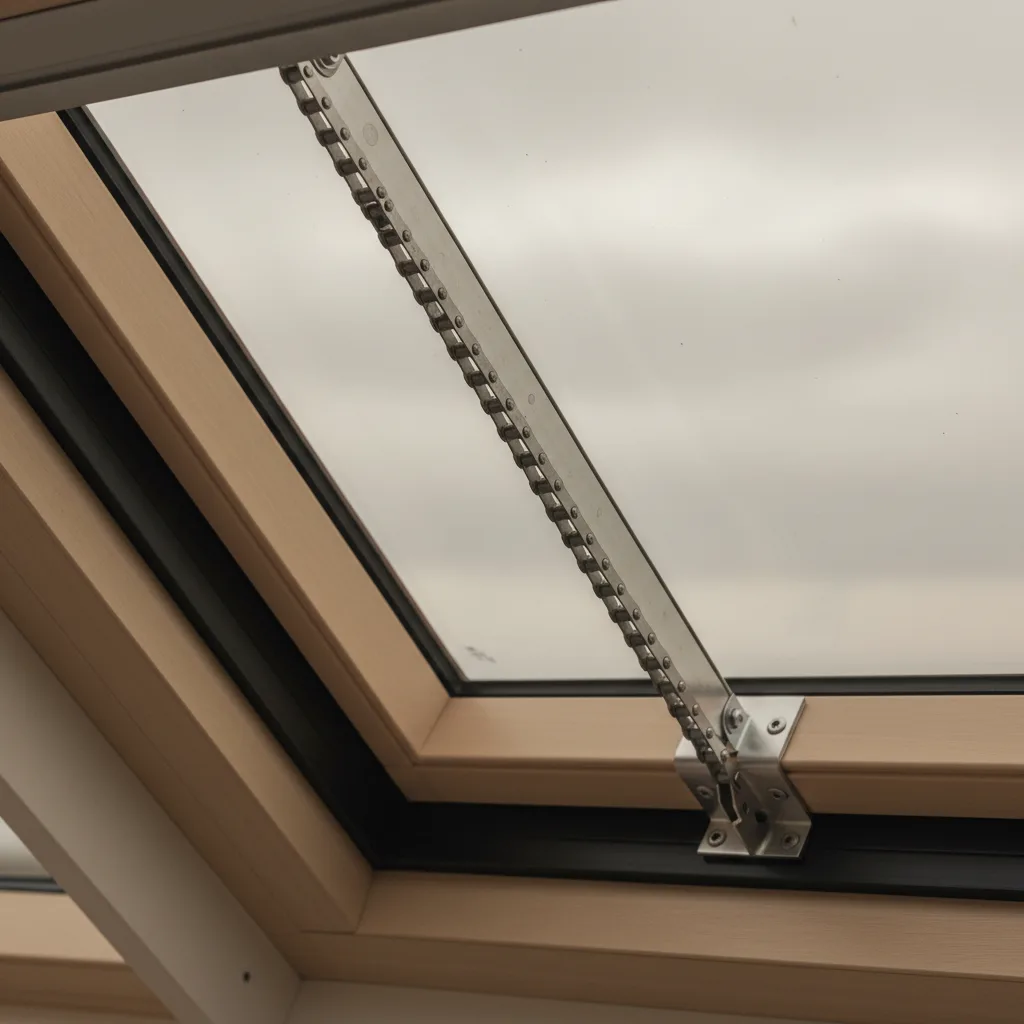
The app, and where it sits in the hierarchy
Phone control is a genuinely useful thing for an opening rooflight — being able to see that it is shut, from somewhere else, is worth more than being able to open it from the sofa. What it is not is a primary control, and the reasons are covered in full on whether an electric rooflight can be controlled from a phone.
What belongs here is how it fits alongside the others. An app is a layer on top of a control system, not a replacement for one. It normally talks to a hub, the hub talks to the controller, and the controller drives the motor. Every one of those links can fail independently, and the switch on the wall bypasses all three.
Scenes, and the order of precedence
A hard-wired scene input is a contact closure from a lighting or home automation system: one button that dims the lights, drops the blinds and shuts the skylight. Where a house already has that infrastructure it is a tidy way to include a rooflight in it, and because it is a wired contact rather than a cloud service it keeps working when the internet does not.
What has to be settled when more than one thing can move the sash is precedence — which input wins.
- Wind and rain sensors. Always first, always able to close, never overridable by a convenience input.
- Any smoke or life-safety signal, where one exists. Separate from all of this, and never wired through a comfort controller.
- A person at a wall switch. The human in the room beats the schedule.
- Remote and app commands. Equal with each other, below the wall switch in practice because the person holding them may not be in the room.
- Schedules and scenes. Last. A timetable should never fight a sensor or a person and win.
Where this lands differently around Poole
Exposure changes the control scheme, not just the hardware. On the spit at Sandbanks, Studland and Mudeford, and on the harbour front at Hamworthy, a wind input has to be in the scheme and has to be able to overrule everything else — an open sash there is a sail, and the gusts arrive without warning off open water. In Broadstone, Ferndown or Wimborne the same skylight can be run on a switch and a handset with no sensor at all and nobody will ever notice the difference. Specifying a marine-grade control scheme for a sheltered inland roof is an overcharge, and we will tell you so rather than sell it.
Holiday lets, second homes and rooms nobody is in
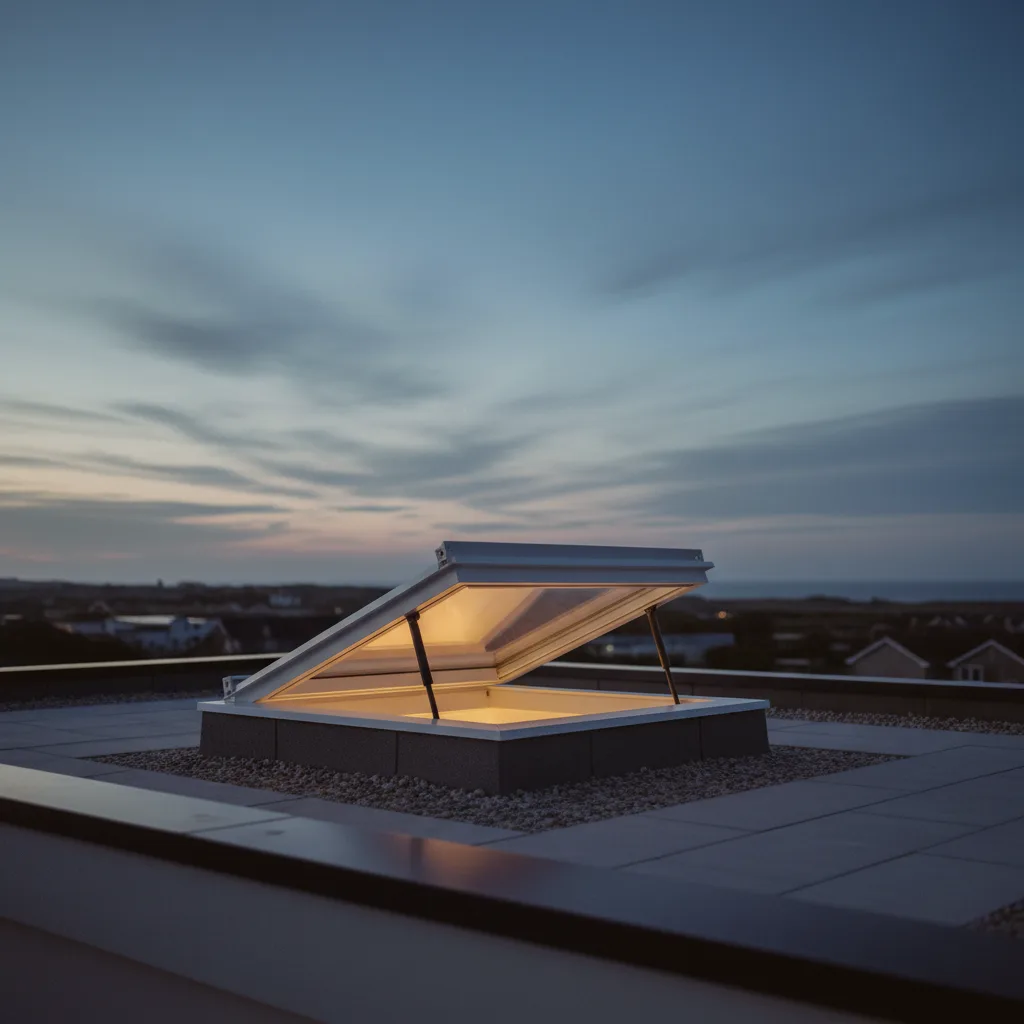
A good part of the housing around Poole harbour and along the coast is let out or stands empty for stretches of the year, and that changes the control question. A skylight that can be checked and shut remotely is worth a great deal when the house is empty and a squall is forecast. A skylight that a guest can open and leave open is worth rather less.
The practical arrangement is usually: a wall switch and sensors for the people in the house, app access limited to the owner, and a schedule that closes everything at a set time regardless of what anybody has pressed. That is a commissioning configuration rather than different hardware, and it costs nothing to set up at handover if it is asked for then.
Accessibility, and the control most often forgotten
A rooflight is the one opening in a room that nobody can reach, which makes it the best possible candidate for being genuinely easy to operate. A large rocker at a sensible height, clearly labelled, is better for most people than a small remote with four identical buttons.
If somebody in the house has limited dexterity or sight, the switch type and its position are worth raising at survey. It costs nothing at first fix and cannot be changed cheaply afterwards, which is the theme of this entire page.
Three things worth asking for, and none of them cost extra
A rocker rather than a small push button, where grip is an issue. A switch plate at the same height as the light switches rather than at the height an electrician finds convenient. And a tactile or clearly engraved plate, so the rooflight control is not a blank white square indistinguishable from the one next to it. All three are specified at order and none of them can be changed without taking a plate off a finished wall.
What we fit and what we hand over
As standard: a wall switch on a planned cable route, a handset paired and labelled, sensors appropriate to the exposure zone with precedence configured so they win, and every control point tested through several full cycles rather than one.
The handover sheet records which controls exist, what is paired to what, the battery type in the handset, and any deliberate travel limit so the next person to look at the unit does not read it as a fault. App and scene integration we will fit where it is wanted and where the underlying system exists, on the condition that the wired controls stay and remain the fallback. To settle switch positions and cable routes before the ceiling closes, ring 01202 923272.
Related reading
Are electric rooflights noisy when they open?
No. A correctly installed unit makes a low hum for the twenty or thirty seconds it is moving and is…
Cable routing through a warm deck without breaching the vapour layer
The electrical side of getting power to an actuator is a settled matter, and it is set out on wiring…
Can a fixed rooflight be upgraded to an opening one?
Almost always this turns out to be a replacement rather than an upgrade, because a fixed rooflight has no hinge,…
Can a rooflight be set to close automatically at night?
Yes. A timed close is the most useful automation an opening rooflight can have, and unlike most of them it…
Can a smoke vent rooflight be used for everyday ventilation?
Technically, often yes — many certified automatic opening vents include a comfort ventilation mode, and it works. Practically, it is…
Can an electric rooflight be controlled from a phone?
Yes — either through a gateway that bridges the rooflight controller onto your home network, or through a manufacturer’s own…