Chain actuators or spindle drives: which suits which opening
How a chain actuator and a linear spindle drive each move an opening rooflight, what they are sized against, and which one suits the sash you actually have.
Two families of drive open almost every electric rooflight fitted in a house around Poole. Which one you end up with is decided by the sash, not by the control panel, and the decision is made before anyone chooses a switch.
What follows is the working version of a choice the service page only sketches: how each drive moves, the numbers it gets sized against, and which of the two you will be grateful for in year eight when the motor stops. A skylight in a ceiling is one component; the drive that pushes it is another, and they age at completely different rates.
Start at the sash, not at the catalogue
A drive does not lift a rooflight. It pushes a hinged leaf away from a frame against three things at once: the weight of the sash, the compression still held in the gasket through the first few millimetres of travel, and whatever the wind is doing to the outside face. The second is worst exactly where the drive has least leverage. The third is why an opening unit on the Sandbanks spit is a different specification from the same unit in Creekmoor.
Sealed glazing is heavy. A square metre of double-glazed unit in an aluminium sash is a serious thing to hold at arm’s length, and a triple-glazed one is heavier again. That is the load the drive carries every cycle, and the load the hinge carries permanently.
The rule, and the exception
The rule: pick the sash first — size, glazing make-up, hinge type and the angle you actually need — then choose a drive that meets it with headroom. A drive chosen at its limit works in June and stalls on a cold February morning.
The exception: a retrofit into an existing frame, where the sash is already fixed and the drive has to suit the mounting points and frame depth left behind. Then the frame chooses for you, and the honest answer is sometimes that the unit will not take a motor at all.
What a chain actuator is doing when it opens
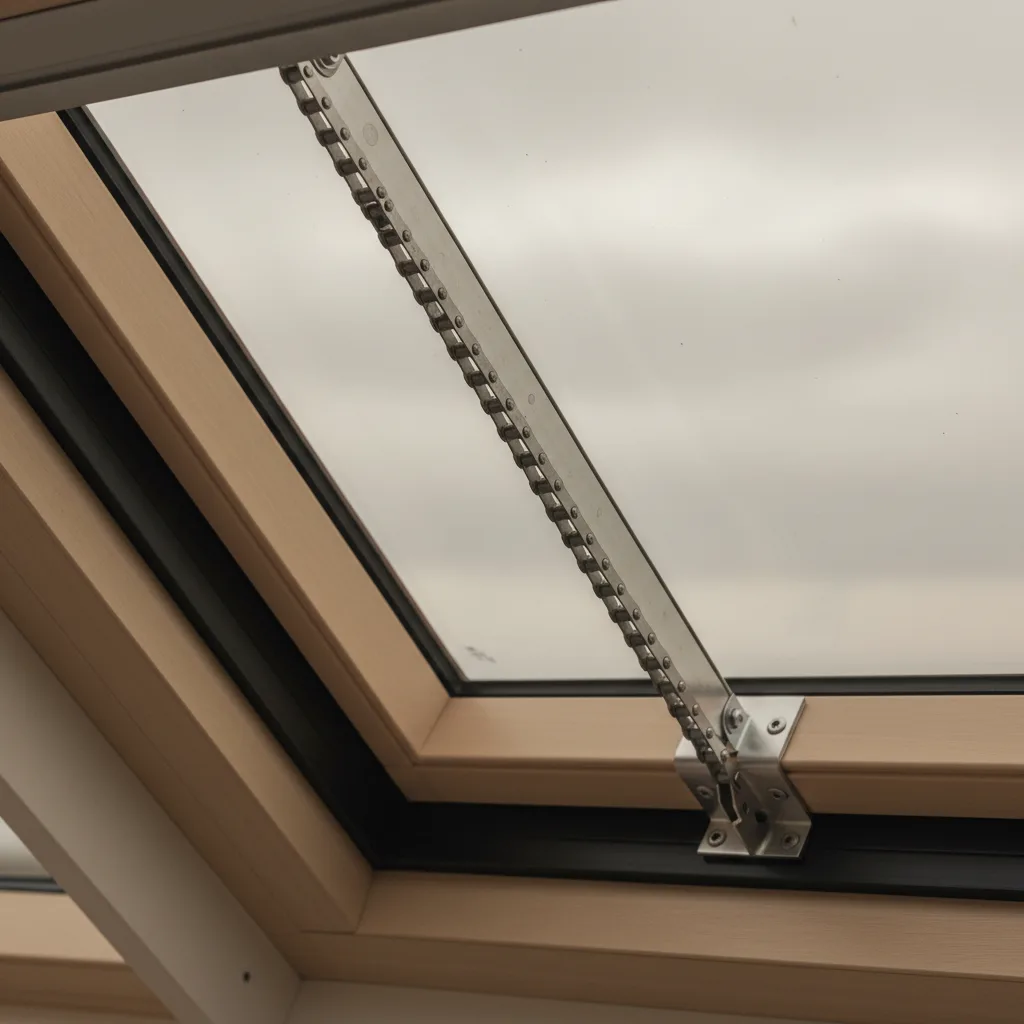
A chain actuator holds jointed links coiled inside a slim housing, shaped to bend one way and lock straight the other. A small motor drives a sprocket, the chain feeds out, straightens as it leaves, and becomes a rigid strut pushing the sash away from the frame. Reverse the motor and it coils up again.
A strut that stores itself flat is why chain units are so common on rooflights: the housing sits along the inside face of a frame without projecting into the reveal, and needs no space behind it for a retracted rod. Most domestic opening rooflights across Poole run a single chain unit at 24 volts.
The limits follow from the same geometry. The chain is only as stiff as its locked links, so chain units come in modest force ratings and modest strokes. And the chain is visible across the opening whenever the skylight is open, which some people never notice and others cannot stop seeing.
What a spindle or rack drive does instead
A linear drive has no trick to it. A motor turns a threaded spindle, or a pinion against a rack, and a rigid arm extends along a fixed line. Because nothing has to fold, the arm can be as stiff as the material allows, which means far higher forces and far longer strokes than any chain of the same size.
The cost is depth. The retracted arm has to live somewhere — inside the frame profile, behind a cover, or on a bracket that projects into the room — so a linear drive is generally designed into the rooflight by its maker rather than added later. It also puts its whole force into a small mounting area, so the fixing detail and the frame it fixes to matter more than they do with a chain.
The practical split: if the sash is modest and the point is fresh air, a chain unit does the job with fewer complications. If it is large, heavy, triple glazed, or has to reach a set angle every time on a roof catching the full south-westerly off the harbour, a linear drive is the honest answer.
The four numbers a drive is chosen against
Every manufacturer publishes selection charts, and every chart wants the same information. We take it at survey and write it on the quote so the choice can be checked rather than believed.
- Sash weight. Glass area times the make-up, plus the frame. This is the number people guess at and it is the one that matters most, because force requirement scales with it directly.
- Hinge line and sash length. Where the leaf is hinged, and how far the drive sits from that hinge. A drive mounted close to the hinge needs far more force for the same movement; moving it further out buys force for free and is often why one installation works and another stalls.
- The opening you need. A ventilation gap and a full swing are different requirements. Ask for a gap and a chain unit is usually enough; ask for a wide opening and the stroke has to grow.
- The exposure. Wind pressure on the open leaf, and a closing force able to pull the sash back onto its gasket against that pressure. On a Zone 1 roof this is the number that upgrades the drive, and inland it is the number that does not.
Two of those are measured, one is a conversation about how the room is used, and the last comes from the address.
Opening angle is geometry, not a setting
People ask for an angle. A drive delivers a stroke. The angle you get is what the geometry does with that stroke, and the relationship is not linear: the first part of the travel opens the sash quickly, and the last part gives progressively less angle for the same movement.
| What changes | Effect on the angle you get | What it means in practice |
|---|---|---|
| Longer stroke, same sash | More angle, with diminishing return as the sash approaches its stop | Doubling the stroke does not double the opening |
| Same stroke, longer sash | Less angle, because the same push moves a longer lever less far round | A big skylight needs a bigger drive just to match a small one |
| Drive moved away from the hinge | Less angle for the same stroke, but much less force needed | The usual trade when a chain unit is marginal on weight |
| Commissioned restrictor applied | Angle capped below the mechanical limit | Deliberate on exposed roofs — hinge life bought with ventilation |
The number that matters to a room is not the angle but the free area the opening gives, which depends on the aperture and where the leaf sits across it. Ask for free area rather than degrees.
One drive, two drives, and what synchronisation is for
Past a certain width a single drive pushing at the centre twists the leaf. The middle moves, the corners lag, the gasket compresses unevenly, and over a few hundred cycles the sash stops sitting square. The fix is two drives, one towards each end, moving together.
Together is the operative word. Two motors of the same model do not run at identical speeds, and if nothing coordinates them one reaches its limit first and the other keeps pushing against a leaf that has stopped. Synchronised pairs are sold as pairs, with a controller that watches both and holds them in step, and they are not two separate units wired to the same switch.
Worth knowing before you compare quotes
A quotation for a wide opening rooflight with a single central drive is either a smaller unit than you think, or a corner cut that shows up as a draught along one edge in about two winters. If a wide sash is quoted with one motor, ask why.
Where the hardware shows, and what that does to the reveal
A chain unit sits on the frame and the chain crosses the opening in plain view. From directly underneath this reads as a thin line against the sky and most people forget it within a week. From a sofa at the far side of an open-plan kitchen it is more noticeable, because you are looking along the opening rather than through it.
A concealed linear drive shows nothing but needs frame depth, and that depth has to be allowed for in the plasterboard reveal. A splay set out for a slim frame will not take a deeper one without changing — a drawing-stage decision, and an expensive discovery at second fix.
There is a third option people forget: the drive does not have to be on the low side. On some units it can go at the head, out of the main sightline, if the hinge arrangement allows. Worth asking at survey rather than accepting the maker’s default diagram.
Wind, salt and debris: which drive minds which
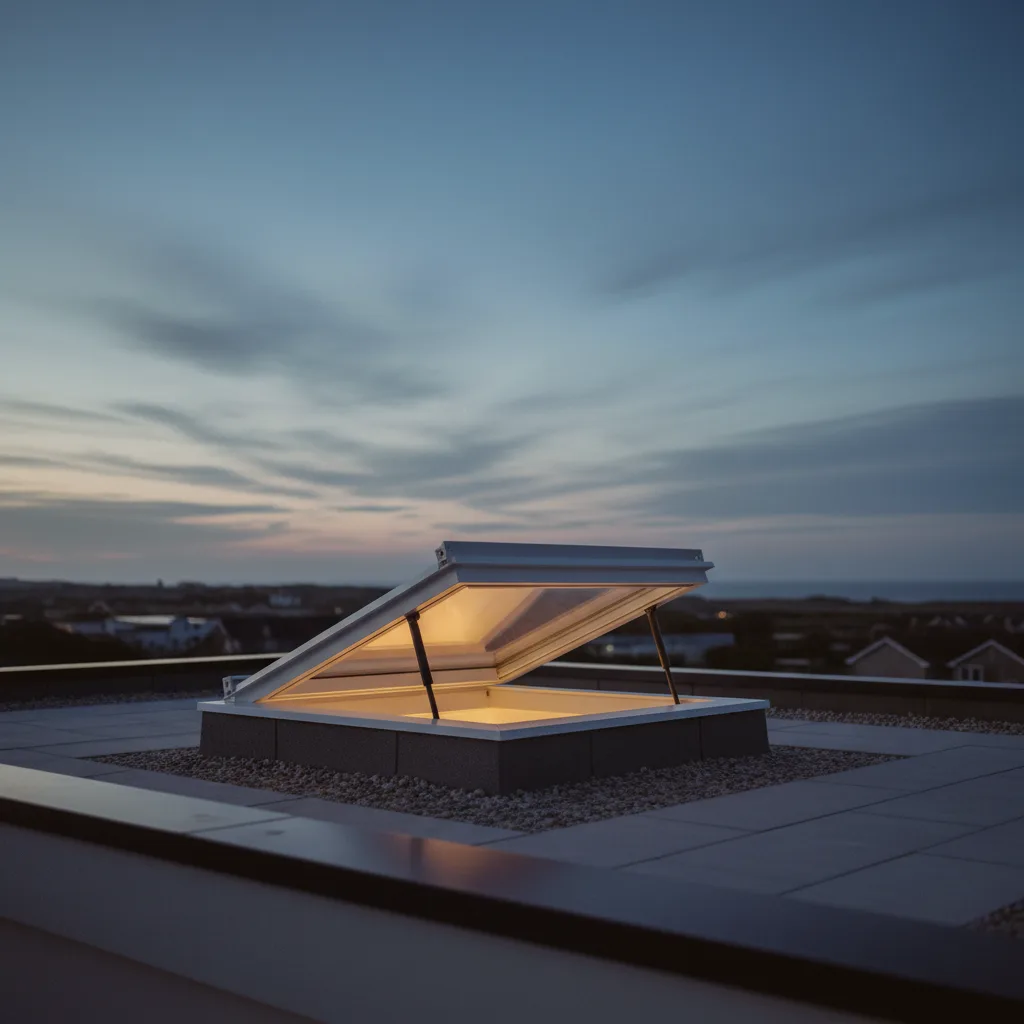
An open sash on the spit is a sail. At Sandbanks, Studland and Mudeford the prevailing south-westerly arrives across water with no fetch break, and the load does not land on the glass — it lands on the hinge knuckles and on whatever is holding the leaf out. A drive rated for the weight of the sash is not automatically rated for the weight of the sash plus a gust.
A chain is the more exposed of the two mechanisms: articulated links collect salt in their joints, and the chain is out in the weather whenever the rooflight is open. A sealed linear arm presents less to attack, which is part of why the specification drifts that way on coastal roofs quite apart from the force question.
Debris behaves differently again. Under the pine canopy in Branksome Park and Canford Cliffs the trouble is fouling rather than corrosion: needles and resin in the channel and in a chain housing never meant to be a gutter.
Year eight, when the motor stops
It will. Glass outlives frames, frames outlive motors, and a drive is best thought of as a serviceable part with a life. What varies is what replacing it costs in disruption.
| Replacement factor | Chain actuator | Linear spindle drive |
|---|---|---|
| Access needed | Usually from inside, off a tower or ladder | Often means removing beads, covers or trim, sometimes the sash |
| Is the model still made? | Generic mounting patterns mean alternatives usually exist | Often proprietary to the rooflight, so the maker is the only source |
| Wiring | Reconnect at the existing terminal if the tail was left with slack | Same, unless the drive is integrated with the control board |
| Recommissioning | Limits reset, sensors retested | Limits reset, and a synchronised pair relearned together |
| Typical disruption | A short visit | Half a day, more if the sash comes out |
This is the argument for leaving slack in the cable at the kerb and noting the route on the handover sheet, both of which are covered in the guide to wiring an actuator back to a fused spur. A swap is a short job when the cable is accessible and a plastering job when it is not.
How the choice lands across the Poole zones
Exposure does not change the physics, only where the headroom goes. Inland at Broadstone, Creekmoor or Canford Heath a correctly sized chain unit on a modest sash is right, and anything heavier is money spent on a problem that is not there. On the spit the drive is chosen with margin, travel is restricted at commissioning, and a wind input is not optional.
If you already hold a quotation naming a drive, four questions are worth asking: what does the sash weigh, what force is the drive rated at, where does it mount relative to the hinge, and what free area does the opening give at the travel it will be set to. Ring 01202 923272 and we will name your exposure zone on the phone; the rest needs the roof measured.
Related reading
Are electric rooflights noisy when they open?
No. A correctly installed unit makes a low hum for the twenty or thirty seconds it is moving and is…
Cable routing through a warm deck without breaching the vapour layer
The electrical side of getting power to an actuator is a settled matter, and it is set out on wiring…
Can a fixed rooflight be upgraded to an opening one?
Almost always this turns out to be a replacement rather than an upgrade, because a fixed rooflight has no hinge,…
Can a rooflight be set to close automatically at night?
Yes. A timed close is the most useful automation an opening rooflight can have, and unlike most of them it…
Can a smoke vent rooflight be used for everyday ventilation?
Technically, often yes — many certified automatic opening vents include a comfort ventilation mode, and it works. Practically, it is…
Can an electric rooflight be controlled from a phone?
Yes — either through a gateway that bridges the rooflight controller onto your home network, or through a manufacturer’s own…