Powder coat grades on the Sandbanks spit and why standard finishes chalk
Chalking, filiform corrosion and galvanic action explained, with the coating grade and fixing specification each Poole exposure zone actually needs.
Run a finger down the frame
If there is a fine pale powder on your fingertip afterwards, and the frame is darker where you have just wiped it, that is chalking. It is the most reliable field test there is for a coating that has begun to break down, it takes two seconds, and it works on any painted aluminium: a lantern, a window, a garage door, a handrail.
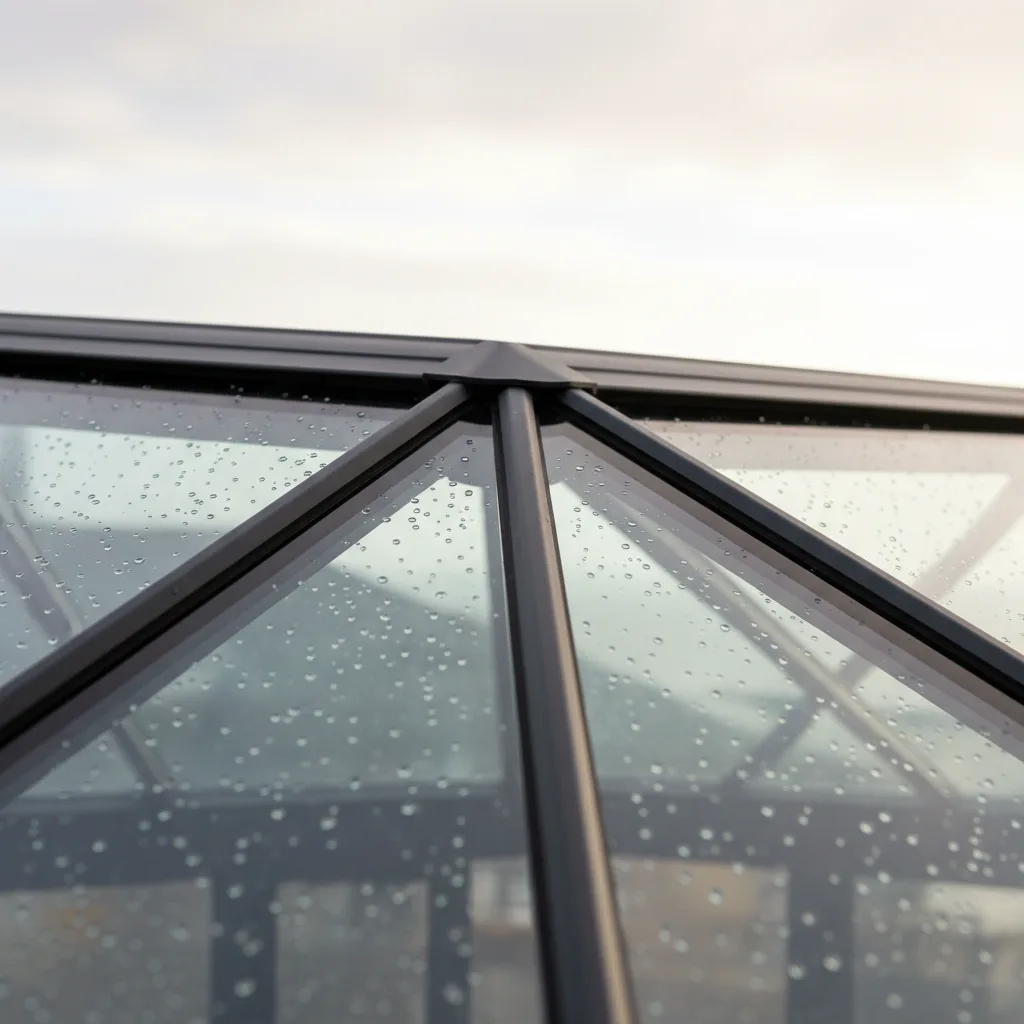
On the Sandbanks spit we see it on frames that are nowhere near old enough to deserve it. A dark grey lantern installed with a perfectly respectable architectural powder coat can be visibly faded on the south-west facing slope within a handful of seasons, while the identical product on an identical house in Broadstone still looks like the brochure. Same coating, same installer, same year. Different air.
The reason is not that one of them is a bad product. It is that “powder coated aluminium” describes a family of finishes with a very wide performance range, and the version that is entirely sensible four miles inland is under-specified on a sand spit with open water on both sides.
What chalking actually is
A polyester powder coat is pigment suspended in a resin binder, cured into a hard film. Ultraviolet light attacks the binder at the surface — not the pigment, the resin holding it. As the top few microns of binder degrade, pigment particles at the surface are left with nothing holding them, and they come away on your finger. That is the chalk. Underneath, the film is still mostly intact; what you have lost is the outermost layer and, with it, the gloss and the depth of colour.
It is progressive and it happens in a recognisable order, which is useful because it tells you where a finish has got to.
| Stage | What you see | What it means |
|---|---|---|
| Loss of gloss | The finish goes flat; reflections become soft rather than sharp | Surface binder degradation has begun; purely cosmetic at this point |
| Colour shift | Sun-facing slopes visibly lighter than shaded ones | Enough pigment lost that the two elevations no longer match |
| Chalking | Powder on a wiped finger; a darker streak where you wiped | Free pigment at the surface; the film is thinning from the outside in |
| Filiform corrosion | Fine worm-like threads under the paint, spreading from an edge or a screw hole | Corrosion has got under the film at a breach; this is the serious one |
| Blistering and lifting | Raised patches, flaking, bare metal | Adhesion has failed; recoating in situ will not hold |
Sun and salt are two separate attacks
This is the distinction that most coastal specification advice blurs, and getting it wrong leads to buying the wrong upgrade.
Ultraviolet causes chalking. It is a surface effect, it is driven by sun hours and orientation, and the defence against it is resin chemistry — a superdurable polyester, or a fluoropolymer system, holds its gloss and colour for much longer than a standard architectural polyester because the binder is more UV-stable.
Chloride causes corrosion. It is not a surface effect at all. Salt in suspension lands on the frame, is not washed off because nothing rinses a sheltered face, and concentrates. Wherever the film has a breach — a cut edge, a drilled fixing hole, a knock from installation, a scratch from a ladder — the chloride reaches bare aluminium and starts working sideways beneath the coating. That is filiform corrosion, and a better topcoat does almost nothing to prevent it, because the failure is happening at the interface between coating and metal rather than at the exposed surface.
So a marine specification has to answer both. Better binder chemistry for the sun, and heavier pre-treatment plus disciplined edge and fixing detail for the salt. Buying only the first is the common mistake, and it produces a rooflight that still looks good in year six and is lifting around every fixing by year ten.
The grades, plainly
| Finish | How it resists UV | How it resists salt | Honest place for it |
|---|---|---|---|
| Standard architectural polyester | Adequate inland; noticeable gloss loss in high UV over time | Depends almost entirely on the pre-treatment beneath it | Broadstone, Creekmoor, Canford Heath — genuinely the right answer inland |
| Superdurable polyester | Substantially better gloss and colour retention from a more UV-stable binder | Same answer — the pre-treatment does this work, not the topcoat | Sun-exposed elevations anywhere; a sensible default on a lantern, which is all sky |
| Seaside or marine specification | As the topcoat chosen, usually superdurable | The point of it: a heavier etch and conversion pre-treatment, often a two-coat build | Sandbanks, the harbour mouth, seaward Lilliput — and wasted money in Creekmoor |
| Fluoropolymer (PVDF type) | The strongest colour and gloss retention of the coated options | Good, but again only over correct pre-treatment | Where long-term colour match across elevations matters most; a premium |
| Anodised | Excellent — the colour is in an integral oxide layer, so there is no binder to chalk | Strong overall, though pitting can occur in severe chloride exposure | Exposed marine positions where a metallic finish is wanted; colour range is limited and batch matching is harder |
Coating quality schemes exist precisely because none of this is visible on a finished frame. Standards such as Qualicoat carry a specific seaside class, and BS EN 12206 covers coatings on aluminium for building use. Asking which class a quoted frame is coated to is a fair, answerable question, and a supplier who treats it as pedantry is telling you something.
The half of the specification nobody quotes
Coatings fail at the bottom, not the top
Almost every serious coating failure on a coastal frame starts at the interface between the paint and the metal, not on the outer face. What controls that interface is pre-treatment: degreasing, then etching away a controlled amount of the aluminium surface, then a conversion coating that gives the powder something to key into chemically rather than just sit on.
A seaside specification is mostly a pre-treatment specification. It typically means a heavier etch — more aluminium removed, a cleaner and more reactive surface — before any powder is applied. It is invisible, it is not something you can inspect on delivery, and it is the difference between a coating that survives thirty years at the harbour mouth and one that lifts around the fixings at year eight.
The exception that catches people out: none of it protects a cut made afterwards. A frame trimmed, drilled or filed on site has bare aluminium at that cut, with no pre-treatment and no coating over it. On the spit, that single unprotected edge will outrun the rest of the frame by a decade.
Fixings, and the problem of two metals in salt water
Put two different metals in contact with an electrolyte and you have made a battery. Salt water is an excellent electrolyte, and aluminium is the metal that loses: it is anodic to stainless steel, so it corrodes preferentially at the point of contact. On an inland roof this proceeds so slowly that nobody ever sees it. At the harbour mouth, with salt spray keeping the junction conductive for months at a time, it is a real mechanism with a visible result — a white bloom and eventual pitting around every fixing head.
Two decisions follow, and they are cheap ones made at the right moment and expensive ones made later.
| Decision | Inland zones | Severe marine zones |
|---|---|---|
| Fixing grade | A2 (304) stainless is normally sufficient | A4 (316) throughout — the molybdenum content is what resists chloride pitting |
| Isolation at the junction | Sealing washer, mainly for weather | Non-conductive washer or gasket separating fixing from frame wherever practical |
| Flashing clips and trims | Standard proprietary components | Non-ferrous or stainless only; no plated steel anywhere in the assembly |
| Site-cut edges | Touched in as good practice | Avoided by design wherever possible; treated without exception where unavoidable |
A marine-grade frame held down with the wrong fixings is not a marine-grade installation. It is an expensive frame with a cheap failure point repeated every few hundred millimetres around its perimeter.
Which zone your roof is actually in
This is the whole argument for surveying before specifying, and the reason we name the zone in writing rather than applying one build-up across the town.
Poole is not one exposure, and the finish is where that costs or saves you real money. Sandbanks, the harbour mouth and seaward Lilliput sit in salt-laden wind with no fetch break — seaside-class pre-treatment and A4 stainless are not an upsell there, they are the minimum that lasts. The Quay and Old Town get the salt but are sheltered from the prevailing south-westerly by the land behind them, so the loading is real but far lower. Canford Cliffs and Branksome Park are elevated and wooded; the pine canopy filters the salt and cuts the UV on shaded slopes, while dropping a constant debris load that traps moisture against the frame — a different problem with a different answer. Broadstone, Creekmoor and Canford Heath are ordinary inland exposure, and specifying marine-grade there is charging you for protection that heathland air will never test.
We say which zone your address sits in, and why, before anything is quoted. It is checkable and you are entitled to hold us to it, in both directions — including the direction where we tell you that the expensive finish is not worth buying.
Keeping a coastal finish alive
A coating in a marine position is a maintained item, not a fit-and-forget one. Manufacturers’ coating warranties in coastal locations commonly carry a cleaning requirement precisely for this reason, and it is worth reading that condition before you need it rather than after.
- Rinse the salt off, on a schedule. Fresh water over the frames. In an exposed marine position this wants doing several times a year; inland, once is plenty. The check is simple — salt concentrates wherever rain does not reach.
- Pay attention to the sheltered faces. The elevation that gets the weather also gets washed by it. The one that fails first is usually the face under an overhang that collects salt and never rinses.
- Use a mild detergent and a soft cloth. No solvents, no abrasives, no pressure washer close in. Anything that scratches the film creates the breach that chloride needs.
- Clear debris from around the frame feet. Wet organic matter held against a coated surface keeps it damp indefinitely, which is the condition corrosion wants.
- Inspect fixing heads once a year. A white bloom around a screw is the early warning. Caught then it is a fixing; ignored, it is a frame repair.
- Record what you did. If a coating warranty ever matters, the cleaning record is what supports the claim.
What we specify, and what we will not claim
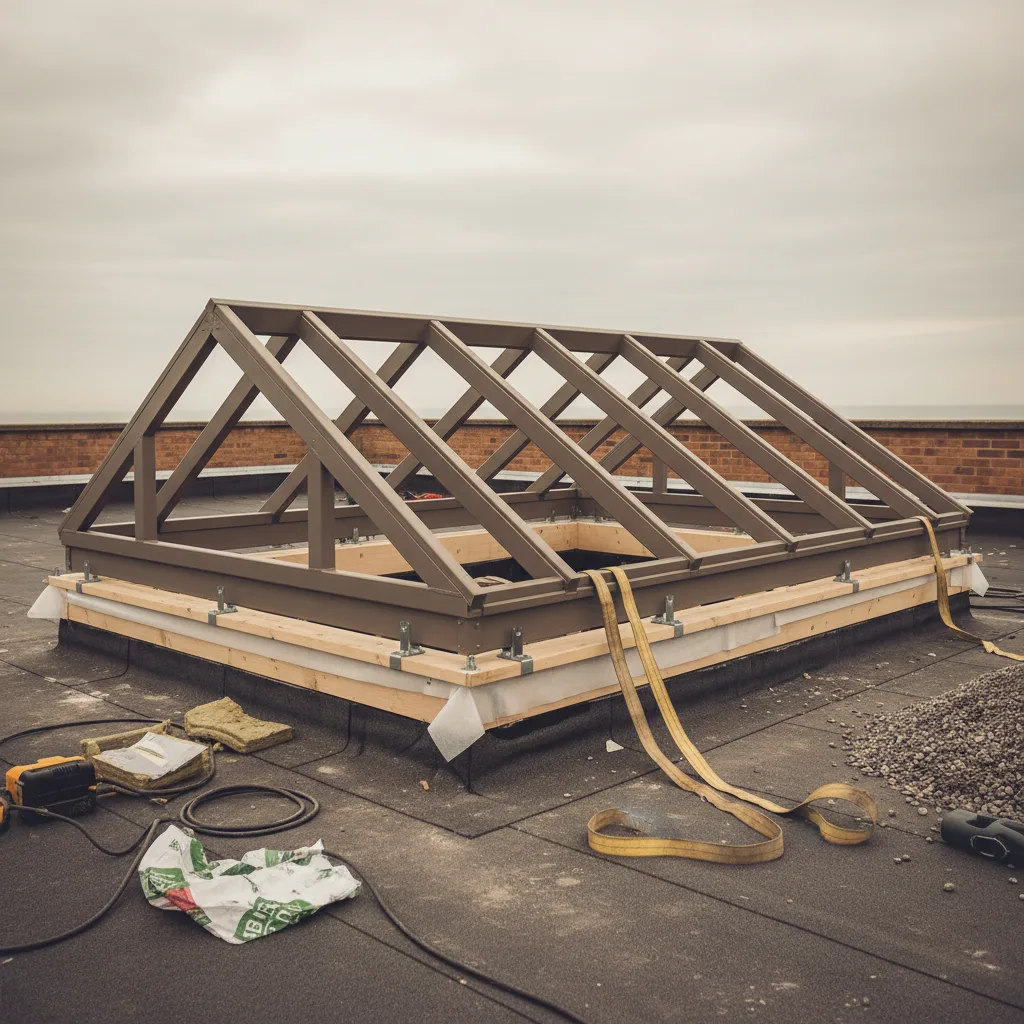
Every quotation names the exposure zone, the coating specification that follows from it, and the fixing grade, with the reason attached. That applies to a lantern, to a flat skylight, and to a replacement rooflight going into an existing kerb — the finish decision does not change with the product, it changes with the address.
We will not tell you a finish will last a specific number of years, because that depends on the coater, the elevation, the maintenance and the winter. We will tell you which failure mechanism your roof is exposed to and what the specification does about it.
What is written down is a ten-year workmanship guarantee on our installation — a workmanship guarantee, and not insurance backed, which we state plainly because the distinction matters. Coating and glazing components carry their own manufacturer warranties, handed over with the paperwork. Price is fixed in writing after the roof has been surveyed.
If you have chalking on a frame now and want to know whether it is cosmetic or structural, ring 01202 923272 — the answer usually comes from where it started rather than how bad it looks. The service hub is at roof lantern installation.
Related reading
Can a roof lantern be fitted in winter?
Yes. Winter changes how the working day is organised, not whether a roof lantern can be installed. Cold is a…
Can a roof lantern be made to open?
Yes, but it is decided at order, not afterwards A roof lantern can be made to open. Most systems offer…
Can a roof lantern go on a pitched roof?
Not onto the slope itself. A roof lantern is designed to stand on a level kerb, and a pitched roof…
Can a roof lantern go over a garage conversion?
Frequently yes — but the garage decides, not the lantern Garage conversions are one of the better places to put…
Can a roof lantern sit on a flat roof without a kerb?
No. A roof lantern has to stand on an upstand of some kind — either a kerb built on site…
Can one cracked pane in a roof lantern be replaced on its own?
Normally yes, and that is a designed-in advantage of the format A roof lantern is assembled from a frame, a…