How walk-on glass ages once a terrace has had a season of use
A season by season account of what changes on a walk-on rooflight in its first year, which marks are normal, and what a handover photograph is for.
A walk-on rooflight looks its best on the day it is commissioned and never looks quite like that again. That is not a defect and it is not a reason to buy something else. It is what happens to a horizontal surface that people cross, weather lands on and trees drop things onto.
What follows is the first year, roughly in order, with the difference between ageing and a fault marked out. The point of it is to make the second conversation easier: when you can say what changed and when, an installer can tell in a phone call whether something needs looking at.
Start with the handover photograph
- Photograph the clean pane on day one. Straight down, in flat light, and again at a low angle with the light raking across the surface. The raking shot is the one that records the finish.
- Photograph the perimeter channel empty. You will want to know what it looked like before anything was in it.
- Photograph every visible fixing head and the frame corners. These are where corrosion starts on a coastal address.
- Photograph the ceiling and reveal below. Any staining later is then dated against a clean baseline.
- Keep the specification with them. Glass make-up, interlayer, coating system and fixing grade, in one folder, so the next person is not guessing.
- Repeat the same four shots each autumn. Five minutes a year, and it turns “I think it has got worse” into evidence.
The first fortnight: settling, and the noises that go with it
New installations move slightly as sealants cure, setting blocks take up load and timber around the opening adjusts to being loaded. A faint tick or click underfoot in the first weeks, always in the same spot, is common and usually settles. A creak that grows, or movement you can feel as well as hear, is not, and should be reported while it is still a phone call rather than a claim.
The other first-fortnight item is the building’s own moisture. Plaster, screed and adhesives all dry out into the air, and the coldest surface in the room is the new glazing. Condensation on the inside face in the first weeks of a winter installation is usually the building drying, not a failed unit.
Spring and summer: the walked line appears
By the end of a first summer a faint path is visible across the pane, running between whatever two points people move between. In raking light it shows as a slightly duller strip. Straight down in flat light it is often invisible.
This is the sacrificial ply doing its job, and the scratching answer covers the mechanism and what makes it faster. What is worth noting here is the pattern rather than the cause: ageing on a walk-on skylight is directional and concentrated, not uniform. Two panes in the same terrace will age at completely different rates depending on which one sits on the route to the door.
A slip finish ages differently again. A fired-in frit does not wear off, but the recesses in the pattern collect fine dirt, so its appearance changes while its grip does not — until the dirt fills the pattern flush, at which point the grip changes too. That is a cleaning interval question rather than a wear question.
A season at a time
| Season | What changes on the unit | What it needs from you |
|---|---|---|
| Spring | Pollen film, tree debris, the first proper use after winter | Clear the channel, wash the pane, check fixings for winter damage |
| Summer | The walked line develops; sealants take their hottest week; salt bakes on at the coast | Rinse more often, especially on the spit; watch for standing water after a downpour |
| Autumn | Leaves and pine needles into the drainage; algae starts in shaded corners | The important clear-out of the year, before the first sustained rain |
| Winter | Standing water, condensation inside, grit tracked across on boots | Check the channel is running; note where and when condensation forms |
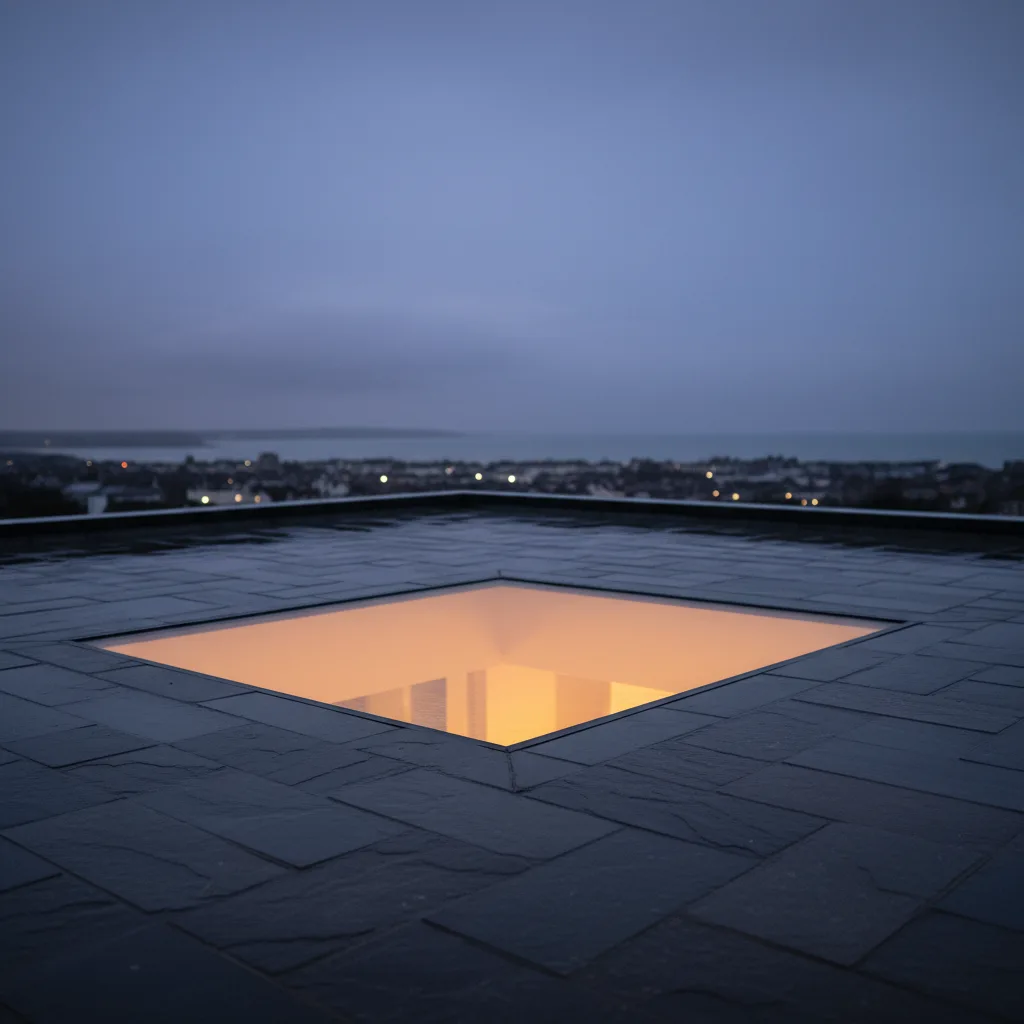
Autumn is where most first-year faults are made
Nearly everything that goes wrong in year one is a drainage story, and it starts in October. A perimeter channel fills with leaf litter, the litter holds water against the frame and the laminate edge, and the pane that drained perfectly in August starts holding a puddle in November.
The drainage guide covers the anatomy. What belongs here is the timing: the single most valuable maintenance visit of the year is the one that happens after the trees have finished dropping and before the weather turns. Under a mature pine canopy that is not a leisurely job.
Canopy addresses age faster, and differently. At Branksome Park and Canford Cliffs the load is pine needles, which are small enough to pass a grating and long enough to mat together once they do. At Sandbanks it is salt film and blown sand, which do not block anything but are relentless. Two very different maintenance regimes, four miles apart, and the wrong one applied to either address produces a complaint.
Stains, and what each of them means
Four marks turn up repeatedly in year one and they have different causes and different urgencies.
A white bloom or haze that returns days after cleaning is mineral deposit — salt at the coast, hard water elsewhere — and it is a cleaning frequency problem, not damage. Rust-coloured weep running down from a fixing head is corrosion starting, and it is worth a photograph and a call, because it is cheap to correct early and expensive once it has pitted a coating.
A dark organic film in a shaded corner is algae, which arrives fastest where the pane stays damp, and which matters because it is slippery. Bird mess is the fourth, and on a harbour or quayside address it is a routine rather than an event; it is mildly acidic and best washed off rather than left to bake.
What is not normal ageing
Report these; do not wait for the annual check
A cloudy fringe creeping inwards from the edge of the laminate. Moisture working between the plies. It does not reverse.
Misting inside the cavity. The edge seal has failed, and a walk-on unit is replaced rather than repaired.
Water standing on the pane a day after the rain stopped. Either the fall has changed or the channel is blocked.
Movement you can feel underfoot that was not there before. Something under the glass has moved.
Any crack, in any ply. Stop using the pane as a route, photograph it with something in shot for scale, and ring. What happens next is set out in the cracking answer.
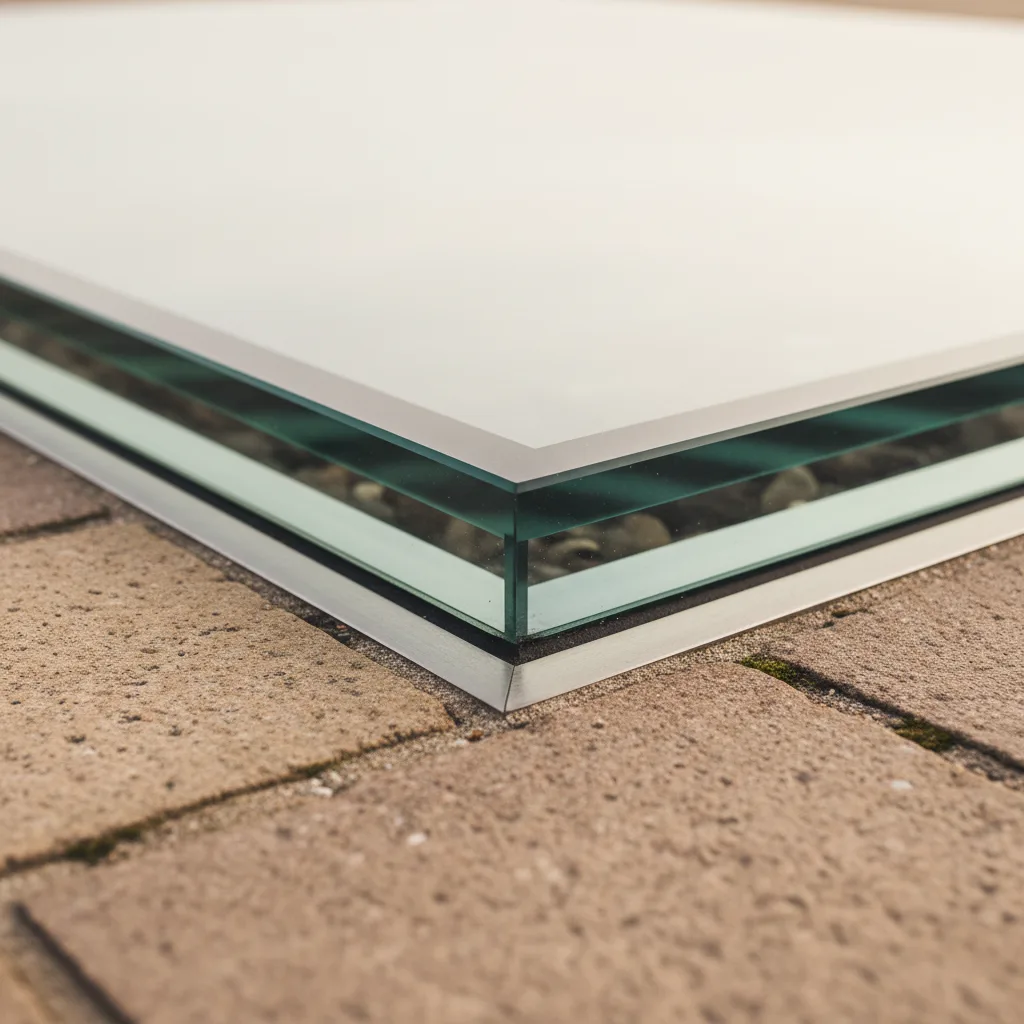
What ages around the glass, and gets blamed on it
The unit is rarely the first thing on a terrace to look tired. Timber decking greys and cups within a season. Composite boards hold algae in their grain. Exposed silicone chalks under summer sun and reflected light. Powder-coated trims fade on the sun-facing side and not the other. A stainless balustrade develops tea staining within sight of salt air, which looks like rust and is a surface film.
All of that changes how the glass looks without anything happening to the glass. It is worth separating before deciding the rooflight has aged badly, because the remedies are different and much cheaper.
What our guarantee covers over that first year
Our installation carries a ten-year workmanship guarantee, stated plainly as not insurance backed. That covers our work: the bearing, the perimeter, the waterproofing termination and the fixings. It does not cover wear on the sacrificial ply, it does not cover a channel that was never cleared, and it does not cover damage from something dropped.
Glass and sealed unit warranties come from the maker and are handed over with the specification. If something in the list above appears, send the photograph and the date. A pane that is genuinely failing tells you early, and the difference between a straightforward fix and an expensive one is usually a season of attention rather than a season of hoping.
Ring 01202 923272 or ask for a survey.
Related reading
Anti slip surfaces and the frit pattern that stays grippy when wet
Slip resistance on a walk-on rooflight is not an opinion about texture. It is a measured number, taken with a…
Are walk-on rooflights noisy to walk on?
No, not in the way people fear. A properly supported walk-on pane is one of the quieter surfaces to cross…
Are walk-on rooflights slippery when wet?
Clear polished glass is dangerously slippery wet, which is precisely why no walk-on rooflight is supplied with one. The top…
Balustrades, edge protection and where a walk-on panel changes the rules
Most of the difficulty in a walk-on project is not the glass. It is what happens at the edge of…
Can a car be parked on a walk-on rooflight?
Not on a domestic walk-on rooflight, no. Glass that carries vehicles exists, but it is a different product designed to…
Can a Quayside flat have a walk-on rooflight on its terrace?
Often yes, and the reasons it might not are rarely technical. On a Poole quayside flat the deciding factors are…