South west facing roofs over Poole Harbour and the glare they catch
A south west facing roof over Poole Harbour takes direct late sun and its reflection off the water at the same time, and glare from that combination is a contrast problem that solar control glass does not solve.
Glare and heat are two different complaints
People ring about a rooflight with what sounds like one problem and is usually two. “It is unbearable in the afternoon” can mean the room is hot, or it can mean nobody can look at a screen, read a recipe or watch a television in it. Those are different physics and they have different fixes, and a firm that hears the first when you meant the second will sell you a coating that does not help.
Heat is about energy: how much solar energy crosses the glass and stays in the room. That is a g-value question and it is dealt with on g-value and solar gain. Glare is about contrast: how much brighter one part of your field of view is than the parts around it. A room can be comfortably cool and completely unusable, and it can be pleasantly lit and far too warm.
The distinction matters most on the roofs this page is about, because a south west facing slope above the harbour is, for a couple of hours on a summer evening, close to the worst glare condition a house can offer.
The harbour is a second light source
Poole Harbour is a very large, very flat, very reflective surface, and a low sun over water does something a low sun over a field does not. At a shallow angle of incidence, water becomes strongly specular — it stops scattering light in all directions and starts behaving like a mirror. The result is the glitter path, the bright track that runs from the sun across the water towards you, and it is not a gentle wash of light. It is a second source of near-direct sun arriving from below the horizontal.
For a rooflight that matters in a particular way. A pitched roof window facing south west over the water at Lilliput, Sandbanks, Hamworthy or the Quay can take the direct sun on its outer face and the reflected track at the same time, from two different directions, neither of which an eaves overhang or a parapet does anything about. Wet sand at low tide on Studland or the harbour flats behaves similarly, and so, on a smaller scale, do the roofs and parked cars of a dense suburban street.
Where the sun actually is, over a Poole year
Glare is geometry before it is anything else, and the geometry is fixed and knowable. At Poole’s latitude the sun’s highest point in the sky varies across the year by a very large margin, and the direction it sets in swings by nearly ninety degrees.
| Time of year | Sun height at midday | Roughly where it sets | What a south west slope gets |
|---|---|---|---|
| Midsummer | About 63° above the horizon | Well north of west | High midday sun arriving glancing on a pitch, but a long, low, near head-on evening exposure |
| Equinox, March and September | About 39° | Due west | The worst combination of the year: a low sun square to the slope for a long period, and the harbour reflection with it |
| Midwinter | About 16° | Well south of west | Very low sun all day, glare at times heat would be welcome, and a reflection off wet surfaces everywhere |
Those heights are astronomy for this latitude, rounded, and the same for every roof in the service area. The row people find surprising is the second: most owners expect July to be the peak, and in practice the September and March evenings are worse, because the sun lands squarer on the slope and the glitter path off the harbour is longer.
Why a rooflight glares differently from a window
A wall window puts a bright patch in a wall you can turn your back on, sit beside, or shade with a curtain you already own. A rooflight does none of those things. It sits in the ceiling plane, in your upper field of view whichever way you face. You cannot sit beside it; you can only sit under it.
It also has no obstruction. A window sees a street, a fence, a neighbouring house, all much less bright than the sky. A skylight sees the sky directly, and an overcast sky is far brighter than people realise — which is why one can be uncomfortable to sit beneath on a dull white day. The eye objects to the contrast between a bright aperture and a dim ceiling, and neither the weather nor the heat comes into it.
Three kinds of glare, three different fixes
Naming which one you have is most of the work
Discomfort glare. You can see perfectly well, but the room is tiring and you find yourself squinting or sitting elsewhere. Caused by contrast ratios rather than absolute brightness. Fixed by reducing the contrast — lighter surfaces around the aperture, a splayed reveal, more balanced daylight from elsewhere.
Disability glare. You genuinely cannot see — a person standing under the rooflight becomes a silhouette, or the sun is in your eyes. Caused by direct or near-direct sun in the field of view. Only fixed by blocking or diffusing the source.
Veiling reflections. The screen, the worktop or the picture has a bright image of the rooflight laid over it. Caused by geometry between the aperture, the surface and your eye. Often fixed by moving the furniture, which costs nothing and is worth trying before anything else.
The order to deal with it in
- Position, if the job is still on paper. Where the rooflight goes, how big it is and which slope it is on decide more about glare than any product will. A skylight moved two metres, or split into two smaller apertures, is often the whole answer and costs nothing at design stage.
- Stop it outside the glass. An external blind, shutter, brise-soleil or awning intercepts the sun before it reaches the pane. It is the most effective option for direct sun and the most exposed to weather; the full comparison is on external shading against an internal blind and is not repeated here.
- Diffuse it at the glass. A translucent or diffusing unit turns a point source into an even glow. Highly effective against disability glare, and it costs you the view and the sky.
- Control it inside. An internal blind, ideally positionable partway rather than only up or down. Cheap, changeable, and it converts the energy into room heat rather than stopping it.
- Change the room around it. Reveal splay, pale finishes near the aperture, moving the screen or the seat.
- Only then, the glazing specification. A solar control coating reduces transmitted energy without proportionally reducing brightness — which is exactly what you want for heat and almost exactly what you do not want for glare.
Diffusing glass, and what it costs you
Diffusing options run from a lightly textured or acid-etched pane through to a full translucent interlayer that passes light while permitting no image at all. They work on glare in a way no coating does, because they remove the point source: instead of a small, blindingly bright sun in your field of view, you get a large, evenly bright panel, and an even panel at the same total light output is far more comfortable to sit under.
The cost is the thing you probably bought a skylight for: the sky, the moving cloud, the sense of the room being open at the top. On a stairwell, a bathroom or a utility that trade is often excellent. Over a kitchen table where people sit and look up, it rarely is.
The reveal is glare control you have already paid for
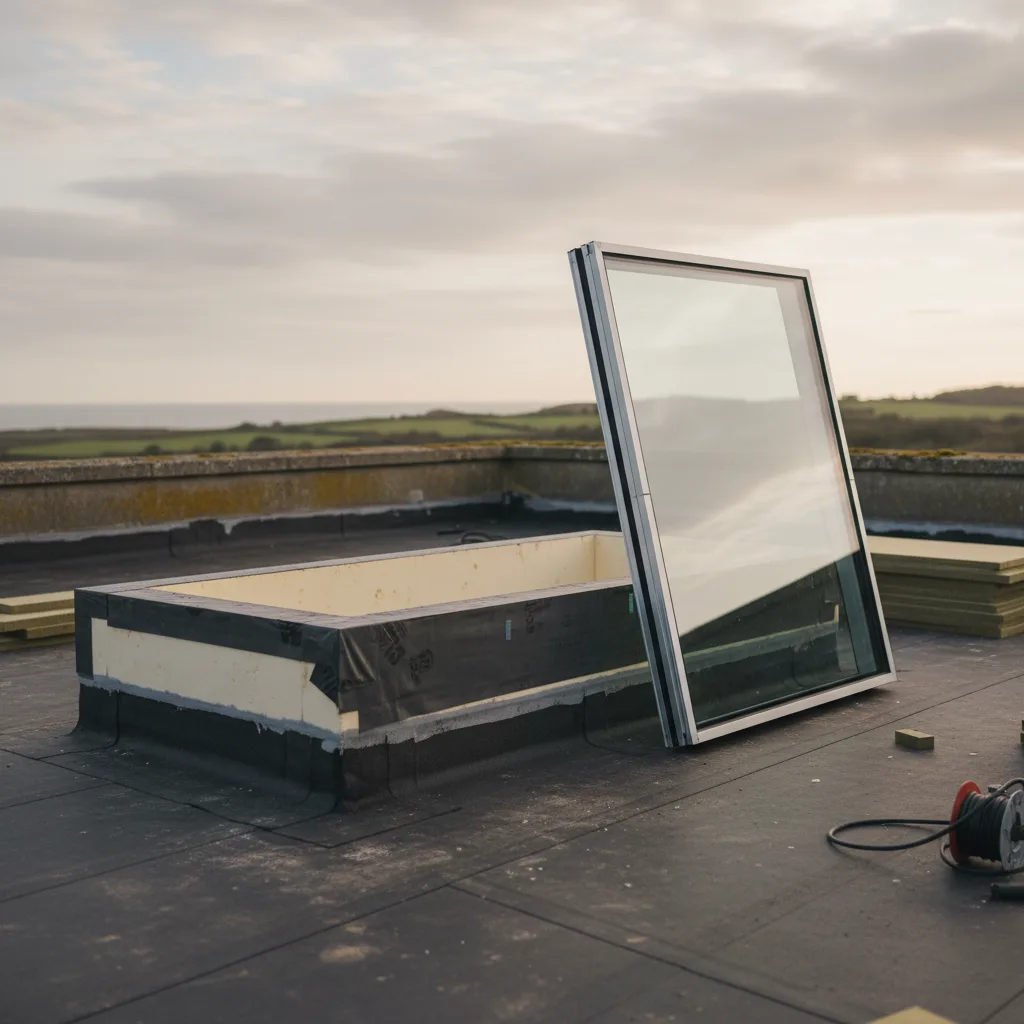
A rooflight in a warm deck roof sits at the top of a lined shaft. That shaft can make glare much worse or much better, and it costs the same either way.
A square reveal with dark or shadowed sides puts a very bright aperture in the middle of a dark surround, which is the definition of a high contrast ratio. A splayed reveal — the lining cut back so the opening widens as it comes into the room — does two things at once. It catches light on the splayed faces so they become an intermediate brightness between the sky and the ceiling, softening the step. And it widens the apparent aperture, spreading the same light over a larger area of ceiling.
Finish matters as much as geometry. A matt near-white reveal reflects light diffusely and reads as bright; a dark one absorbs it and deepens the contrast. It is the cheapest glare intervention on a rooflight, and it is decided by a carpenter on a Tuesday without anyone mentioning it.
Where the water is actually in view
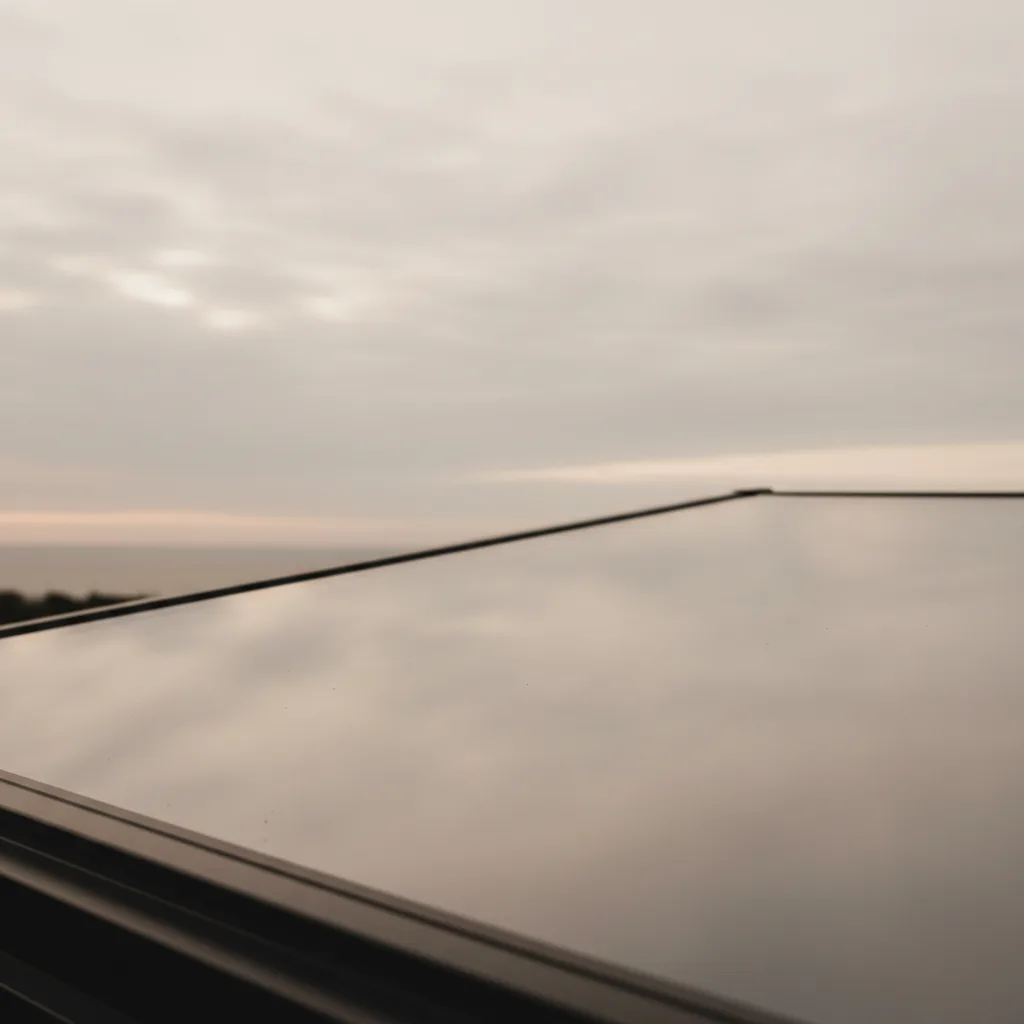
On the spit — Sandbanks, Shore Road, Studland across the water — there is water on both sides and no obstruction in any direction. A rooflight here sees the whole sky dome and a reflective surface at low angle for much of the day. External shading is the honest answer, and it has to be specified to survive an exposure with no fetch break: marine-grade finishes, stainless fixings, and a wind rating that means something.
Around Lilliput, Parkstone Bay, Hamworthy and the Quay, the water is in view from upper rooms but the land behind breaks the prevailing south-westerly. External shading is more durable here than on the spit, and the reflected component is still significant on a calm evening — a flat harbour reflects far better than a choppy one.
In Branksome Park and Canford Cliffs, elevation puts the water in view from a good many roofs, but the protected pine canopy intercepts most of the low sun before it arrives. Glare there is intermittent and dappled rather than sustained, and the right response is usually a blind rather than a permanent alteration to the glazing.
We will name which of these your roof is on the survey. We will not predict what any planning authority will accept on a visible slope — external shading on a prominent roof in a conservation area is assessed on merit by BCP Council or Dorset Council, and never assured.
The rooms where it actually matters
Glare is worth spending money on where people look at things. A home office with a monitor under a south west rooflight is the clearest case, and it is also the one where the cheapest fix — turning the desk ninety degrees — frequently works. A sitting room with a television on a wall opposite a bright aperture is the second. A kitchen where the work surface is glossy and the light well is directly above it is the third.
It matters much less in a hallway, a stairwell or a utility. It matters not at all on a north-facing slope, where there is no direct sun to catch — which is why north light has been the studio glazing of choice for two centuries.
What we set out on the survey
For any roof with a westerly component we record the slope direction and pitch, what is in view from the aperture, whether open water is part of that view, and what the room is actually used for. Those four things decide whether the answer is a repositioned rooflight, an external blind, a diffusing unit, a splayed reveal or simply a different place to put the desk.
What we will not do is quote a glare index or a percentage reduction. Those depend on the sky, the hour and where the person is sitting. Where a manufacturer declares a light transmittance for a diffusing or coated unit, that declared figure goes on the quotation as theirs and it governs.
Our installation work carries a ten-year workmanship guarantee — a workmanship guarantee, plainly, and not insurance backed — with a fixed written price after survey. If your skylight faces the harbour and the evenings have become unusable, ring 01202 923272 and tell us which direction the slope faces and what you are trying to look at.
Related reading
Argon and krypton fills matter less than the brochure suggests
The cheapest line on the specification is usually the loudest Argon fill appears on almost every glazing quotation in the…
Condensation on the inside of the glass is a humidity problem
A week with a hygrometer settles it faster than an argument Almost every conversation about a wet skylight starts in…
Do rooflights cause draughts?
A correctly installed one should not. When a skylight is blamed for a draught it is almost always one of…
Do rooflights help with damp in a room?
With one kind of damp, and only if it opens. A skylight does nothing whatever for rising or penetrating damp…
Do rooflights lose more heat than walls?
Per square metre, yes, and it is not close. Any glazing loses heat several times faster than the insulated fabric…
Do rooflights make a room colder in winter?
No, not a modern one. A well-specified rooflight in a well-detailed opening adds heat loss in the same way any…