Wind sensors on the harbour front where gusts arrive unannounced
A wind sensor protects the hinge rather than the carpet, and on a harbour-front roof the threshold it is set to matters more than the sensor you buy.
Rain sensors get all the attention because wet carpet is visible. Wind does the expensive damage, and it does it quietly: a hinge strained on a Tuesday does not announce itself until it fails in March. On the water at Poole the case for a wind sensor is stronger than it is almost anywhere inland in Dorset, and it rests on one fact about the geography.
Wind is the load. Rain is only the nuisance
A closed rooflight is a stiff panel with its edges supported all the way round. Every component in it is sized for that condition. Open the sash thirty degrees and you have made a cantilevered plate held on two hinges and a drive arm, standing in moving air, and the loads have moved from the perimeter into a handful of fixings.
Wind does not push evenly on that plate either. Air accelerating over the opening lifts the leading edge, and the shock loading of a gust is worse than the steady pressure of the same wind because it arrives as an impulse. That is what strains a hinge knuckle, opens up a drive bracket’s fixing holes, and over a few seasons leaves a skylight that will not quite pull down onto its gasket any more.
What the sensor actually measures
| Type | How it reads the wind | What it is like to live with |
|---|---|---|
| Cup anemometer | Three cups on a spindle; rotation speed becomes a pulse count | Cheap and well understood, but it has a moving bearing outdoors in salt air, which is the one thing you would rather avoid here |
| Ultrasonic | Time-of-flight between transducers; no moving parts at all | The sensible choice on the spit and the harbour front. Nothing to seize, and it reads direction as well as speed |
| Pressure or vane switch | A flap or diaphragm deflects past a set point and closes a contact | A switch, not a measurement. It tells the controller “too windy”, nothing more, and cannot be tuned afterwards |
| Internet weather data | A forecast or an observation from a station some distance away | Not a wind sensor. A station at the airport knows nothing about the gust crossing your roof, and it needs the broadband to be up |
Most domestic controllers accept a single speed input, so whichever device is fitted ends up producing one number. The difference between them is reliability in this climate and whether the reading can be trusted enough to set a fine threshold.
Mean, gust, and the number a threshold is set against
Weather forecasts quote a mean wind speed with gusts given separately, and the gap between the two is usually large. A controller closing a rooflight is not interested in the mean. It is interested in the peak that arrives in the next second, because that is the load the hinge sees.
So a threshold set on a mean reading closes far too late, and a threshold set on a raw instantaneous peak closes constantly. Controllers deal with this by sampling fast and averaging over a short window — long enough to ignore a single eddy, short enough to catch a real gust front. The window length is as much a part of the commissioning as the speed figure, and it is the setting most often left wherever the factory put it.
Why the harbour front is its own case
The problem at Poole is fetch, and the lack of a warning. Poole Harbour is a wide, shallow, largely obstruction-free body of water. Wind crossing it from the south-west loses almost nothing to surface friction, so it arrives at the northern and eastern shores at close to its open-water speed. On a wooded inland roof a gust announces itself in the trees a few seconds before it arrives. On the quay, at Hamworthy, on the Sandbanks peninsula, there is nothing between the water and the roof to rustle. The first sign is the sash moving.
That is not a reason to panic about opening a skylight near the water. It is the reason the sensor has to be a real measurement on the roof rather than a guess, and the reason a threshold that would be sensible in Broadstone is set lower here.
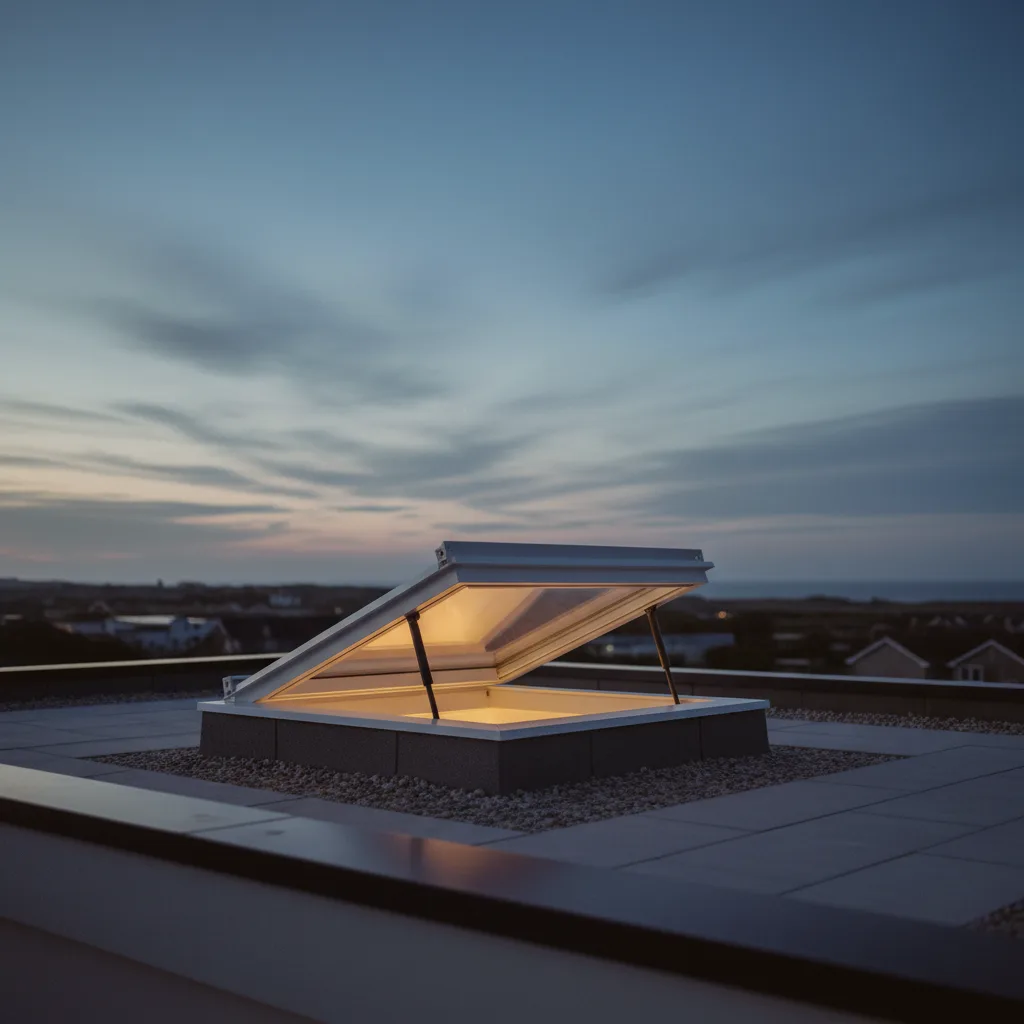
Siting the sensor so it reads the roof and not the garden
- Put it in the same airflow as the opening. Same roof plane, same general height, close enough that it experiences the gust that will load the sash. A sensor on the sheltered side of a ridge reads a different wind entirely.
- Clear of local turbulence. Not immediately behind a chimney, a parapet, a plant deck or a dormer cheek. Eddies in a wake read as gusts, and a sensor there will close a rooflight on a calm afternoon.
- Not so exposed it over-reads. On a raised mast at the highest point of an exposed roof, an anemometer sees a harsher wind than the sash does. You want representative, not worst case.
- Cabled, not battery, where you can. A radio sensor with a coin cell on a roof you cannot reach is a maintenance problem waiting eight feet above your head.
- Reachable for a rinse. Salt crust on an ultrasonic transducer or in an anemometer bearing changes the reading. If it cannot be cleaned it will not be cleaned.
Closing is the easy half
Any controller can shut a sash when a number goes high. The behaviour that separates a good installation from an irritating one is what happens next.
Two settings do the work. The first is a lockout: once the wind sensor has closed the unit, the controller refuses to open it again — from the switch, the remote or the app — until the wind has dropped. Without that, somebody presses the button, the rooflight opens, the wind closes it, and the drive cycles all afternoon. The second is hysteresis: the reopening threshold sits meaningfully below the closing threshold, so the unit does not hunt around a single figure. A blustery day with a wind average sitting exactly on the set point is otherwise a genuinely miserable thing to live under.
When the wind sensor and the rain sensor disagree
Safety inputs win, and they never argue for long
Both sensors only ever ask for the same thing: close. They cannot conflict, because neither of them opens anything. What can conflict is a sensor against a person or a schedule, and the rule we commission to is that any safety input overrides any convenience input, every time. A schedule that wants the skylight open at seven does not get it if the anemometer says no. If a control system lets a scene override a wind input, that is a configuration error, not a feature, and it should be corrected before handover.
What a wind sensor does not do
It does not protect a closed rooflight. A shut unit is wind-rated by its own construction and its fixings, and if that specification is wrong for the exposure no sensor helps. It does not know which way the wind is blowing unless it is an ultrasonic type wired to a controller that uses direction, which most domestic ones are not — so a gust from the sheltered side closes the unit just the same.
And it does nothing at all without power. In an outage an open sash stays open in rising wind, which is the single strongest argument for a mechanical override you can actually reach. That behaviour is covered in full on what a vent does when the mains fails.

Thresholds by zone, and why they are not the same number
| Zone | Wind behaviour | How the setting is approached |
|---|---|---|
| Spit — Sandbanks, Studland, Mudeford | Water on both sides, no fetch break in any direction, gusts with no lead-in | Lowest threshold in the service area, short averaging window, firm lockout. A wind sensor here is not optional in our view |
| Harbour — Hamworthy, Upton, Lower Parkstone | Open-water fetch from the south-west, some shelter from the land behind | Low threshold, with siting checked against the direction the water lies in |
| Cliff and wooded — Canford Cliffs, Branksome Park | Elevated, but the pine canopy breaks the flow and makes it turbulent rather than fast | Longer averaging window so canopy eddies are not read as gusts; threshold nearer the inland figure |
| Exposed coast — Portland, Barton on Sea, Milford on Sea | Direct Channel exposure, sustained rather than gusty | Low threshold, and a hard look at whether a wide opening angle belongs on that roof at all |
| Inland — Broadstone, Ferndown, Wimborne, Verwood | Sheltered, heathland edge, gusts arrive attenuated and with warning | Standard threshold. A wind sensor is a reasonable extra here rather than a necessity |
Where a wind sensor earns nothing
On a small opening rooflight with a restricted travel, in a sheltered inland garden, wired to a unit that is only ever cracked open for a few minutes, a wind sensor is an additional component to fail and a cost with little behind it. We will say so. The same goes for a skylight on a low-pitched roof set well back behind a taller neighbouring building, where the sash never sees clean air.
The honest test is whether the sash can be caught by air that arrives faster than a person can react. On the harbour front it can. In a Broadstone cul-de-sac with mature gardens on three sides it generally cannot.
What we set, and what goes on the handover sheet
At commissioning the sensor position is checked against the five siting rules above, the averaging window is set for the zone rather than left at default, and the lockout and hysteresis are configured and then tested by holding the unit open and forcing a close. The threshold and the reopen figure both get written down, because the next person to touch the system needs to know what it was set to and why.
We also tell you the limitation plainly: a wind sensor is a backstop for an opening skylight, not a licence to leave a large rooflight wide open on a roof that cannot carry it. The opening angle and the unit specification are the primary protection, and they are settled at survey rather than in software. To have an exposure assessed before anything is ordered, ring 01202 923272.
Related reading
Are electric rooflights noisy when they open?
No. A correctly installed unit makes a low hum for the twenty or thirty seconds it is moving and is…
Cable routing through a warm deck without breaching the vapour layer
The electrical side of getting power to an actuator is a settled matter, and it is set out on wiring…
Can a fixed rooflight be upgraded to an opening one?
Almost always this turns out to be a replacement rather than an upgrade, because a fixed rooflight has no hinge,…
Can a rooflight be set to close automatically at night?
Yes. A timed close is the most useful automation an opening rooflight can have, and unlike most of them it…
Can a smoke vent rooflight be used for everyday ventilation?
Technically, often yes — many certified automatic opening vents include a comfort ventilation mode, and it works. Practically, it is…
Can an electric rooflight be controlled from a phone?
Yes — either through a gateway that bridges the rooflight controller onto your home network, or through a manufacturer’s own…