Cable routing through a warm deck without breaching the vapour layer
The cable to an opening rooflight is trivial electrically and consequential in building physics, because the vapour control layer it crosses is the thing keeping the roof dry.
The electrical side of getting power to an actuator is a settled matter, and it is set out on wiring a rooflight actuator back to a fused spur. This page is about something else entirely: the hole that cable makes on its way, and why a two-minute decision about where to put it can decide whether a warm deck stays dry for thirty years or quietly rots from the inside.
What a warm deck is doing, in one paragraph
In a warm deck the insulation sits above the structural deck, with the waterproof membrane on top of it and a vapour control layer underneath. Everything below the insulation — the deck, the joists, the ceiling — is kept at close to room temperature, which means water vapour from inside never reaches a surface cold enough to condense on. That is the whole design. It works because the vapour control layer stops moist indoor air getting up into the cold part of the build-up in the first place.
Puncture that layer and you have made a route for warm, humid indoor air to reach the cold underside of the membrane. It condenses there, out of sight, and nothing tells you until a ceiling stains or a fixing pulls out of soft timber years later.
Where the cable is actually trying to go
The drive sits at the rooflight, on or in the kerb. The supply comes from inside the building. So the cable has to cross the plane of the vapour control layer once, somewhere. The only questions are where, and how well that crossing is made.
| Route | What it does to the vapour layer | Verdict |
|---|---|---|
| Up the inside face of the kerb, into the frame | Crosses inside the warm envelope at the upstand, where the layer is already being dressed and terminated | The preferred route on almost every job. One detail, done where a detail already exists |
| Through the ceiling and the deck in the field of the roof | A penetration in the middle of an otherwise continuous sheet, then a run through the insulation | Avoid. It puts a cold-side cable and a lone penetration where nothing else is happening |
| Surface trunking on the ceiling to the kerb | Nothing at all, until it turns up into the upstand | Ugly but honest. The retrofit answer when a ceiling cannot be opened |
| Over the membrane and in from above | Leaves the vapour layer alone but puts a hole in the waterproofing | Only where the manufacturer details it, and never as an improvisation |
| Through a service void below the vapour layer | Nothing. The void is on the warm side and the layer is untouched along its length | The best arrangement of all, where the ceiling build-up allows one |
The service void is the answer nobody asks for
If a battened service void is formed under the vapour control layer, every cable in the ceiling — lighting, the actuator, anything added later — runs below the layer and never crosses it. The only crossing left is the single one at the kerb.
It costs a small amount of headroom and a little battening. In exchange it removes the entire category of problem this page is about, and it means the next person who wants a cable in that ceiling does not have to make a decision about the roof’s vapour performance to get one. On a new extension we will raise it. On an existing roof being reworked it is often still possible.
Making the one crossing properly
- Form the opening, do not tear it. A neat cut or a drilled hole can be sealed. A ragged tear has no edge to seal to.
- Use a grommet or top-hat detail. A proprietary cable grommet sealed to the membrane gives a defined, sealable junction. Improvising with whatever tape is on the van does not.
- Seal with the membrane maker’s own tape or mastic. Compatibility is not cosmetic. The wrong adhesive on the wrong membrane releases within a few years, and it does so invisibly.
- Seal around the cable, not just to the surface. Air travels along the outside of a cable sheath and, on a multicore, sometimes along the inside of it. A collar that grips the sheath is the point of a grommet.
- Leave a service loop. A cable pulled tight across a sealed penetration works the seal every time the building moves or the drive is replaced.
- Photograph it before it is covered. Five seconds now, and it is the only evidence that will ever exist that the detail was made properly.
Conduit is not a substitute for a seal
A conduit is an air path with a smooth bore
Putting the cable in a conduit makes it drawable and replaceable, which is worth doing for its own sake. What it does not do is stop air movement — it improves it, unless both ends are sealed. A conduit running from a warm room up into a cold roof build-up, open at the top, is a chimney. Seal the conduit to the vapour layer where it crosses, and seal the bore itself at one end around the cable. Both, not either.
Cold decks and pitched roofs behave differently
On a cold deck, with insulation between the joists and a ventilated void above, the rules are the same in principle and the consequences arrive faster. The void above the insulation is genuinely cold, and warm air pushed into it through a light fitting or a cable hole condenses on the deck underside within a single winter. Cold decks are less forgiving than warm decks, not more, which surprises people.
On a pitched roof with a rooflight or roof window, the equivalent plane is the vapour control layer behind the plasterboard on the slope. The cable normally runs in the batten zone or the void below it and crosses at the window’s own trimmed opening, where the insulation is being dressed and taped to the frame in any case. Same principle: cross where a detail already exists.
The cold bridge nobody mentions
A cable is a small thermal bridge, and on its own it is unimportant. What matters is what has to be cut away to get it through. A notch taken out of rigid insulation to let a cable pass is a gap of air in a layer that only works when it is continuous, and gaps in insulation are where surface temperatures fall and condensation starts.
So the rule is to route around insulation rather than through it, and where a crossing is unavoidable, to reinstate the insulation snugly and cut a groove for the cable rather than leaving a void around it. This is a five-minute discipline with a thirty-year consequence.
Why this is more than a theoretical risk on Poole roofs
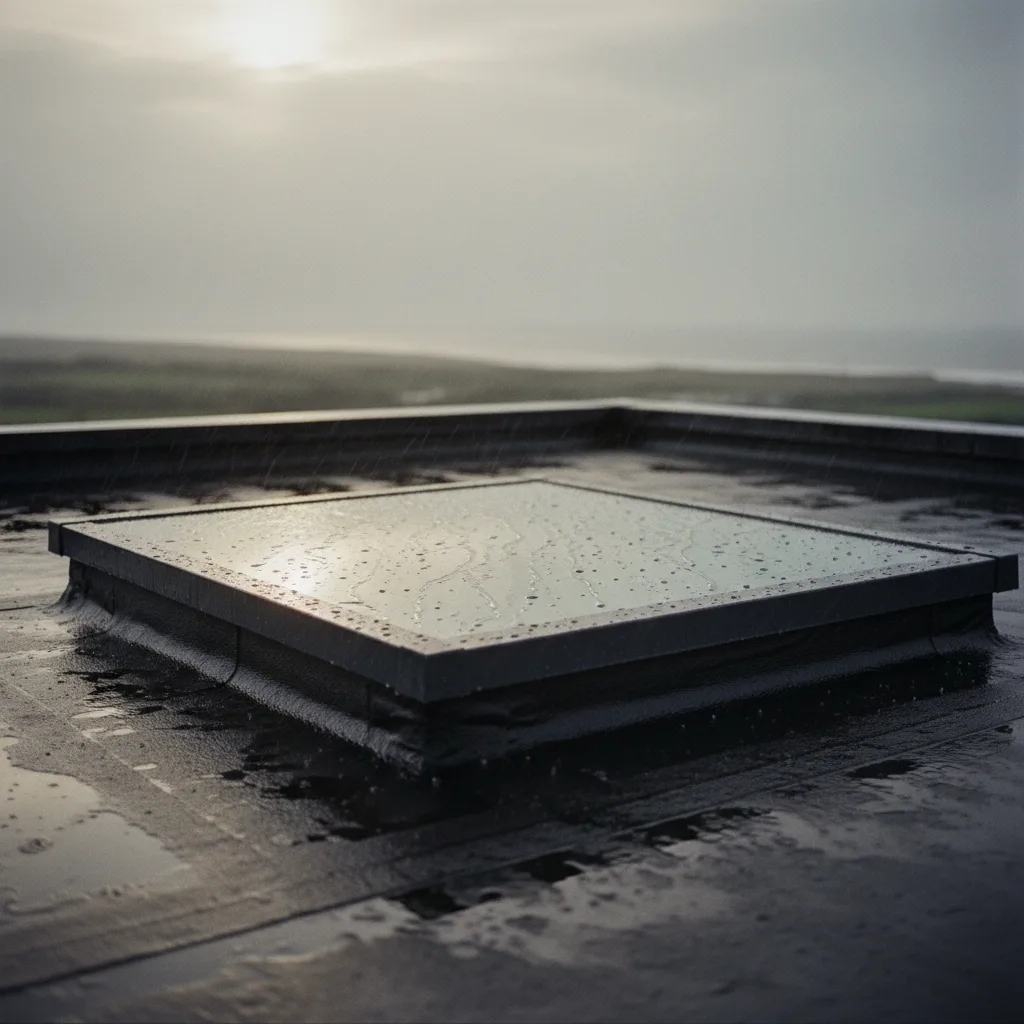
The local housing stock loads the dice. A great deal of what we work on around Poole, Parkstone and Hamworthy is single-storey flat-roof extension, much of it from the 1970s onwards and a good proportion re-covered at least once. Re-covering usually means a new membrane and sometimes new insulation over an existing deck, with whatever vapour control layer was originally there left in place and unknown. Add a coastal climate that is humid for much of the year and rarely cold enough to dry a build-up out quickly, and an interstitial condensation problem can run for a long time without ever producing a frozen, obvious failure. The cheap insurance is to make one clean crossing at the kerb and to know where it is.
The sequence that avoids a second hole
Almost every unnecessary penetration in a roof comes from doing things in the wrong order. The cable arrives after the ceiling is up, or the drive position changes after the route is fixed, and somebody makes a second hole rather than revisiting the first.
The order that works is: settle the switch position and the drive position at survey; agree the crossing point at the kerb; pull the cable with a draw cord left in the conduit before the vapour layer is sealed; make and photograph the seal; then close the ceiling. The draw cord is the part people skip, and it is what makes replacing an actuator in year ten a job rather than an ordeal.
What we do, and what we will not sign off
We route at the kerb wherever the build-up allows it, seal with the membrane manufacturer’s own system rather than a generic tape, leave a draw cord, and photograph the detail before it disappears. Where a service void exists or can be formed, the cable goes in it.
What we will not do is put an unsealed penetration in a vapour control layer because it is a quicker route, or cover one somebody else has made without saying so. A skylight installed well and a roof quietly wetting itself above the ceiling is not a job finished. If a cable route on your roof needs working out before anything is ordered, ring 01202 923272.
Related reading
Are electric rooflights noisy when they open?
No. A correctly installed unit makes a low hum for the twenty or thirty seconds it is moving and is…
Can a fixed rooflight be upgraded to an opening one?
Almost always this turns out to be a replacement rather than an upgrade, because a fixed rooflight has no hinge,…
Can a rooflight be set to close automatically at night?
Yes. A timed close is the most useful automation an opening rooflight can have, and unlike most of them it…
Can a smoke vent rooflight be used for everyday ventilation?
Technically, often yes — many certified automatic opening vents include a comfort ventilation mode, and it works. Practically, it is…
Can an electric rooflight be controlled from a phone?
Yes — either through a gateway that bridges the rooflight controller onto your home network, or through a manufacturer’s own…
Can an electric rooflight be fitted in a bathroom?
Yes, and a bathroom is one of the best arguments for an electric rooflight there is. It is the room…