Condensation in a sun tunnel and the insulation sleeve that stops it
Why a metal tube crossing a cold loft attracts condensation, what the insulation sleeve and sealed ceiling collar are actually doing, and how to distinguish the symptom from a leak.
A sun tunnel drips because a cold surface has met warm wet air, not because the roof is leaking. The fix is upstream of the drip: stop the house air reaching the cold part of the tube, and stop the tube being cold in the first place.
Condensation is the most misdiagnosed fault on a tunnel installation, because the symptom looks exactly like the thing it is not. Water appearing at a ceiling diffuser below a roof opening reads as a leak to anyone, which is why the first job is telling them apart and the second is understanding what the sleeve is for.
The physics, in the fewest words that are still true
Air holds moisture, and warm air holds more of it than cold air. Cool a parcel of moist air far enough and it reaches the point where it cannot hold what it is carrying, and the surplus comes out as liquid on the nearest cold surface. That temperature is the dew point, and it moves with how wet the air is.
A house in winter produces warm moist air constantly — cooking, washing, drying, breathing. A loft above the insulation is deliberately cold and, in most houses, deliberately ventilated. A sun tunnel is a tube of cold metal or plastic running from that cold void, through the insulation, and ending at a hole in the ceiling of a warm room.
That is the whole problem stated as an object: a cold bridge with a vapour source at one end.
Three places the water actually appears
| Where you see it | What is happening | What it points to |
|---|---|---|
| Inside the tube, running down to the diffuser | Room air is getting into the tunnel and meeting the cold upper wall | The ceiling collar is not sealed, or a joint is open |
| On the outside of the tube in the loft | Loft air condensing on an uninsulated cold tube surface | Missing or incomplete insulation sleeve |
| Around the ceiling trim, staining the plaster | Warm air escaping up past the trim, cooling, returning as liquid | No vapour seal at the ceiling, or a poorly cut opening |
| Under the dome, visible through the tube | Moisture trapped inside a sealed unit, or the dome seal has failed | A product fault or a failed gasket, not an installation error |
| Wet insulation in a patch near the tunnel | Persistent vapour leak that has been going on for a while | Both seals need looking at, and the insulation replacing |
Condensation or a leak: telling them apart
- When does it appear? Rain-linked, during or shortly after weather, points to a leak. Cold-linked, worst on frosty mornings and in the hour after a shower, points to condensation.
- Is it clean? Condensate is clear. Water that has come through a roof usually carries dirt from the covering and stains as it dries.
- How much, how fast? A leak in driving rain produces a run. Condensation produces beads that coalesce and drip slowly, then stop.
- Where is the loft wet? A leak wets the roof timbers, the underlay and the insulation around the roof opening. Condensation wets the tube and whatever is directly beneath it.
- Does it follow the household? Worse in a wet week of indoor drying, or after a house full of people, is the giveaway. Rain does not care how many showers were taken.
The two can also coexist, which is why a tunnel that drips gets both ends inspected rather than one theory applied.
What the insulation sleeve is actually doing
The sleeve is a wrap of insulation around the length of tube crossing the cold void. Its job is not to keep the room warm, although it helps. Its job is to keep the tube’s surface temperature above the dew point of the air touching it, so that air has nowhere to give up its moisture.
That is why partial sleeving fails so reliably. Insulate ninety per cent of a run and the remaining ten per cent is the coldest exposed surface in the loft with moist air circulating past it. Water finds it. A sleeve that stops short of the ceiling line, or is left open along a seam, or is compressed flat where it passes a joist, has effectively created a small cold spot and pointed the problem at it.
The sleeve also has to be continuous with the loft insulation it passes through. A gap between the two is a channel from the warm ceiling void straight to the cold tube.
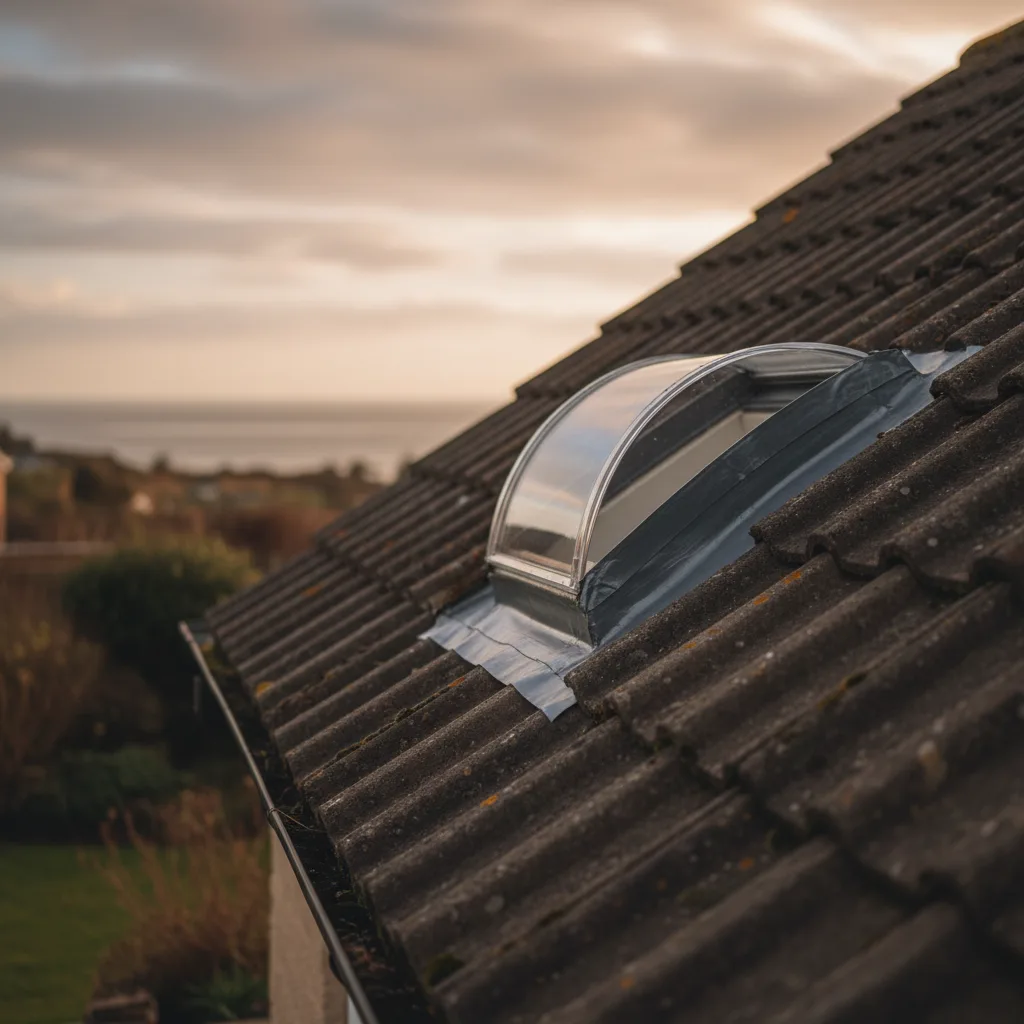
The ceiling seal matters more than the sleeve
The one that gets skipped, and the exception
Sealing the collar where the tube meets the ceiling is the single most effective part of the job. No sleeve stops condensation if warm moist room air is being fed up into the tunnel through a gap at the trim. That gap acts as a chimney: warm wet air rises into the tube, hits cold wall, condenses, and runs back down onto the diffuser you are looking at. The sleeve reduces how cold the wall is; the seal removes the supply of moisture.
The exception worth naming: in a bathroom or utility, sealing alone is not enough, because the room genuinely produces more vapour than the seal can be asked to hold back forever. There the specification also assumes working mechanical extraction. A tunnel is a daylight product, not a ventilation one, and it does not remove the need for an extract fan or replace anything required by the building regulations.
The build-up, in the order it goes together
Order matters here because each layer is only effective if the one before it was done properly.
- Cut the ceiling opening square and to size. A ragged oversized hole cannot be sealed neatly afterwards, and the trim will hide the gap without closing it.
- Fit and secure the tube perpendicular to the ceiling. A tube arriving at an angle leaves a crescent-shaped gap on one side.
- Seal the collar to the plasterboard. Continuously, all the way round, to the ceiling’s vapour-resisting layer where there is one.
- Sleeve the full run. Every part of the tube above the insulation line, with no bare sections and no crushed sections.
- Make the sleeve continuous with the loft insulation. Butted and dressed, not left with a ring of daylight between the two.
- Leave the loft ventilation working. Eaves ventilation blocked by insulation shoved back to clear the tunnel is a new problem replacing an old one.
- Check the dome and collar seals before leaving. A tunnel is a closed run from dome to diffuser, and any opening in it is both a light leak and a moisture path.
Cold lofts, warm lofts and loft conversions
The whole discussion above assumes a cold ventilated loft, which is what most Poole houses with a tunnel have. In a warm roof construction, where the insulation follows the rafter line and the void below it is inside the thermal envelope, the tube is no longer crossing cold space and the condensation risk changes completely.
That sounds like good news and usually is not, because a warm roof generally means a loft conversion, and a converted loft usually has no void left to run a tunnel through at all. Where the roof has been converted, the honest answer is more often a rooflight in the new ceiling than a tunnel threaded through a dormer cheek.
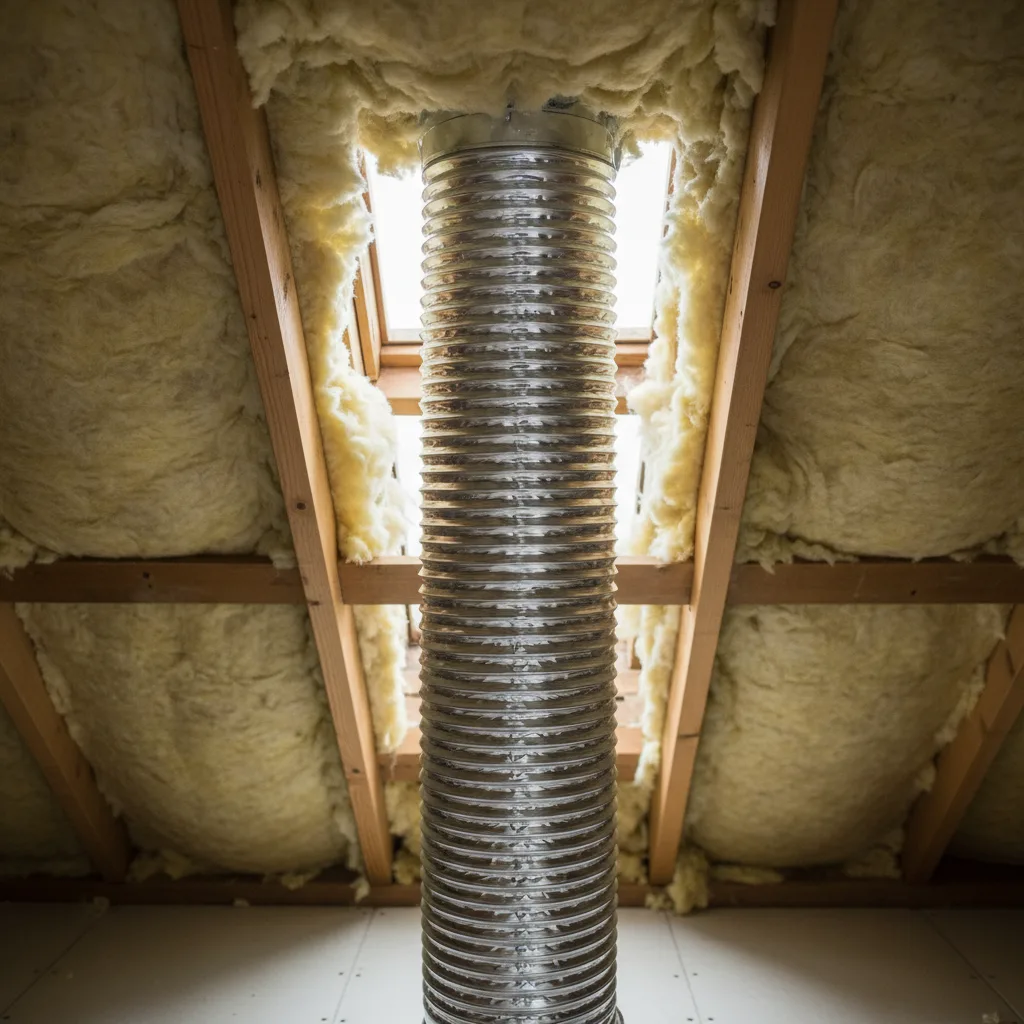
What makes it worse around Poole specifically
Local conditions that load the dice
A maritime climate is a humid one. Poole, Hamworthy and the harbour edge sit in air that carries moisture most of the year, with mild damp winters rather than hard dry cold. Mild and damp is worse for condensation than cold and dry, because the air arriving in the loft already holds a great deal.
Internal bathrooms are the commonest tunnel location. They are also the wettest rooms in the house, and the ones with no window to open. A tunnel into an internal en-suite in a 1930s Parkstone semi is the highest vapour load meeting the longest cold tube, which is precisely why the sleeve and the seal are specified rather than assumed.
Boarded lofts hide it. Where storage boards cross the run, a slow vapour leak wets insulation under the deck and is found years later. Boards get lifted at survey for this reason as much as for routing.
Fixing one that is already dripping
An existing tunnel that condenses can almost always be corrected without replacing anything. The sequence is: confirm it is condensation rather than a leak, inspect the collar seal at the ceiling and reseal it properly, inspect the full length of sleeve for gaps, crushing and discontinuity, check the joints are taped, and check the loft ventilation has not been obstructed at the eaves.
If all of that is sound and it still condenses, the next questions are about the room rather than the tunnel: whether extraction is working, whether it runs long enough, and whether washing is being dried in a room with no way for the moisture to leave. A skylight, a rooflight or a tunnel will all condense in a house that is making more vapour than it can get rid of.
What we put in writing
Our quotation states the sleeve specification, that the ceiling collar is sealed, and what the loft ventilation arrangement is, because those are the three things that decide whether you ever see a drop of water. It names the exposure zone your roof sits in as well, since that governs the dome and flashing rather than the condensation detail but belongs on the same document.
Price is fixed in writing after survey. Workmanship carries a ten-year guarantee, our own, not insurance backed. If you have a tunnel dripping now and want it diagnosed properly rather than sealed hopefully, ring 01202 923272.
Related reading
1930s Poole semis with internal bathrooms and no wall to reach
The interwar semi built across Parkstone, Winton, Penn Hill and Oakdale has a recognisable problem: a bathroom in the middle…
Adding a light kit so the tunnel works after dark
A sun tunnel goes dark when the sky does. In a bathroom or a hall that had no daylight at…
Are sun tunnels warm or do they lose heat?
A sun tunnel is a hole through your insulated ceiling, so yes, it loses some heat — and a properly…
Broadstone bungalows where the loft void is shallow and wide
Broadstone, Creekmoor and the bungalow runs out towards Corfe Mullen were built low and built wide. Every room sits on…
Can a sun tunnel be fitted in a bathroom?
Yes. A windowless internal bathroom or en-suite is the single most common place a sun tunnel earns its keep, and…
Can a sun tunnel be fitted into a Purbeck stone slate roof?
Yes, but not with a kit. Purbeck stone slates are thick, heavy and laid in diminishing courses, and there is…