Salt air on an actuator: sealing, gaskets and Sandbanks exposure
Salt attacks the moving parts of an opening rooflight long before it touches the glass, and the specification that answers it is about fixings, coatings, gaskets and rinsing.
On a coastal roof an opening rooflight does not fail at the glass. It fails at the hinge knuckle, the chain joint, the fixing head and the sensor pad, and it does so in that order.
The reason is worth understanding before anyone starts comparing specifications, because it explains why marine-grade hardware is genuinely necessary four miles from Broadstone and a straightforward overcharge in Broadstone itself.
What salt does that rain does not
Rain washes. Salt stays. A droplet of sea spray evaporates and leaves chloride behind, and dry chloride is hygroscopic — it pulls moisture out of humid air and re-wets itself, long after the weather has cleared. What sits on the metal afterwards is not a drop of water but a persistent electrolyte film.
Two things follow. Corrosion continues on dry days, so exposure is not counted in hours of rainfall. And chloride specifically attacks the passive oxide layer that protects stainless steel and aluminium, which is why metals that are inert everywhere else start pitting near the sea.
A fixed skylight presents a sealed face to all of that. An opening one presents joints, sliding surfaces, a chain or spindle out in the weather whenever it moves, and a gap that lets damp air into the frame cavity every time it opens.
The order in which things go
| Part | Why it is early in the queue | How it shows itself |
|---|---|---|
| Chain links and pivot pins | Articulated joints hold damp, and movement breaks any protective film | Stiffness, then a grinding note, then a stall short of the limit |
| Hinge knuckles | Small clearances, constant movement, often a dissimilar-metal pair | The drive works harder, the sash sits proud on one side |
| Exposed fixing heads | The cut end of any fastener is its weakest point | Rust weeping down the frame, and a head that rounds off on removal |
| Sensor pad | Salt is conductive and hygroscopic, which is exactly what the pad measures | Reads permanently wet, so the rooflight will not open |
| Gaskets | UV and salt together, plus compression set from being held shut | Hardening, then a split at a corner, then driven rain past the seal |
| Frame coating | Slowest of the lot, unless the coating was the wrong grade | Chalking, loss of gloss, then blistering from an edge or a fixing |
Notice that nothing in that list is the motor windings. The drive usually fails because something it is pushing became stiff, not because the motor itself corroded, and that is good news: the fix is in the specification of the parts around it.
IP ratings tell you about water, not about salt
An actuator’s IP rating describes how well the enclosure resists solid objects and water ingress under a defined test. It is a useful number and it is routinely quoted as though it meant durability at the coast. It does not. A high IP rating says nothing about whether the housing, the shaft seal or the fasteners will survive a chloride environment.
Two different questions
Ingress: will water get in? Answered by the IP rating, and it matters most for a drive mounted outside the weather line.
Corrosion: will the materials survive the atmosphere? Answered by the alloy, the coating and the pretreatment — and by whether the maker will state a corrosivity category for a marine environment rather than just an IP number.
A drive can be excellent at the first and poor at the second. On the spit you need both.
Stainless grades, and the pair that eats itself
Stainless is not one material. A2, the common austenitic grade, is fine inland and starts pitting in a chloride atmosphere. A4 contains molybdenum, which is what resists chloride attack, and it is the grade that belongs on any exposed fixing within reach of spray.
There is a second, quieter problem. An aluminium rooflight frame with a stainless fixing through it is a pair of dissimilar metals, and add an electrolyte film and you have a galvanic cell in which the aluminium is the one that gives way. The stainless is unmarked; the frame around it softens and weeps. The answers are ordinary and effective: isolating washers or bushes, bedding compound, and never leaving an exposed cut edge of aluminium in contact with a steel head.
The same logic applies to anything site-drilled. A hole cut through a coated frame exposes bare metal at its edge, and that edge is where coastal failures start. Seal what you cut, every time.
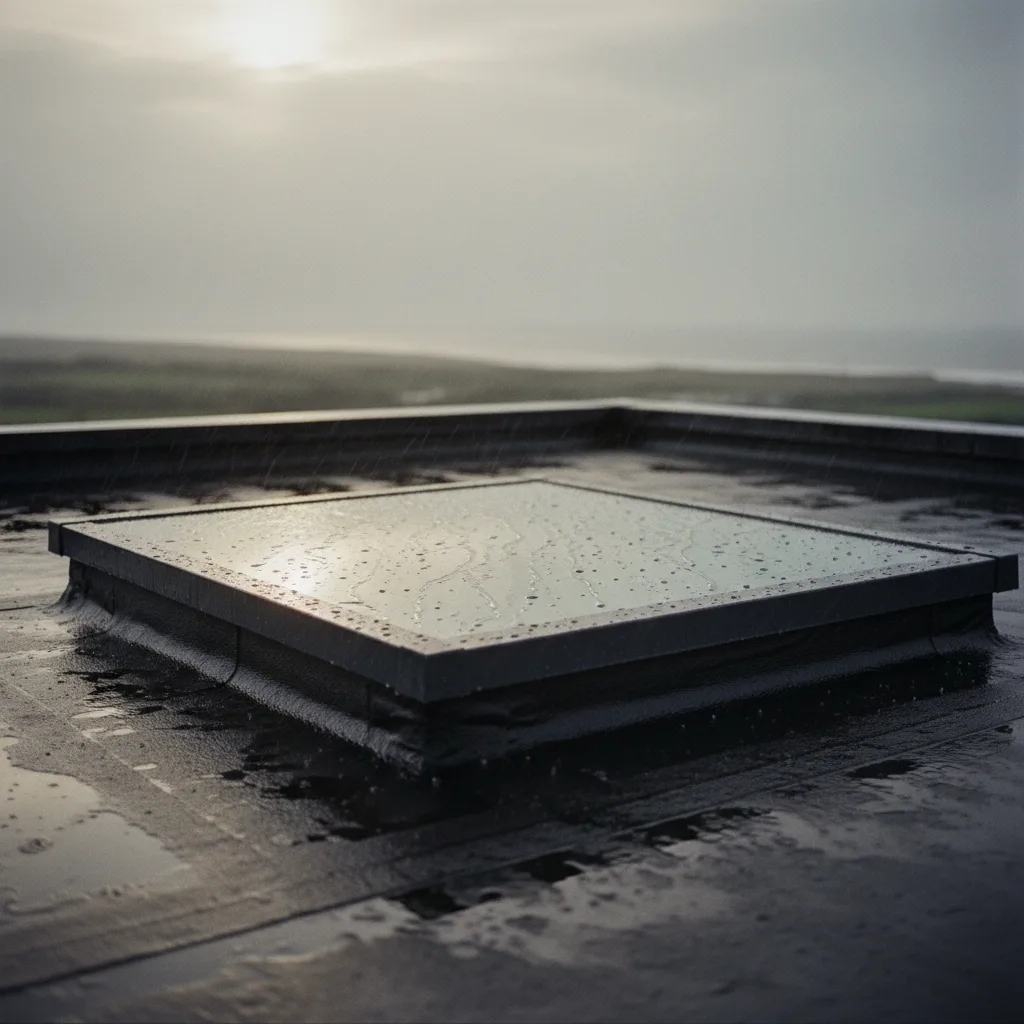
Coatings, and the one that chalks
Standard architectural powder coating is a decent product doing an ordinary job. Put it on the spit and it chalks: the surface oxidises, the gloss goes flat, colour fades, and the finish loses the ability to shed what lands on it. The film is still there but it has stopped working as a barrier.
What answers it is not a different colour but a different system — a marine or coastal grade coating, over a pretreatment specified for the environment, with the polyester chemistry chosen for the exposure. It is available from every serious manufacturer, it is a specification line rather than an upgrade tier, and it has to be asked for at order stage because nobody supplies it by default.
Anodising is the alternative and behaves differently: the protection is grown into the surface rather than laid on it, so it does not chalk or blister, but it is thinner at edges and can be marked by alkaline cleaners. Both work at the coast when specified properly. Neither survives being cut into and left unsealed.
Gaskets are a consumable, and nobody says so
An opening rooflight seals by squeezing a gasket. That gasket spends its life compressed, in sunlight, in salt, and it ages in three ways at once: UV breaks down the polymer at the surface, chloride attacks anything reinforcing it, and compression set means the rubber gradually stops springing back.
EPDM handles UV and ozone well and is the usual choice. Silicone handles temperature extremes and holds its recovery longer, at a price. What matters more than which one is that neither is permanent, that a hardened gasket leaks at the corners first, and that the compression is adjustable on many units — a seal that has taken a set can often be brought back into contact before it needs replacing, if someone looks at it.
Sandbanks, Studland and Mudeford are a category of their own. Water on both sides, no fetch break on the prevailing south-westerly, and spray carried well inland by wind rather than by proximity. A roof there is not simply a coastal roof with a bit more salt on it. It is the most aggressive exposure in the service area, and on it the open sash is also acting as a sail — so the hinge is carrying wind load while its own knuckles are the part corroding fastest.
Put the mechanism on the warm side where you can
The most effective corrosion measure costs nothing: keep the drive inside. An actuator mounted on the room side of the frame lives in warm, dry, clean air and only its working end crosses the weather line. An externally mounted drive lives in the atmosphere full time.
Not every unit allows it, and on a flat rooflight with a top-opening leaf the geometry sometimes decides for you. But it is the first question worth asking of a coastal specification, ahead of IP ratings and ahead of grades, because a component that never meets the salt does not need to resist it.
The rinse regime, and why a pressure washer makes it worse
- Fresh water, low pressure, quarterly. On the spit, after any serious blow as well. The purpose is to dissolve and carry chloride away, so volume matters more than force.
- Hinges and the drive first. These are the parts in the queue above. The glass is the least urgent thing on the roof.
- Wipe the sensor pad by hand. Soft cloth, fresh water, no solvent. A rinsed pad that is still filmed with salt is still going to read wet.
- Dry lubricant on the hinges annually. PTFE rather than oil — oil holds grit and salt against the metal and makes a grinding paste of it.
- Check the gasket in daylight with the sash shut. Look along the seal line for gaps, hardening and corner splits.
- Never a pressure washer. It drives salt water past seals designed to shed rain, strips coating from cut edges, and forces water into a drive housing that an IP rating never promised to keep out under a jet.
Ten minutes, four times a year, with a hose. That is the whole maintenance regime for a coastal opening skylight, and it is worth more than any single line on the specification.
Where this specification is right, and where it is an overcharge
On the spit: marine-grade coating, A4 fixings, isolated dissimilar-metal joints, a sealed or internally mounted drive, quarterly rinsing, wind input and restricted travel. Around the harbour and the Quay, at Hamworthy, Lower Parkstone and Upton, the salt is real but the south-westerly has been broken by land first — coastal coating and A4 on exposed fixings, with the rest to ordinary standards.
Inland at Broadstone, Creekmoor, Canford Heath, Wimborne or Ferndown, none of it is needed. Standard coating, standard fixings, an annual rinse because everything benefits from one. Anyone quoting marine hardware for a rooflight on the heathland edge is either selling from a single price list or hoping you will not ask, and we would rather name the zone on your quotation and leave the coastal lines off it. Ring 01202 923272 and we will tell you which zone your address falls in before anyone visits.
Related reading
Are electric rooflights noisy when they open?
No. A correctly installed unit makes a low hum for the twenty or thirty seconds it is moving and is…
Cable routing through a warm deck without breaching the vapour layer
The electrical side of getting power to an actuator is a settled matter, and it is set out on wiring…
Can a fixed rooflight be upgraded to an opening one?
Almost always this turns out to be a replacement rather than an upgrade, because a fixed rooflight has no hinge,…
Can a rooflight be set to close automatically at night?
Yes. A timed close is the most useful automation an opening rooflight can have, and unlike most of them it…
Can a smoke vent rooflight be used for everyday ventilation?
Technically, often yes — many certified automatic opening vents include a comfort ventilation mode, and it works. Practically, it is…
Can an electric rooflight be controlled from a phone?
Yes — either through a gateway that bridges the rooflight controller onto your home network, or through a manufacturer’s own…