Twenty year old units and the moment replacement beats repair
Age tells you which generation of glazing you have, but the repair or replace decision turns on how many components have failed and whether parts still exist.
A rooflight does not have an expiry date printed on it, and a firm that tells you twenty years is the number has decided something before looking at your roof. Age is evidence. It is good evidence, because it tells you which generation of glazing you are dealing with and what parts are likely to exist. It is not a verdict, and plenty of twenty-year-old units on Poole roofs are worth repairing while plenty of twelve-year-old ones are not.
What follows is the way we actually decide, set out so you can apply it yourself before anyone comes out.
The four questions that settle it
- What has failed? One component, or several? A misted unit in a sound frame on a sound kerb is one failure. A misted unit in a corroding frame on an uninsulated upstand is three, and three failures do not get repaired one at a time.
- Can the failed component be obtained? Glass can always be made. Gaskets, beads and opening gear for a discontinued system frequently cannot, and a unit whose parts have gone is a unit whose next fault is terminal.
- Will the repair last as long as the rest of the assembly? New glass in a frame with five years left in it is money spent twice.
- Is the thing worth keeping on its merits? A 1990s skylight that has been re-glazed is still a 1990s skylight: same frame, same thermal bridge, same opening, same look.
If the answers are one, yes, yes and yes, repair. If more than one of them turns, the arithmetic has usually already gone the other way.
What a twenty-year-old unit is actually made of
People imagine the difference between an old rooflight and a new one is a matter of degree. It is closer to a difference in kind, because several things changed at once.
| Element | Typical late 1990s or early 2000s | What a current unit does |
|---|---|---|
| Cavity fill | Air, in most units | Argon as standard, krypton where the cavity has to be narrow |
| Coating | Often none, or an early hard coat | Soft-coat low emissivity, with solar control where the aspect needs it |
| Spacer | Plain aluminium, conducting heat straight round the edge | Warm edge, which lifts the temperature of the perimeter glass and reduces edge condensation |
| Secondary seal | Polysulphide, frequently a window make-up laid flat | Silicone on overhead glazing, because it is stable under ultraviolet |
| Frame thermal break | Modest, and sometimes absent on older aluminium | Polyamide break sized for the assembly, which is what stops the internal face dewing |
| Inner pane | Toughened, or in some cases annealed | Laminated inner as the norm overhead, so a broken pane stays in the opening |
That last row is a safety point rather than a comfort one, and it is the one we would raise even where everything else argues for a repair.
The second failure changes everything
There is a pattern we see often enough to warn about. A rooflight mists at eighteen years and the glass is replaced. Two winters later a gasket perishes and whistles in a south-westerly. Two years after that the fixings weep rust and the frame is found to be corroding under the coating. Each intervention was reasonable in isolation. Together they cost more than the replacement that was declined at the start, and the owner has lived with scaffold or access equipment three times instead of once.
The guard against this is not pessimism. It is inspecting the whole assembly at the first failure rather than only the part that is complained about. If the frame, gaskets and kerb are genuinely sound at eighteen years, a re-glaze is a good decision and we will recommend it. If two of the three are marginal, the second failure is not a risk, it is a schedule.
Repair is right more often than the trade admits
We would rather sell you a pane
A misted sealed unit is the most over-diagnosed fault on a roof. It looks like a dead skylight from the kitchen floor and is frequently one failed component in an otherwise healthy assembly. We see sound frames taken out every year because a cloudy pane was read as the end of the rooflight.
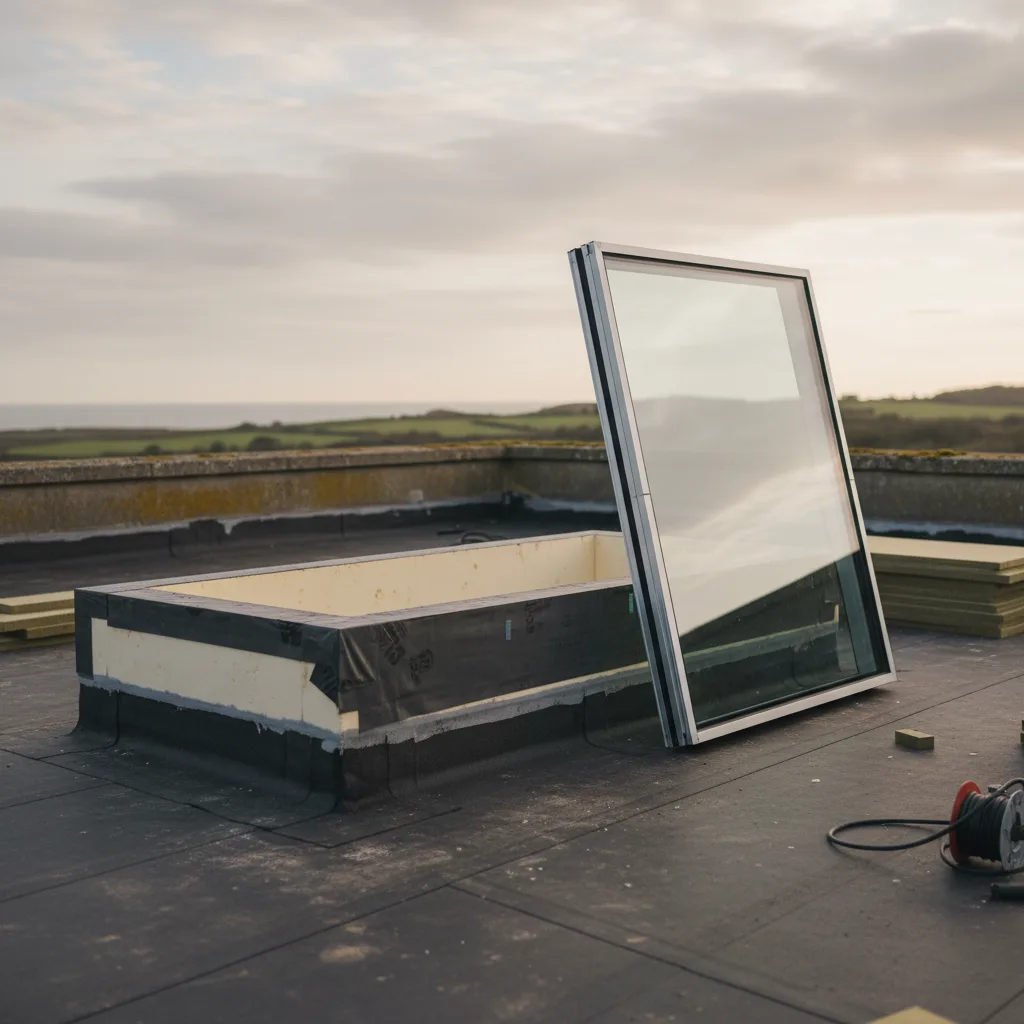
Where the frame is mechanically glazed, the rebate is deep enough to give a compliant unit proper edge cover, the thermal break is intact and the kerb is dry, square and insulated, the right answer is new glass and new seals. It is the smaller job and it is the one we will put forward.
When repair stops being honest
There are four situations where we will not offer a repair, and it is fairer to state them than to price the repair high enough to discourage it.
The first is a factory-bonded or frameless unit, where glass and carrier are a single assembly and there is nothing to re-glaze. The second is a rebate too shallow to give a current unit proper edge cover, since the only way to make it fit is to shorten the cover and guarantee an early failure. The third is corroding steel reinforcement or corroding fixings, where the visible finish is the least of it. The fourth is a polycarbonate dome, which cannot be re-glazed at all: the material itself has yellowed and crazed, and there is no component to swap.
What actually drives the cost of either route
We publish no prices, no ranges and no guide figures. Not as a negotiating position, but because a fixed written price after a survey is worth something and a number invented before one is worth nothing. What we will do is name the things that move it, so you can work out for yourself which way your job is likely to fall.
| Factor | Pushes towards repair | Pushes towards replacement |
|---|---|---|
| Access | Straightforward, one visit, no equipment hire | Difficult access makes a second visit expensive, so doing everything once wins |
| Number of units | A single failure among several sound units | Several units of the same age failing in sequence |
| Frame condition | Sound sections, intact break, obtainable gaskets | Corrosion, distortion, obsolete beading |
| Kerb condition | Square, dry, insulated, tall enough for the exposure | Low, bare timber, out of square, or the reason the unit failed |
| The covering around it | Years of life left, best left undisturbed | Near the end of its life, so the detail is coming out anyway |
| What you want from the room | The rooflight suits the space and always has | The opening was always too small, or the glass too hot in summer |
Counting the rest of the roof in
A misted unit is often the same age as the covering it sits in, because both went on in the same fortnight. That matters to the decision, because replacing a rooflight means cutting into the covering and dressing it up the upstand, and doing that to a felt roof with two years left in it is work that gets undone.
Where the covering is near the end, the sensible sequence is usually to do both as one piece of work, so the roof is opened once. Where the covering has years in it, the rooflight can be dealt with on its own and the detail remade properly. We install and replace glazing rather than covering whole roofs, so when we say the covering should come first we are arguing ourselves out of an earlier job, not into one.
Twenty years on the spit is not twenty years inland
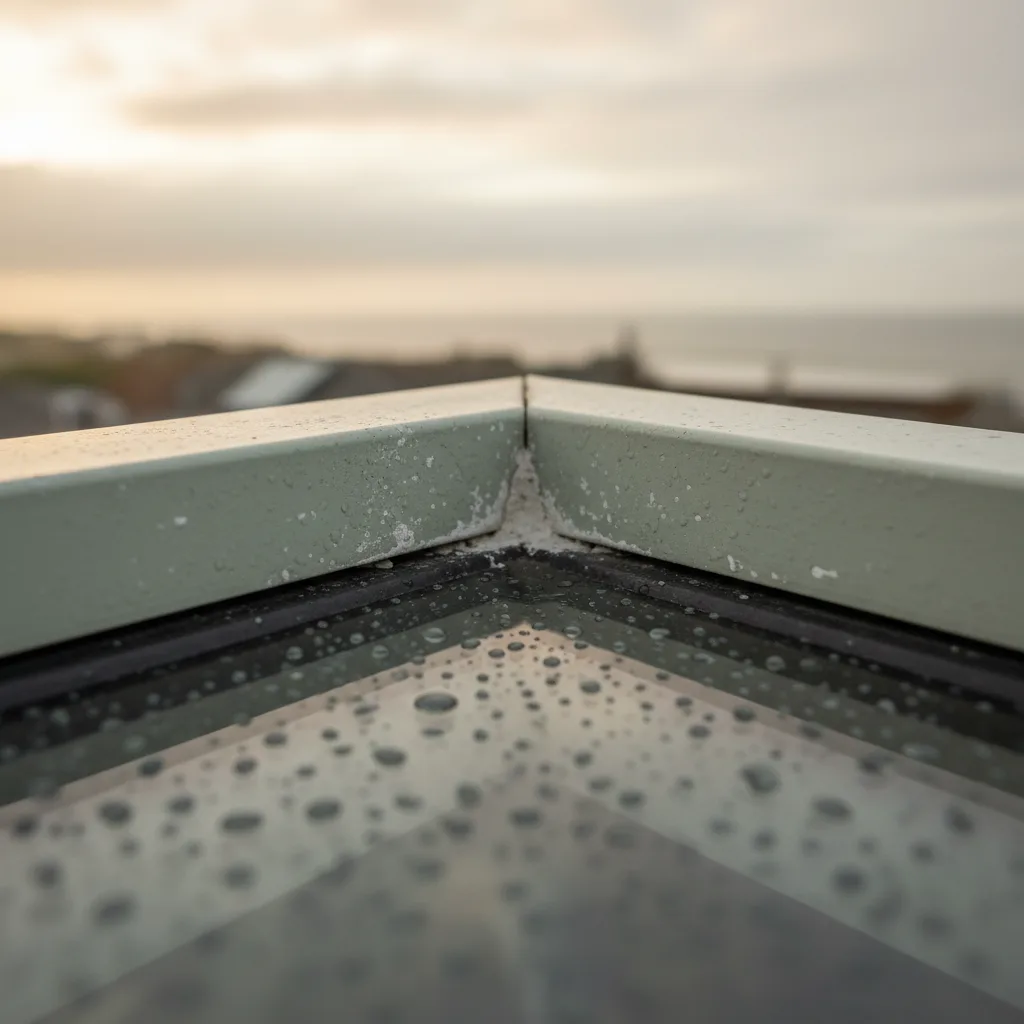
The same number of years does not mean the same amount of ageing. A unit that has spent two decades on the sand spit at Sandbanks, with open water on both sides and the prevailing south-westerly arriving unbroken, has taken more salt and more ultraviolet than an identical unit at Creekmoor four miles away. On the spit we expect chalked coatings and finished seals at twelve to fifteen years, and we expect the fixings to tell a worse story than the frame. On the heathland edge inland the same units commonly run their full life and the fault, when it comes, is simply age. Which of those your roof is on changes not only when to replace but what to put back, and it is the first thing we establish.
What we will not do
We will not manufacture urgency. A misted skylight is unattractive and it is costing you a little in heat; it is not a leak and it is not a hazard, and if the honest answer is that it can wait until spring, that is the answer you will get. Nor will we re-glaze a frame we have just told you is failing and then put a guarantee over the result. Our ten-year workmanship guarantee covers our own work, is given directly by us and is not insurance backed, and it cannot be stretched over somebody else’s 1998 upstand.
How we put it to you
After the survey you get one written document with the repair route and the replacement route priced separately, the condition of the frame, kerb and covering recorded with measurements rather than adjectives, the Building Regulations position for each route stated plainly, and any carpentry or roof repair shown as its own line so you can decline it. If the right answer is a sealed unit rather than a new rooflight, the price falls accordingly and we say so. To talk it through before booking anything, ring 01202 923272.
Related reading
Are 1990s rooflights on Poole extensions worth replacing now?
In most cases yes, and usually not for the reason people expect. A 1990s unit that has misted is finished…
Can a leaking rooflight be resealed instead of replaced?
Sometimes, where the leak is at a gasket, a termination or a joint that can genuinely be renewed. But the…
Can a misted rooflight be repaired?
Sometimes, but not in the way most people mean. The misting itself cannot be cured, because the fault is inside…
Can a misted unit be replaced with a larger one?
Yes, and it is often worth doing while the roof is open. But be clear what you are agreeing to:…
Can a rooflight be replaced in one day?
The fitting usually is, yes. One rooflight, on a roof that can be reached, onto a kerb that turns out…
Can an old dome rooflight be swapped for flat glass?
Yes, and it is one of the replacements people are most pleased with afterwards. The work is usually straightforward, because…