Salt off the harbour and UV: what ages a rooflight seal fastest
Ultraviolet attacks the sealant, salt attacks the metals holding it in place, and standing water and thermal cycling finish the job, in proportions set by exposure.
Four things age a rooflight seal, and they are not equally guilty. Ultraviolet does the most damage to the sealant itself; salt does its damage to everything holding the assembly together; standing water and thermal cycling finish what the other two start. Which of them dominates depends on where in Poole the roof is, and the gap between the spit and the heathland edge is wider than most people expect from four miles.
The four agents, ranked
| Agent | What it attacks | How you see it | What answers it |
|---|---|---|---|
| Ultraviolet | The secondary seal, and the resin in a powder coating | Misting at eight to twelve years; a finish gone matt then chalky | Silicone secondary seal and adequate edge cover; a coating grade rated for the exposure |
| Airborne salt | Fixings, clips, steel reinforcement, coating adhesion at cut edges | Rust weeping from fixing heads, blistering at corners and cut edges | A4 austenitic stainless fixings, marine pre-treatment, no dissimilar metals in contact |
| Standing water | The perimeter seal at the low edge, and the drainage of the rebate | Misting that starts as a band along one edge rather than at a corner | A genuine fall, clear drainage slots, deeper edge cover |
| Thermal cycling | The bond between sealant and glass, through sheer repetition | Nothing, until the day it shows as misting | Correct setting blocks, an unrestrained unit, and a make-up sized for overhead use |
Ultraviolet is first and it is not close
A vertical window sees the sun at a shallow angle for part of the day and has its edges hidden in a deep frame. A rooflight faces the sky. Between May and August the perimeter of an overhead unit in Dorset takes something close to the maximum ultraviolet dose available at this latitude, every clear day, for months.
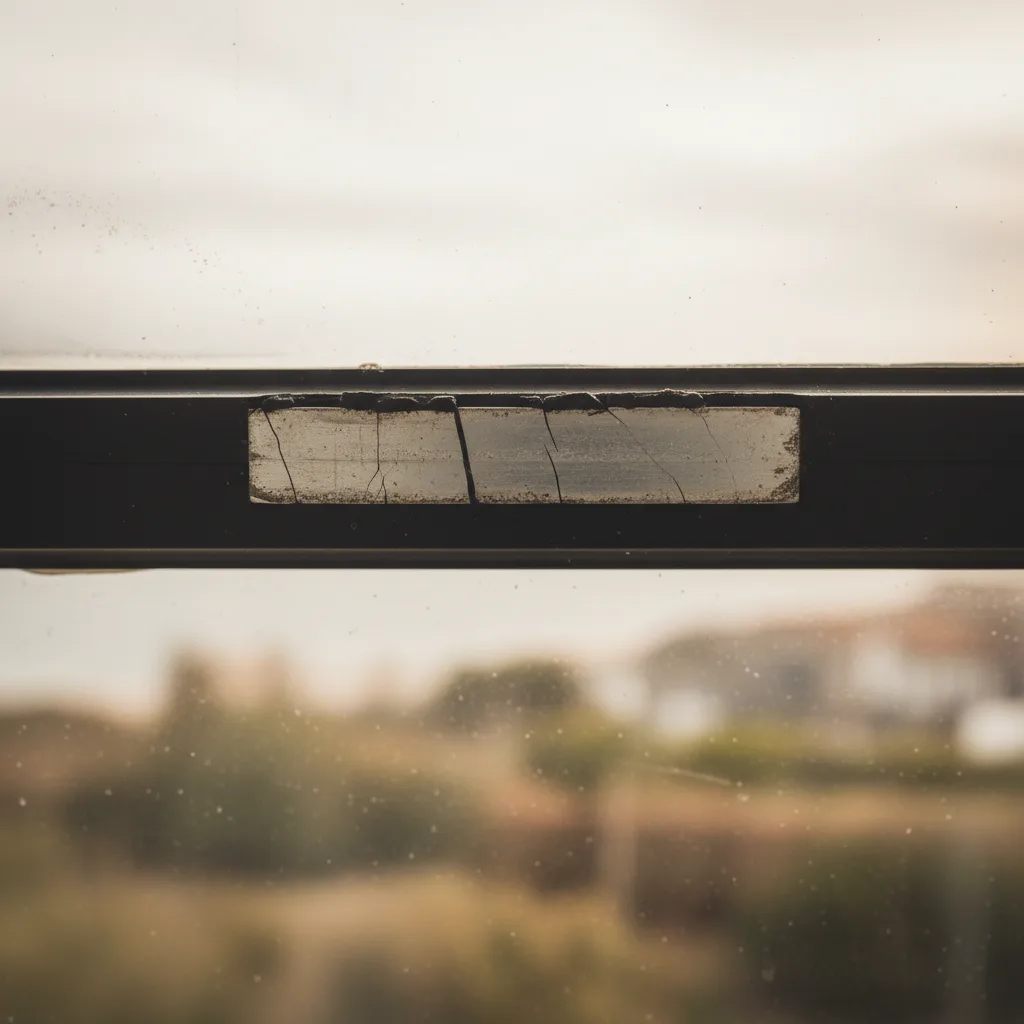
Polysulphide, the usual secondary sealant on volume-made window units, does not tolerate that. It hardens, loses elasticity, and eventually cracks, and once the secondary seal has gone brittle the primary seal is left carrying loads it was never designed for. Silicone is stable under ultraviolet, which is why it is the correct secondary seal for overhead and structurally bonded glazing. A window make-up laid flat is the most common single reason a skylight in Poole mists at ten or twelve years rather than twenty-five, and it has nothing to do with the sea.
The second defence is geometry. Edge cover, the depth of frame overlapping the perimeter seal, exists partly to shade it. Slim frames look elegant and sometimes buy that elegance with edge cover, which is a design decision the owner never sees and lives with for a decade.
Salt does not attack the sealant, it attacks what holds it there
This distinction is worth being precise about, because it changes what the specification has to answer. Chloride in the air does very little directly to a cured silicone or polysulphide seal. What it does is corrode metals, and a rooflight is held together, held down and held closed by metals.
Chloride ions break down the passive oxide film on stainless steel, which is why lower grades pit rather than rusting evenly. On aluminium they exploit any break in the anodised layer or the powder coating, particularly at drilled holes and cut edges where the factory treatment was interrupted. Where two different metals are in contact and salt-laden moisture bridges them, galvanic corrosion does the rest, and the less noble metal goes first.
The visible result is almost always the same: a rust streak running down the frame from a fixing head. The frame itself is generally still sound aluminium under a tired finish. The fixing is not, and neither is any steel reinforcement inside a composite section.
Standing water at the low edge
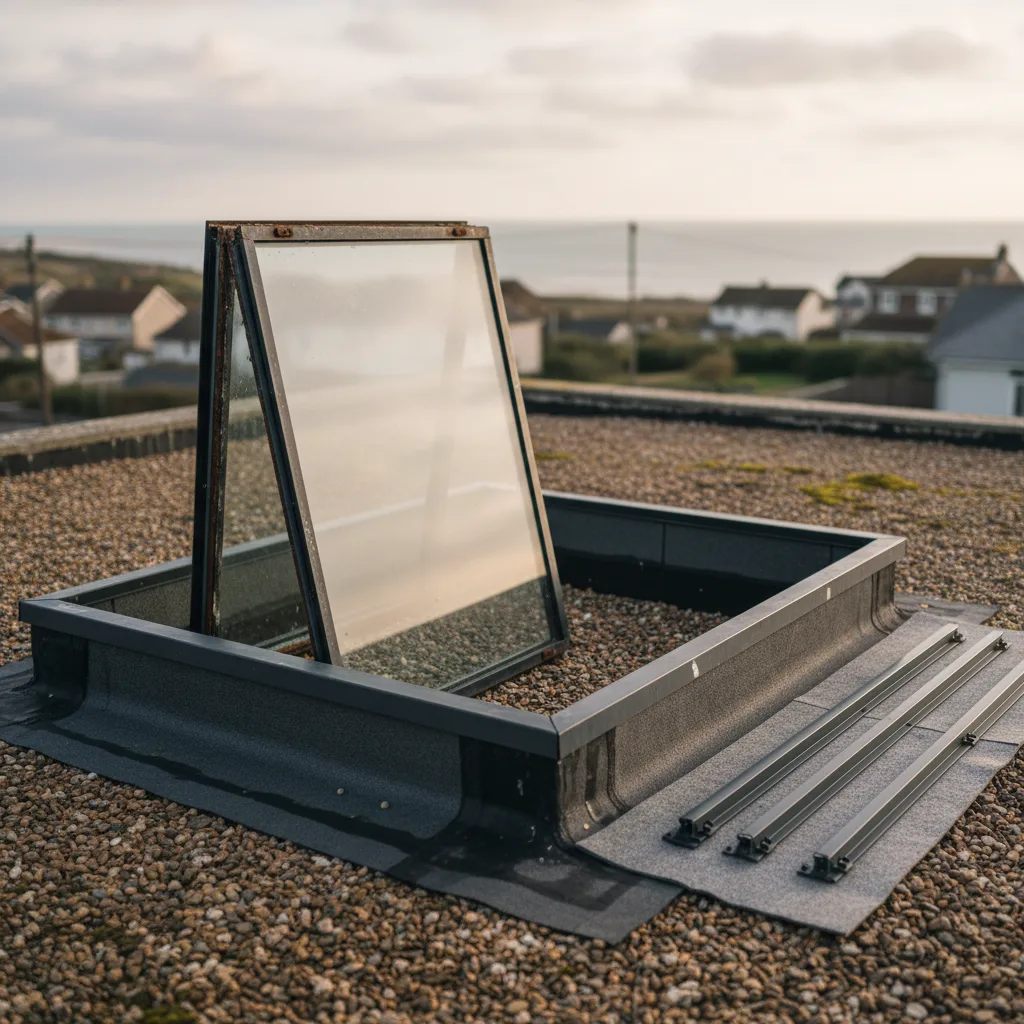
A flat rooflight that is genuinely flat is a design fault, not a style. Overhead glazing needs a fall so that water runs off rather than sitting at the perimeter. Where there is no fall, a film of water stands along the low edge of the glass, directly over the part of the sealed unit that must stay dry, for days after rain and all winter where a pine canopy keeps the sun off it. That is why misting so often begins as a band along one edge rather than as a bloom in a corner. The fall is designed into the kerb and the deck beneath, not into the glass, which is why a replacement is the moment to fix it.
Thermal cycling: the number of movements in a year
Every day the cavity gas expands and contracts, and the panes bow out and back. Every night a clear sky pulls the outer pane below air temperature. Add barometric swings as low-pressure systems cross the Channel, and the seals on an overhead unit make several hundred meaningful movements a year, and tens of thousands across a life.
Nothing about this is visible and nothing about it can be maintained. What can be controlled is whether the unit is free to make those movements. Setting blocks carry the weight of the glass at specific points; if they have migrated or compressed, the unit bears on the frame and the perimeter seal takes load it should never see. A unit pinched by a bead screwed down too hard, or bedded solidly in sealant with no allowance for movement, fails early for reasons nobody attributes to the fitter afterwards.
Chalking: what is actually happening to the powder coat
Chalking is not dirt and it does not wash off. Ultraviolet breaks down the resin binder at the surface of the coating, leaving pigment particles loose on the face. The finish goes matt, then powdery, and a wiped hand comes away coloured. Underneath, the aluminium is usually still perfectly sound.
| Finish approach | Where it belongs | What to expect of it |
|---|---|---|
| Standard architectural polyester powder | Sheltered and inland roofs, the heathland edge, suburban Poole | Fades gradually. Perfectly adequate where salt is not in the air |
| Enhanced durability powder | Coastal and harbour-edge roofs with some shelter | Holds gloss and colour considerably longer under the same ultraviolet load |
| Marine pre-treatment beneath the coating | The spit, the harbour mouth, anywhere with no fetch break | Addresses adhesion and under-film corrosion, which is the failure that actually matters |
| No upgrade at all | Broadstone, Creekmoor, Canford Heath and similar | The right answer. Marine specification inland is money spent on a threat that is not present |
A chalked frame is a decision about appearance. Rust under the fixings is a decision about whether the thing is still held on. They get confused constantly, and only one of them is urgent.
Debris under the Branksome pines
Canford Cliffs and Branksome Park sit under a mature pine canopy that tree preservation orders make permanent rather than seasonal. Needles, resin and small cones gather at the low edge of a flat rooflight and in the drainage channels round a lantern. They hold water against the edge cover, they keep the perimeter wet through a whole winter, and resin binds them into a mat that does not blow away.
It is the one part of the service area where units fail early with essentially no salt involved. The answer there is not a marine specification. It is deeper edge cover, a checked fall, drainage that can actually be cleared, and somebody clearing it.
Which agent dominates where
| Zone | Dominant ageing agent | What we expect to find on a twenty-year-old unit |
|---|---|---|
| Spit and harbour mouth | Salt first, ultraviolet close behind | Fixings gone before the frame; coating chalked; seals finished well before twenty |
| Harbour edge | Ultraviolet, with salt present but broken by land | Coating often sound; gaskets and kerb detail the usual faults |
| Wooded cliff | Standing water and debris | Misting beginning as a band at the low edge; moss and resin against the edge cover |
| Suburban Poole | Ultraviolet and thermal cycling | Ordinary end-of-life misting, coating faded rather than chalked |
| Inland heathland edge | Thermal cycling alone | Units that ran a full life. The fault is age, not the air |
What maintenance genuinely changes
Very little of this can be maintained, and it would be dishonest to imply otherwise. The sealed unit cannot be serviced and the coating cannot be restored once it has chalked. Two things can be maintained and both matter more than they sound: keeping the perimeter and the drainage clear so water is not standing against the edge seal, and rinsing salt off exposed frames and fixings on the most exposed roofs, which slows chloride attack considerably for the cost of a hose and twenty minutes.
That is the whole maintenance regime. It is not a service contract and we are not going to sell you one.
Naming your zone before we specify anything
The specification follows the exposure, which means the first thing a survey establishes is which of those zones your roof sits in, and we will say so in writing. On the spit that means marine pre-treatment, A4 stainless throughout and a silicone secondary seal. Four miles inland it means a standard coating and standard fixings, and telling you that the marine upgrade you have been quoted elsewhere is not buying you anything. The price is fixed in writing after the survey, and our installation work carries a ten-year workmanship guarantee given directly by us, which is not insurance backed. Ring 01202 923272 with your address and we will name the zone over the phone.
Related reading
Are 1990s rooflights on Poole extensions worth replacing now?
In most cases yes, and usually not for the reason people expect. A 1990s unit that has misted is finished…
Can a leaking rooflight be resealed instead of replaced?
Sometimes, where the leak is at a gasket, a termination or a joint that can genuinely be renewed. But the…
Can a misted rooflight be repaired?
Sometimes, but not in the way most people mean. The misting itself cannot be cured, because the fault is inside…
Can a misted unit be replaced with a larger one?
Yes, and it is often worth doing while the roof is open. But be clear what you are agreeing to:…
Can a rooflight be replaced in one day?
The fitting usually is, yes. One rooflight, on a roof that can be reached, onto a kerb that turns out…
Can an old dome rooflight be swapped for flat glass?
Yes, and it is one of the replacements people are most pleased with afterwards. The work is usually straightforward, because…