Polycarbonate domes on Poole estate extensions after fifteen summers
Yellowing, crazing, cell fouling and brittleness are four separate failures in a plastic dome, and only one of them is about how it looks.
A polycarbonate dome does not fail the way a sealed glass unit fails. Nothing mists, because there is usually nothing sealed. What happens instead is that the material itself changes: it yellows, it goes brittle, the ultraviolet layer on the outside erodes, and the cells inside a twinwall sheet slowly fill with dirt and condensation that nobody can reach.
Fifteen summers is roughly when all four of those become visible at once on a south-facing Dorset roof. This guide is about what is actually happening to the plastic, how to judge a dome without climbing on a roof it may no longer support, and what changes in the room if it is replaced with glass.
What a dome is actually made of
Three quite different products get called a dome, and they age at different speeds.
| Material | How to recognise it | How it ages |
|---|---|---|
| Acrylic, single skin | A smooth clear or opal shell, often quite thin, usually the oldest domes | Holds colour well, goes brittle, and cracks rather than bends when something lands on it |
| Acrylic, double skin | Two shells with an air gap between them, visible at the flange | As above, plus dirt and moisture in the gap that cannot be cleaned out |
| Polycarbonate, multiwall | Visible ribs or cells when you look up at it, often rectangular rather than domed | Tougher for longer, then yellows noticeably, and the cells foul from the inside |
Acrylic and polycarbonate are often used interchangeably in conversation and they are not the same material at all. Polycarbonate takes an impact that shatters acrylic. Acrylic keeps its clarity longer than untreated polycarbonate. Most domes on Poole estate extensions are one of the first two; most 1990s and later flat-profile units are the third.
Fifteen summers of ultraviolet
Polycarbonate on its own has no real ultraviolet resistance. What protects it is a co-extruded surface layer applied during manufacture, a few microns thick, bonded to the sheet rather than sprayed on. That layer is the whole defence, and it is consumed rather than permanent. Once it erodes, the sheet beneath starts yellowing and then chalking, and no cleaning or coating brings it back.
Two things shorten that clock. One is fitting the sheet the wrong way up, which puts the protected face inside the building where it does nothing, and it is more common on site-fitted replacements than anyone would like. The other is a south-facing roof with no shading, which on this coast also means reflected light off water and pale render. A dome over a kitchen at Creekmoor and the identical dome under the pine canopy at Branksome Park will not be in the same condition at fifteen years, and the shaded one usually wins.
The five failures, and which one you have
| Symptom | What it is | Whether anything can be done |
|---|---|---|
| Yellowing | The ultraviolet layer is spent and the sheet itself is degrading | No. It is the material, not a film of dirt on it |
| Chalky white surface | Surface erosion, the stage after yellowing, often felt before it is seen | No, and washing it accelerates the erosion |
| Fine crazing | A network of hairline cracks, usually starting near fixings or a stress point | No. Structurally it is the end |
| Cells fouled | Dirt, algae or condensation inside a multiwall sheet | Rarely. Nothing reaches inside a sealed cell, and flushing pushes it further in |
| Flange distortion | The perimeter has lifted, cupped or pulled over elongated fixing holes | Sometimes refixed as a holding measure, but it is a symptom of a tired assembly |
The useful distinction is between the first four, which are the material finishing its life, and the fifth, which is a fitting problem that can be argued about. Only crazing and flange failure affect whether the thing is safe. The rest affect what the room looks like.
Testing one from underneath
You can learn most of what matters standing in the room below, and that is the right place to do it, because a fifteen-year-old plastic dome is not something to lean on.
- Look up at midday on a bright day. A dome that has gone yellow reads clearly against a white ceiling; against a grey sky through the glass it does not.
- Hold a sheet of white paper up near the opening and compare. Fifteen years of drift is gradual enough that nobody notices it happening.
- Look for the pattern of a multiwall sheet. If you can see the cell lines and some of them are darker than others, they are fouled.
- Check the perimeter from inside for daylight, staining on the reveal, or a gap that opens and closes with the wind.
- Look at the corners of the dome from below for the beginning of crazing, which shows first as a faint frosted patch rather than as cracks.
- Photograph it from directly underneath and from the door of the room, because the two together show both the material and the light it is actually giving.
Why crazing ends the conversation
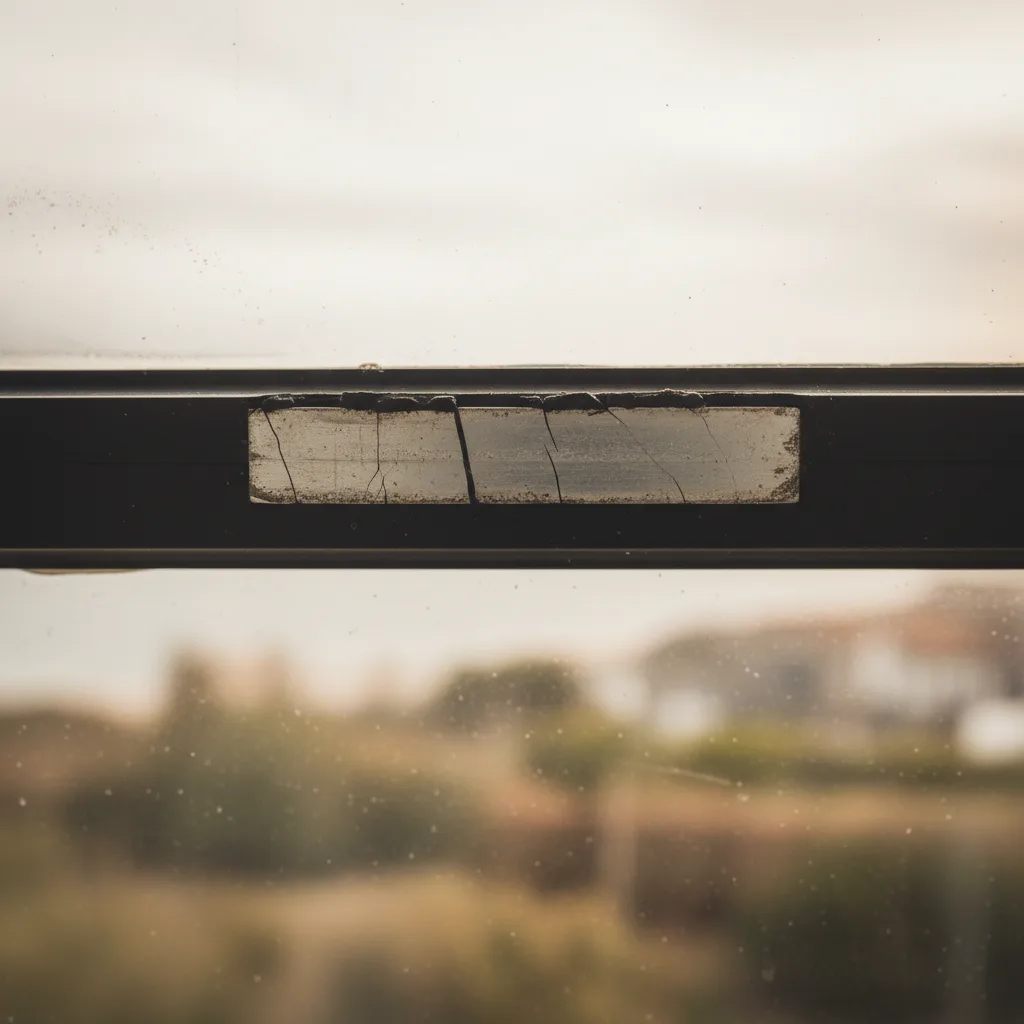
Crazing is not cosmetic. It is the material relieving stress by cracking at a microscopic scale, and it propagates. A crazed acrylic dome has lost the impact resistance it had when new, and the failure mode is not a bend and a leak, it is a piece giving way. That matters most where a dome sits over a walkway, a doorway, or a room that gets used by children, and it matters enormously to anyone who has to go on the roof afterwards.
Nobody should be standing near it
Fragile roof, not a surface
Treat every plastic dome as fragile, whatever its age. A dome is not a working surface and was never designed as one, and an aged one gives way without warning and without bending first. Falls through fragile roof materials are among the most serious accidents in the building trades, and a domestic garage or extension roof is exactly where they happen.
What that means in practice. Nobody works next to an unprotected dome without either covering it or providing protection at the opening, and that applies to a homeowner clearing leaves as much as it applies to us. If you are minded to go up and look at yours, the honest advice is not to. Send photographs instead.
What a dome was actually good at
It is worth being fair to the product, because domes are frequently disparaged by people selling something else. A dome sheds water from its shape in every direction, so it tolerates a kerb that is out of level, which is why so many of them survived on roofs that were never truly flat. It is light, so it needs no structural thought. It self-cleans reasonably well in rain because of the curve. And it throws light sideways as well as down, which is why a small dome can light a windowless bathroom better than a flat unit of the same size.
The reasons to replace one are that the material has a finite life, its thermal performance was poor even when new, and rain on a plastic shell over a bedroom or a kitchen is loud in a way that people stop noticing until it is gone.
The estate extensions this describes
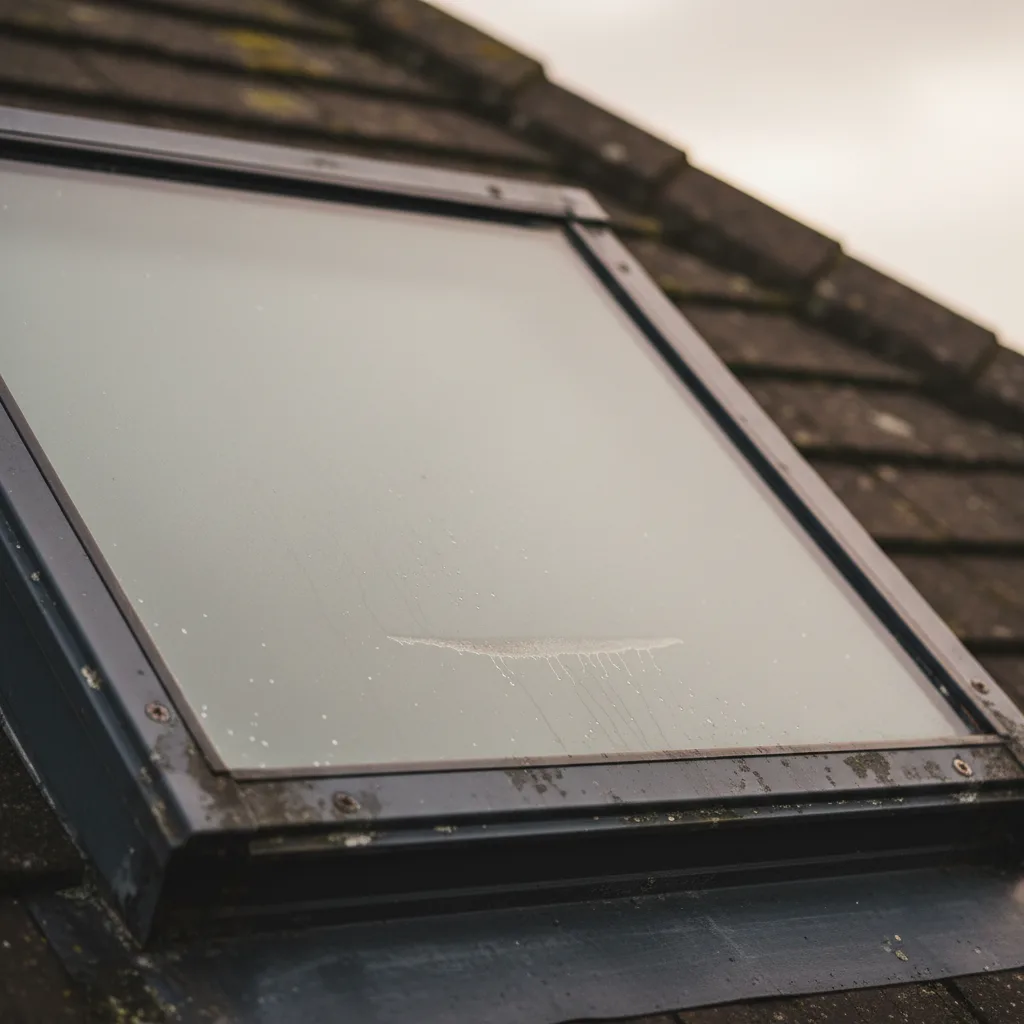
There is a recognisable Poole version of this roof. A single-storey rear or side extension built between the late 1970s and the mid 1990s, felt covered, with one dome over the kitchen or a bathroom on a site-built timber upstand. It is the standard arrangement across Canford Heath, Creekmoor, Broadstone, Alderney and the Turlin Moor side of Hamworthy, and because those estates were extended in waves, the domes come to the end of their lives in waves too. Inland on the heathland edge the limiting factor is usually the plastic itself. Nearer the water at Hamworthy, Lower Parkstone and Poole Quay the fixings, the flange and anything ferrous in the assembly get there first, because salt has been on them the whole time. Same dome, same age, two different failures and two different repairs.
What changes if glass goes in instead
Four things, and it is worth knowing which of them you actually care about. The light changes character: flat glass gives a cleaner, whiter light and a view of the sky, where a dome gives diffuse light and no view. The noise changes most of all, and it is the change people comment on first. The thermal performance improves substantially, because a plastic dome was never insulating in any meaningful sense. And the maintenance changes, because glass does not degrade in ultraviolet and will still be clear when the frame around it is the oldest part.
What does not automatically change is the kerb it all sits on. A flat skylight is far less forgiving of an upstand that has drifted out of level than a dome ever was, and that is the single most common reason a dome-to-glass swap needs more work than the glazing alone.
What we settle before quoting
Which material the existing dome is, how it is fixed, whether the upstand is square and sound, what the covering is and how it was terminated, the exposure zone the address sits in, and how the roof is reached. Cost follows from those, and from the specification of the replacement rooflight; it does not follow from a figure anyone can give you over the phone, and we will not pretend otherwise. The survey produces one fixed written price with the glazing and any kerb or roofing work listed separately.
Our installation work carries a ten-year workmanship guarantee, given directly by us and not insurance backed. If your dome has gone yellow, milky or noisy, ring 01202 923272 or send a photograph taken from directly beneath it to 447880284133.
Related reading
Are 1990s rooflights on Poole extensions worth replacing now?
In most cases yes, and usually not for the reason people expect. A 1990s unit that has misted is finished…
Can a leaking rooflight be resealed instead of replaced?
Sometimes, where the leak is at a gasket, a termination or a joint that can genuinely be renewed. But the…
Can a misted rooflight be repaired?
Sometimes, but not in the way most people mean. The misting itself cannot be cured, because the fault is inside…
Can a misted unit be replaced with a larger one?
Yes, and it is often worth doing while the roof is open. But be clear what you are agreeing to:…
Can a rooflight be replaced in one day?
The fitting usually is, yes. One rooflight, on a roof that can be reached, onto a kerb that turns out…
Can an old dome rooflight be swapped for flat glass?
Yes, and it is one of the replacements people are most pleased with afterwards. The work is usually straightforward, because…