Changing the glass without changing the frame, and when that works
Whether the glass can be changed without the frame depends on how the frame holds the glass, how deep the rebate is and whether the frame itself is still sound.
Whether you can change the glass and keep the frame comes down to one thing: how the frame holds the glass. A mechanically glazed rooflight can usually be re-glazed on the roof in a morning. A factory-bonded one cannot be re-glazed at all, on any roof, by anybody.
This is the single most useful distinction in the whole subject of failed units, and it is invisible from the ground. It is also the difference between a modest piece of work and a full replacement, so it is worth establishing before anyone gives you a price.
Four ways a rooflight holds its glass
| Glazing method | How to recognise it | Re-glaze in place? | What it needs |
|---|---|---|---|
| Bead glazed | A removable trim or capping runs round the outside of the glass, usually screwed or clipped | Yes, in most cases | Beads and gaskets that are still made, or salvageable |
| Gasket glazed | A wedge or bubble gasket pressed into a groove holds the pane against the rebate | Yes, and it is the kindest system to work on | A matching gasket profile, which is the part that goes obsolete |
| Wet glazed or capped and sealed | Continuous silicone line round the perimeter with no removable trim | Sometimes, with care | The old sealant cut out cleanly and the rebate prepared properly, which is slow work |
| Factory bonded or frameless | Glass appears to float, no visible frame from outside, a slim carrier hidden under the glass edge | No | Replacement as a complete assembly. Glass and carrier are one item |
The frameless flat rooflight that has been fashionable for the last fifteen years is the bonded type, and it is the reason a lot of otherwise sensible advice about “just changing the glass” is wrong. The unit is silicone-bonded to an aluminium carrier in factory conditions, cured under controlled temperature and humidity, and it is a structural bond rather than a weather seal. There is no honest way to reproduce that on a roof in Hamworthy in November. The good news is that such a unit lifts off a sound kerb and a new one goes back down on it, which is still a one-day job with no carpentry.
Edge cover: the measurement that decides everything
Edge cover is the depth of frame that overlaps the perimeter of the sealed unit. Its job is to keep ultraviolet off the secondary seal and to hold the unit mechanically. Too little, and the new glass fails early for the same reason the old glass did.
The trap in re-glazing an old frame is that a modern unit is thicker than the one it replaces. A 1990s rooflight was typically glazed with a 20mm to 24mm make-up. A current unit with a low-emissivity coating, an argon fill and a warm-edge spacer usually wants 28mm or more, and a laminated inner pane adds to that again. Push a thicker unit into a rebate designed for a thinner one and something has to give: either the bead no longer closes, or somebody trims the edge cover to make it fit.
Slim make-ups, and what you trade for them
There is a legitimate answer to that, which is a slim unit: a make-up engineered to give respectable performance in a narrower overall thickness, usually by using a tighter cavity with a denser gas fill and a high-performance coating. On a sound frame this is a genuinely good outcome, because you keep the aluminium, the fixings, the flashing and the covering, and only the glass changes.
What a slim unit gives up
A narrower cavity is thermally less efficient than an optimum one, all else being equal, and the gap is made up with coatings and gas rather than geometry. That is a fair trade when the alternative is replacing a perfectly good frame. It stops being a fair trade when the slim unit is being used to avoid admitting that the frame is finished.
The test we apply: if a slim make-up gives full edge cover in the existing rebate and meets the U-value required of a replacement, it is the right answer. If it only works by shortening the edge cover, it is not, and we will give you the measurement rather than an opinion.
What has to be renewed at the same time
Re-glazing is not simply swapping a pane. Everything that was doing a job at that perimeter is the same age as the failed unit and should come out with it.
- Setting blocks. These carry the weight of the glass at specific points and stop it bearing on the frame. Old ones compress and migrate, and a badly supported unit fails at the corner.
- Gaskets and weather seals. Twenty-year-old EPDM has taken a permanent set and will not seal against a new pane, however clean the rebate looks.
- Drainage. Most glazed frames are drained and ventilated systems, with small slots that let incidental water out of the rebate. They block with dust, moss and pine debris, and a blocked rebate is a bath the new unit sits in.
- The rebate itself, cleaned back to sound material, degreased, and any corrosion treated before the new unit is set.
- Fixings that were disturbed, renewed in a grade that suits the exposure rather than whatever was in the bag.
- The external cap seal, run properly rather than smeared over the old one.
Skip those and the new glass will still be there in ten years, but the frame around it will have been leaking for eight.
Is the frame worth keeping at all
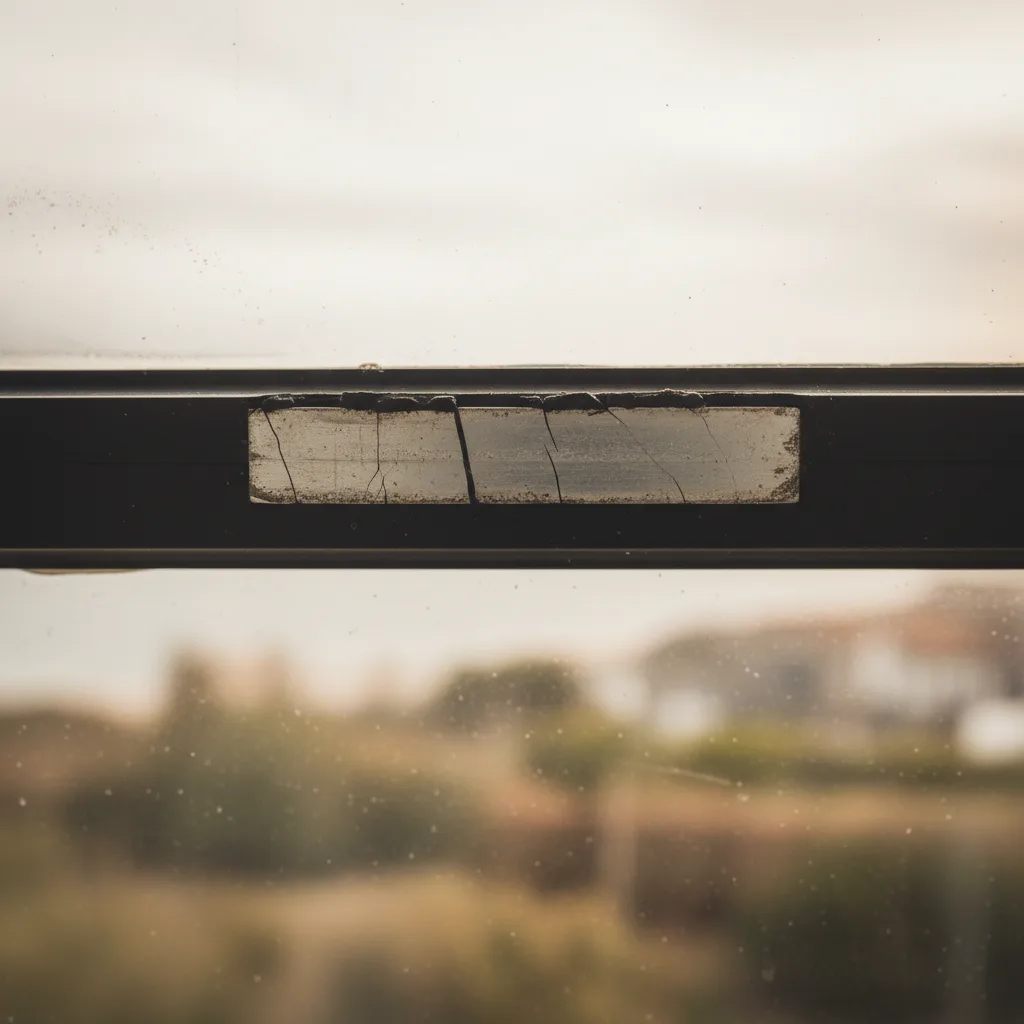
A frame can be mechanically glazed and still not be worth re-glazing. What we look at, in order: corrosion at the corners and under the fixing heads, because that is where water sits; whether the thermal break in an aluminium frame is intact, since a failed break puts the internal face below dew point and produces water that everyone reports as a leak; whether the frame has distorted, which shows up as a rebate depth that changes along its length; and whether the beads or gaskets are still obtainable in that profile.
On coastal roofs the corrosion question is usually the decider. Aluminium under a failed coating is normally still structurally sound, if unattractive. Steel reinforcement inside a composite frame, and steel fixings on a roof within reach of harbour air, is a different matter, and rust weeping from a fixing head is a statement about what else was specified the same day.
On the roof or on the ground
Where a frame is being re-glazed there are two ways to do it: work on the unit in position, or lift the whole frame off, re-glaze it at ground level and put it back. Working in position avoids disturbing the flashing and the covering, which is a real advantage on an old felt roof that will not forgive being handled. Taking it down gives a controlled surface, a clean rebate and better access to the drainage, and it is usually the better result where the covering is robust enough to allow it.
The decision belongs on site and depends mostly on what the covering is made of. We will tell you which we intend to do, and why, before the day.
The regulations position on a glass-only change
Controlled fitting, or repair
The rule. Replacing the whole rooflight is a controlled fitting under the Building Regulations in England. What goes back has to meet the current standard for a replacement, and the work is notifiable.
The exception. Replacing only the sealed unit inside a frame that stays exactly where it is is generally treated as a repair, and that duty does not bite in the same way.
This is not a loophole to aim for. A repair is only the right answer when the frame is genuinely sound, and we will not re-glaze a dying frame to keep paperwork simple. It is, though, the honest reason a glass-only change costs less, and we state in writing which of the two you are being quoted for.
What drives the price of a re-glaze
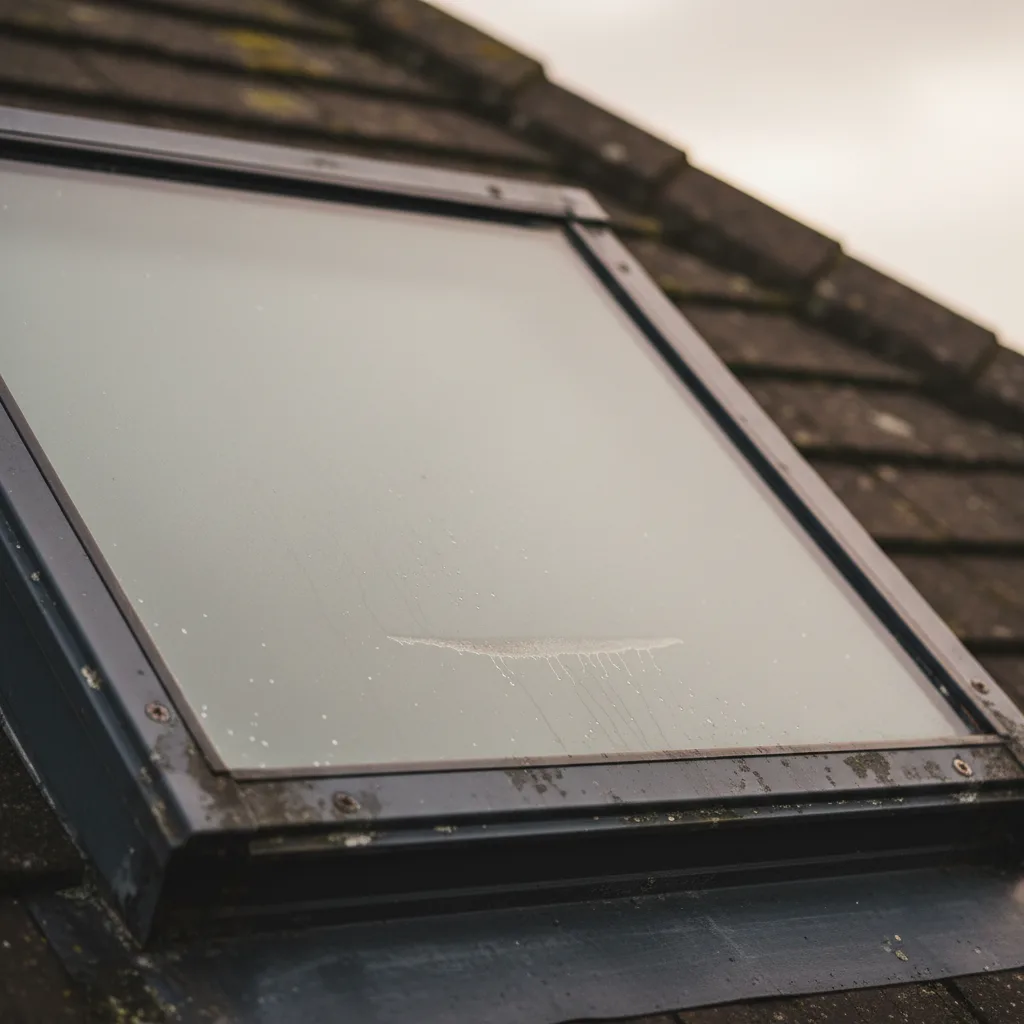
We publish no prices and no ranges, because a rooflight priced from a photograph is a guess that moves once the old unit is out. What we will set out plainly is what actually moves the figure, so you can see why two apparently similar jobs are not the same job.
| What drives it | Why it moves the figure |
|---|---|
| Unit size and weight | Decides whether two people can handle it or four are needed, and whether mechanical lifting is involved at all |
| Glazing method | A gasket-glazed frame gives the unit up quickly. Cutting out cured silicone from a wet-glazed rebate is slow, careful work |
| Glass make-up | A stock thickness, a slim engineered unit, laminated inner panes and solar-control coatings are all different products |
| Access | On a Quayside or Old Town roof with no rear access this is frequently the largest single item on the quote |
| Condition of the frame | Corrosion treatment, seized fixings and obsolete beading all add labour that cannot be seen from the ground |
| Making good | Whether the internal reveal and the roof covering are disturbed, and how far |
Anyone quoting a figure before seeing the frame is pricing a category, not your rooflight. Ours is fixed in writing after the survey.
Poole roofs where re-glazing is the likely answer
The aluminium survives, the glass does not. Across the suburban roofs at Parkstone, Penn Hill and Oakdale, and inland at Broadstone and Creekmoor, we expect to find powder-coated aluminium frames from the late 1990s and early 2000s whose coating has faded but whose sections are intact, glazed with beads or gaskets and carrying a misted unit. Those are re-glazing candidates and we will say so, even though it is the smaller job. On the spit at Sandbanks the same-age frame is more likely to have chalked to a matt bloom with rust weeping from the fixings, and there the frame is usually going with the glass — not because of the finish, but because of what the fixings and the reinforcement have been doing underneath it.
What the survey settles
We identify the glazing method, measure the rebate depth and the available edge cover, check the frame for corrosion and thermal break failure, confirm whether a compliant unit fits without shortening the cover, and price the glass-only route and the full replacement route separately so you can see the difference and decide. Our installation carries a ten-year workmanship guarantee, given directly by us and not insurance backed. If you would like to know whether your skylight is a re-glaze or a replacement, ring 01202 923272 and describe what runs round the outside of the glass.
Related reading
Are 1990s rooflights on Poole extensions worth replacing now?
In most cases yes, and usually not for the reason people expect. A 1990s unit that has misted is finished…
Can a leaking rooflight be resealed instead of replaced?
Sometimes, where the leak is at a gasket, a termination or a joint that can genuinely be renewed. But the…
Can a misted rooflight be repaired?
Sometimes, but not in the way most people mean. The misting itself cannot be cured, because the fault is inside…
Can a misted unit be replaced with a larger one?
Yes, and it is often worth doing while the roof is open. But be clear what you are agreeing to:…
Can a rooflight be replaced in one day?
The fitting usually is, yes. One rooflight, on a roof that can be reached, onto a kerb that turns out…
Can an old dome rooflight be swapped for flat glass?
Yes, and it is one of the replacements people are most pleased with afterwards. The work is usually straightforward, because…