Rooflight and Skylight Installation Milford on Sea
Rooflight and skylight installation in Milford on Sea, where the wind funnels through the Needles channel and the slope your unit sits on changes what it should cost.
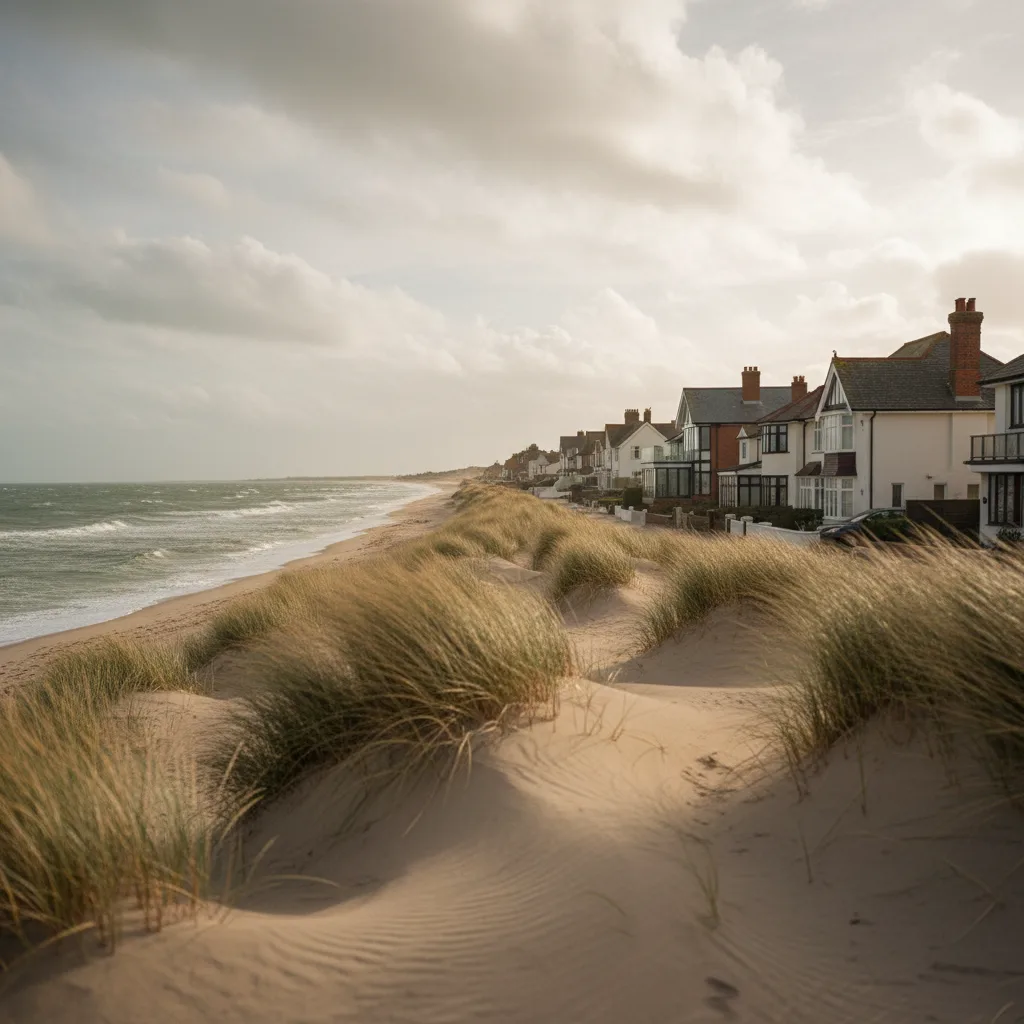
The wind here is funnelled, not just strong
Stand on the front at Milford on Sea and the Needles are close enough to count. That gap between the western tip of the Isle of Wight and Hurst Spit is the entrance to the Solent, and it does something to weather that an open coastline does not: it squeezes it. A south-westerly arriving off the Channel meets a narrowing channel and accelerates through it. The seafront here has the scars to prove it — the winter storms of 2014 took the beach huts off the front and rearranged a good deal of the shingle with them.
That is the difference between Milford and a merely coastal address a few miles inland. It is not only that salt reaches this village; it is that it arrives with force, along with shingle-borne grit in a real blow, and it keeps arriving because the shoreline is low and open and there is nothing to slow it down before it reaches the houses.
Exposure zone: exposed coast. Marine-grade coating to a named standard — always ask which standard, because the phrase alone means nothing. A4 (316) stainless on every exposed fixing. Fixing centres from the manufacturer’s wind-load schedule for this exposure category rather than the standard drawing. Gaskets and seals specified for salt and UV. This is the same band we put Barton on Sea in, and it is two full steps above what we would write for Sway, four miles inland.
Which slope the rooflight goes on changes the price
Here is a saving most firms will not mention, because it costs them money. Exposure is directional. A roof slope facing south-west across open water at Hurst takes the full load. A slope on the landward side of the same roof, sheltered by the ridge, by a chimney stack, by the house next door or by a belt of planting, does not — and specifying the seaward build-up for a landward slope is paying for protection that will never be tested.
How we actually decide, on the roof
Which way does the slope face, and what is in front of it? Open water, or two rows of houses and a hedge? Distance is less important than what stands between.
What has already failed on this roof? The most reliable evidence of exposure is the existing building. Chalked paintwork, pitted ironmongery, salt haze that will not clean off — the house has been running the experiment for decades and we read the result.
Is the unit overhead or vertical? An overhead flat rooflight collects everything that lands on it; a roof window on a steep slope sheds more of it.
And then we write the zone on the quote. If the answer is that your slope is sheltered and gets the lesser specification, that is what you are charged for.
On the cliff frontage the answer is almost always the full build-up. One street back, behind the first row, it is sometimes not. We would rather explain the difference than average it across the village.
A village with a green, a church and a seafront that were built at different times
Milford is really two settlements joined together. The old village around the green and All Saints’ church is genuinely historic, with listed fabric, a conservation area and the street pattern of a place that existed long before anybody came here for the view. The seafront and the cliff road are Victorian, Edwardian and twentieth-century — villas, inter-war houses, and later apartment blocks taking the Isle of Wight view. Keyhaven, out along the marsh, is different again.
| Where | Typical roof | What the job looks like | The constraint |
|---|---|---|---|
| The old village and the green | Clay plain tile and natural slate, some listed fabric, conservation area | Hand-stripped and re-laid around the flashing; a flush conservation-pattern unit on anything prominent | Listed building consent where applicable, which is separate from planning and applies to the fabric itself |
| Seafront and cliff road | Victorian and Edwardian slate, inter-war tile, some re-covered in concrete interlocking | Roof windows to slopes, flat units over rear extensions, full exposed-coast specification on seaward faces | The weather, and on apartment blocks the freeholder, who owns the roof |
| Post-war and later housing | Concrete interlocking tile on trussed rafters | The straightforward job — standard flashing, one day on the roof, priced accordingly | Trussed rafters limit opening width without a designed alternative |
| Keyhaven and the marsh edge | Mixed, with a good deal of older and adapted building | Assessed individually — structure is the question more often than glazing is | Access along narrow lanes, and designations over the marshes worth checking before anything else |
Driven rain, and why upstand height is not the place to save
Most of the coastal leak calls we take are not sealed-unit failures. They are water arriving from a direction the detail did not anticipate. Inland, rain broadly falls. On this shoreline it travels horizontally in a gale and it climbs — up a kerb, under a flashing lap, into any gap that was detailed for a vertical drip.
Which is why on a Milford flat roof we build the kerb properly rather than minimally: the waterproofing carried at least 150mm above the finished surface, more where the roof is small and the parapet or the surroundings can pool water, with a built fall of three to five degrees so nothing stands. On a pitched slope the equivalent care goes into the head flashing and the side soakers, and into making sure the covering above the unit is sound enough to keep doing its job. A rooflight set into a tired roof will be blamed for the tired roof.
The second common call is condensation, and it is worth separating the two before anybody replaces anything. Water appearing in cold, still weather, running down the inside of the frame, is condensation. Water appearing during driven rain from one particular direction is ingress. They have different causes and different fixes, and swapping a unit for the first one wastes a lot of money.
If you live in a flat on the cliff road, the roof is probably not yours
Milford has a good number of apartment blocks along the front and the cliff road, bought precisely for the view. Enquiries from them come to us regularly and they need a different first conversation, because in almost every case the roof is a communal part of the building rather than something the lease gives you control of.
The order of events for a leasehold property. Read the lease, or have somebody read it. Then approach the freeholder or the management company and get consent in writing, with any conditions they attach. Then we survey. A firm that surveys first and asks about the lease afterwards is setting up an awkward conversation and possibly a breach.
There is a technical dimension too. A communal flat roof is usually covered under a maintenance regime, sometimes with a warranty on the covering held by the management company, and cutting into it can affect that. Where a block has a single ply or felt system under warranty, the sensible route is often for the penetration and the kerb to be formed by, or in agreement with, whoever holds it — and for us to install the glazing into a kerb somebody else has warranted. We are perfectly happy to work that way and we would rather propose it than quietly void somebody’s cover.
Planning: New Forest District, Hampshire, and a conservation area at the centre
Milford on Sea is in Hampshire, and the planning authority is New Forest District Council. The village lies outside the New Forest National Park boundary, so the Park Authority does not determine applications here. Bournemouth and Christchurch, across the bay, are BCP Council and nothing decided there applies.
- Usual position. A rooflight or skylight in an existing slope is normally permitted development where it projects no more than 150mm beyond the plane of the roof and does not sit above the highest part of the roof.
- Conservation area. The old village core is designated, and a prominent slope in a designated area is where the appearance of the unit starts to matter — flush conservation-pattern glazing rather than a standard window standing proud.
- Listed buildings. Listed building consent is a separate consent from planning, it covers the fabric inside as well as out, and it is the first question rather than the last.
- Conditions and Article 4. Either can remove permitted development rights. The planning history for the address is a ten-minute check.
- Building regulations. Always, and independently of all of the above.
We check the constraint at survey and tell you what you are dealing with. We do not submit applications on your behalf and we will never tell you an outcome is assured — consent in a designated area is assessed on its merits, by somebody we do not work for.
Questions we get asked in Milford on Sea
Is Milford as exposed as Barton on Sea?
Different reason, same band. Barton takes Channel weather straight up a cliff face. Milford sits low and open at the funnel between the Needles and Hurst Spit, which accelerates the wind and carries salt and grit further inland. We write the same exposed-coast specification for both.
Can I get away with a cheaper specification on the back of the house?
Sometimes, genuinely. Exposure is directional, and a sheltered landward slope behind other buildings may not need the seaward build-up. We decide it on the roof and write the reason on the quote.
My rooflight leaks only in certain weather.
That pattern points to driven rain finding a detail rather than a failed unit — commonly a head flashing, a low upstand, or a lap that works for vertical rain and not for horizontal. Worth diagnosing before replacing.
Is my house listed, and does that stop me?
Plenty of the old village is listed and plenty of it is not — the designation is on the record and easy to check. It does not automatically stop a rooflight, but it adds a separate consent and it usually changes which unit is appropriate.
Do you work through the winter here?
Yes, with weather watched closely. We do not open a roof on this frontage in a forecast gale, and we would rather move a start date by two days than have your roof open in the wrong conditions.
What we promise, in writing, and nothing else
We install and replace rooflights and skylights and nothing else. Not roofing, not extensions.
The two things that are genuinely ours
A ten-year workmanship guarantee on our installation, stated plainly as not insurance backed.
A fixed written price after survey — itemised, with roof repair separated from glazing, and no range dressed up as a quote.
If you want the exposure zone for your Milford address and the build-up that goes with it, ring 01202 923272. We will give you the specification whether or not you use us; it is checkable, and that is the point of stating it publicly.
Related reading
Rooflight and Skylight Installation Alderney
The Alderney question is not what it is made of. It is whether it opens Most of the calls we…
Rooflight and Skylight Installation Barton on Sea
Barton on Sea is a cliff top with a clear view of the Isle of Wight and absolutely nothing between…
Rooflight and Skylight Installation Bere Regis
Cob, and why we ask what your walls are made of Cob is earth. Subsoil, water, straw and sometimes chalk…
Rooflight and Skylight Installation Blandford Forum
A town rebuilt all at once, and what that does to roof work Most English towns grew in layers, so…
Rooflight and Skylight Installation Boscombe
In Boscombe, the roof is usually not the shape people think it is Ask someone what their roof looks like…
Rooflight and Skylight Installation Bournemouth
Bournemouth is not one exposure, and neither is its roof stock Bournemouth runs from a clifftop down a set of…