Rooflight and Skylight Installation Langton Matravers
Rooflight and skylight installation in Langton Matravers, the Purbeck quarrying village on the clifftop plateau, where full south-westerly exposure meets a stone slate covering no standard kit fits.
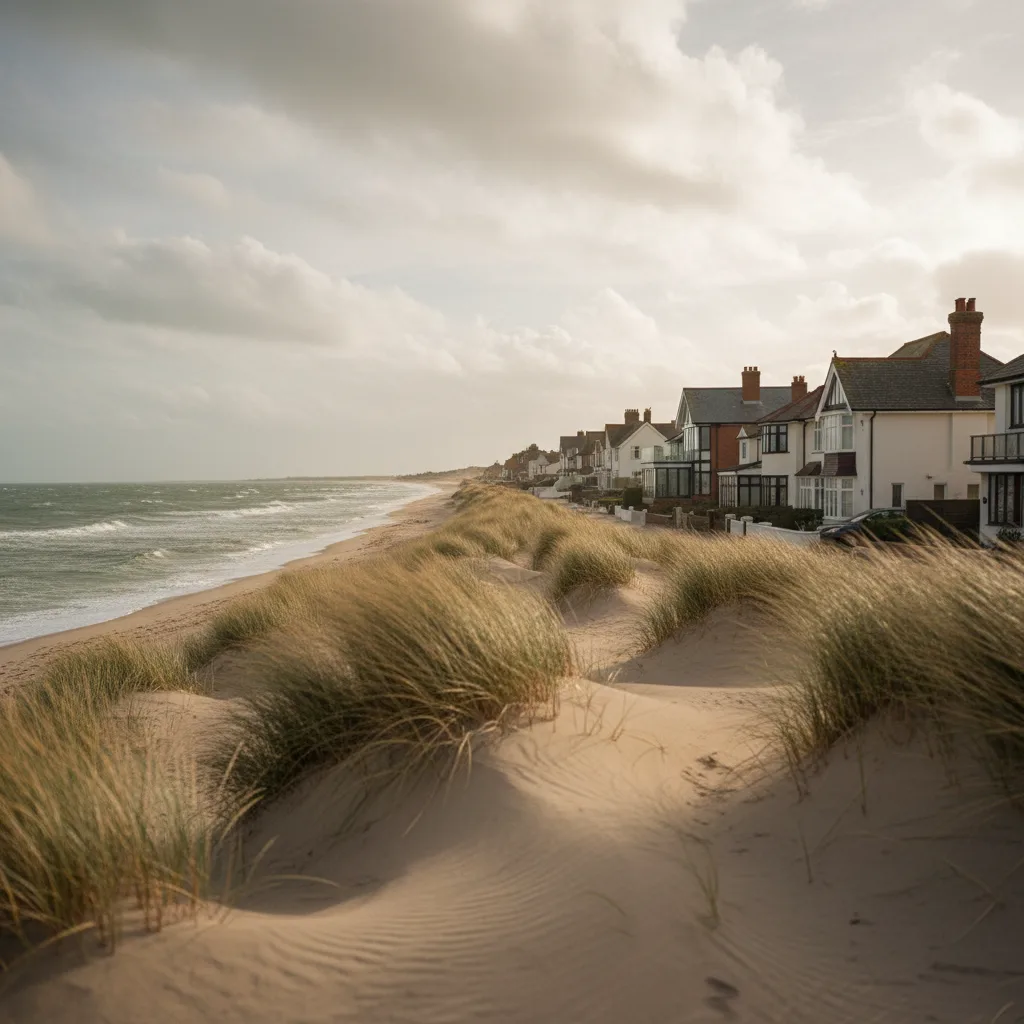
Two miles from Swanage and a completely different roof
Langton Matravers sits up on the Purbeck plateau, roughly a hundred metres above the sea, with open fields and then the cliffs at Dancing Ledge a short walk to the south. Swanage is a couple of miles east and down. People treat the two as one place. For a rooflight or a skylight they are not remotely the same job.
Swanage is tucked into a bay behind high ground, sheltered from the prevailing south-westerly and exposed to easterlies off Poole Bay. Langton Matravers is the opposite. It sits on top of the high ground, which means the south-westerly that Swanage never really feels arrives here having crossed the Channel and climbed a cliff, with a field or two of fetch break and nothing else.
| What matters | Langton Matravers | Swanage town |
|---|---|---|
| Position | Clifftop plateau, around 100m above sea level | Bay, rising from the seafront behind a sheltering ridge |
| Prevailing south-westerly | Full strength off the Channel over the cliff edge | Broken by the ridge and the Durlston high ground |
| Salt load | Real, carried up the cliff face, less than a shoreline but more than most people assume of an inland-looking village | Heavy on bay-facing elevations, light on the landward side |
| Wind uplift on a roof | High — exposed plateau, no surrounding shelter | Moderate, and dependent on where in the town you are |
| Usual covering | Purbeck stone slate on the older stock, tile on later housing | Mixed: stone slate, Welsh slate and Victorian clay tile |
The village that the stone came out of
Langton Matravers is a quarrying village. Purbeck stone was cut out of the ground here and in the ground around it for centuries, the old village school now holds a museum of that industry, and quarries on this stretch of the ridge are still working. Stone walls, stone cottages, stone slate roofs: the building material and the geology are the same thing.
One practical advantage of being in the quarrying village: when a stone slate breaks during a lift, replacement is a sourcing problem rather than an impossibility. The Purbeck quarries between here and Acton are still producing. What still takes time is matching — bed thickness, course size and weathered colour on a roof a century old are not things you order from a list. That lead time belongs in the programme at the start, not discovered in week two.
It also means Langton roofs are frequently laid to locally specific sizes and coursing, because they were roofed out of the field next door rather than from a national supplier. We photograph and record a slope before anything comes off it, so what goes back reads as the same roof.
Why a standard rooflight kit does not belong on this roof
The rule, and its one exception
The rule: a Purbeck stone slate is limestone split along its bed, not a cleaved slate. It is thick, irregular in outline, and irregular in thickness along a single piece. Every proprietary rooflight flashing kit sold is made for a thin natural slate, a flat plain tile or a profiled interlocking tile. None of them is made for this. On a stone slate slope the detail is hand-dressed lead — apron, soakers and back gutter formed to the slates actually going back — usually with the unit set on an upstand so the head has somewhere to discharge to.
The exception: plenty of Langton properties have a later addition on the back. A 1970s or 1990s extension under concrete interlocking tile, or a flat-roofed rear, takes a perfectly ordinary flashing kit and should be priced as the ordinary job it is. Where the daylight is wanted in a room under that kind of roof, saying so saves you real money — and on a visible stone slope the flush conservation unit is usually the only thing that will get anywhere anyway.
Uplift, fixings and an exposed plateau
On the coast people worry about corrosion. On an exposed plateau the failure mode that actually takes a rooflight off a roof is uplift, and it is a different problem with a different answer. Corrosion is solved with coatings and fixing metallurgy. Uplift is solved with fixing into sound structure at the right centres, and with a kerb or frame tied into the deck rather than resting on it.
Langton Matravers needs both, which is unusual. The salt load is genuine — carried up the cliff face on a south-westerly, it is more than an inland village gets, even though the village does not look coastal from the middle of it. And the wind loading is high, because there is nothing around the village to break it. A specification written for either problem alone is half a specification.
The commonest thing we find under a failed unit on an older roof anywhere in this area is fixings that went into something soft — a decayed batten, a perished deck, or a rafter edge that had already split. On a historic Purbeck roof that is a real possibility rather than a remote one, and it is why we look at the timber from inside with a torch before quoting rather than after.
Dorset Council, and the designations over this village
Langton Matravers is in the Dorset Council area. It is not in BCP. Poole and Bournemouth are a different authority with a different local plan, a different portal and different officers, and until 2019 this village was in Purbeck District Council, a name still attached to plenty of guidance you will find online.
What we check for your address
Conservation area. Much of the village core falls within one. We check the boundary against your specific address rather than assuming from the postcode, because boundaries run down the middle of streets more often than people expect.
Listed status. If the building is listed, listed building consent is required for works affecting its character whether or not planning permission is. Cutting an opening in a historic stone slate slope is exactly that kind of work.
The Dorset National Landscape, which covers this part of Purbeck, and the Jurassic Coast World Heritage Site along the shore below the village. Neither removes permitted development rights on its own, but both raise how carefully a proposal needing consent is looked at.
And the limit of what anyone can tell you: whether consent is granted is a decision on the merits of the individual proposal. It is never assured. We tell you what applies and what usually sits well; we do not submit applications on your behalf and we do not predict outcomes.
The exposure zone we write on a Langton quote
Exposure zone: exposed marine plateau. Marine-grade coastal powder coat and A4 (316) stainless on every exposed fixing, because the salt arriving over the cliff is real. Fixing centres and structural tie-down set for high uplift rather than for a sheltered village roof, because the wind is the bigger of the two problems here. That is a heavier specification than we would write for Wareham and a different one from Studland — same coating grade, different reason, different fixing schedule.
How the work runs
- Survey inside and out. Covering identified on the roof, rafters and battens looked at from within, designations checked against the address.
- Set the opening out from inside, so the aperture falls between structural members instead of needing one cut where it should not be.
- Record the slope before anything moves. Diminishing courses photographed and marked so they go back as they came off.
- Lift by hand and stack by course. Slates bedded in lime mortar are eased, not levered, and a realistic breakage allowance is in the quote from the start.
- Form and trim the opening, square, to the designed detail, with any structural work done as designed rather than improvised.
- Dress the lead to the slates going back, not to a template, and fix the unit down for uplift at the centres specified.
- Re-lay the courses in order, re-pegging and re-bedding as found.
- Hose test, make good, hand over the written specification, the named zone and the guarantee.
What we promise
Two written things, and nothing borrowed
A ten-year workmanship guarantee on our installation. Workmanship, and not insurance backed — stated plainly, because that difference is the whole meaning of the word. Units and components carry their own manufacturer warranties, handed over with the paperwork.
A fixed written price after survey, with the stone allowance, the lead detail and any structural work itemised separately so you can see what is glazing and what is not.
The firm is new and holds none of them.
We install and replace rooflights and skylights. We are not stone roofers — where a Langton Matravers roof wants a whole slope properly re-laid by someone who works in Purbeck stone year round, we will tell you that and fit the glazing afterwards. To talk through what is on your roof, ring 01202 923272.
Related reading
Rooflight and Skylight Installation Alderney
The Alderney question is not what it is made of. It is whether it opens Most of the calls we…
Rooflight and Skylight Installation Barton on Sea
Barton on Sea is a cliff top with a clear view of the Isle of Wight and absolutely nothing between…
Rooflight and Skylight Installation Bere Regis
Cob, and why we ask what your walls are made of Cob is earth. Subsoil, water, straw and sometimes chalk…
Rooflight and Skylight Installation Blandford Forum
A town rebuilt all at once, and what that does to roof work Most English towns grew in layers, so…
Rooflight and Skylight Installation Boscombe
In Boscombe, the roof is usually not the shape people think it is Ask someone what their roof looks like…
Rooflight and Skylight Installation Bournemouth
Bournemouth is not one exposure, and neither is its roof stock Bournemouth runs from a clifftop down a set of…