Rooflight and Skylight Installation Hurn
Rooflight and skylight installation in Hurn, next to Bournemouth Airport, where acoustic glazing, the ventilation trade-off and aerodrome safeguarding are the live questions.
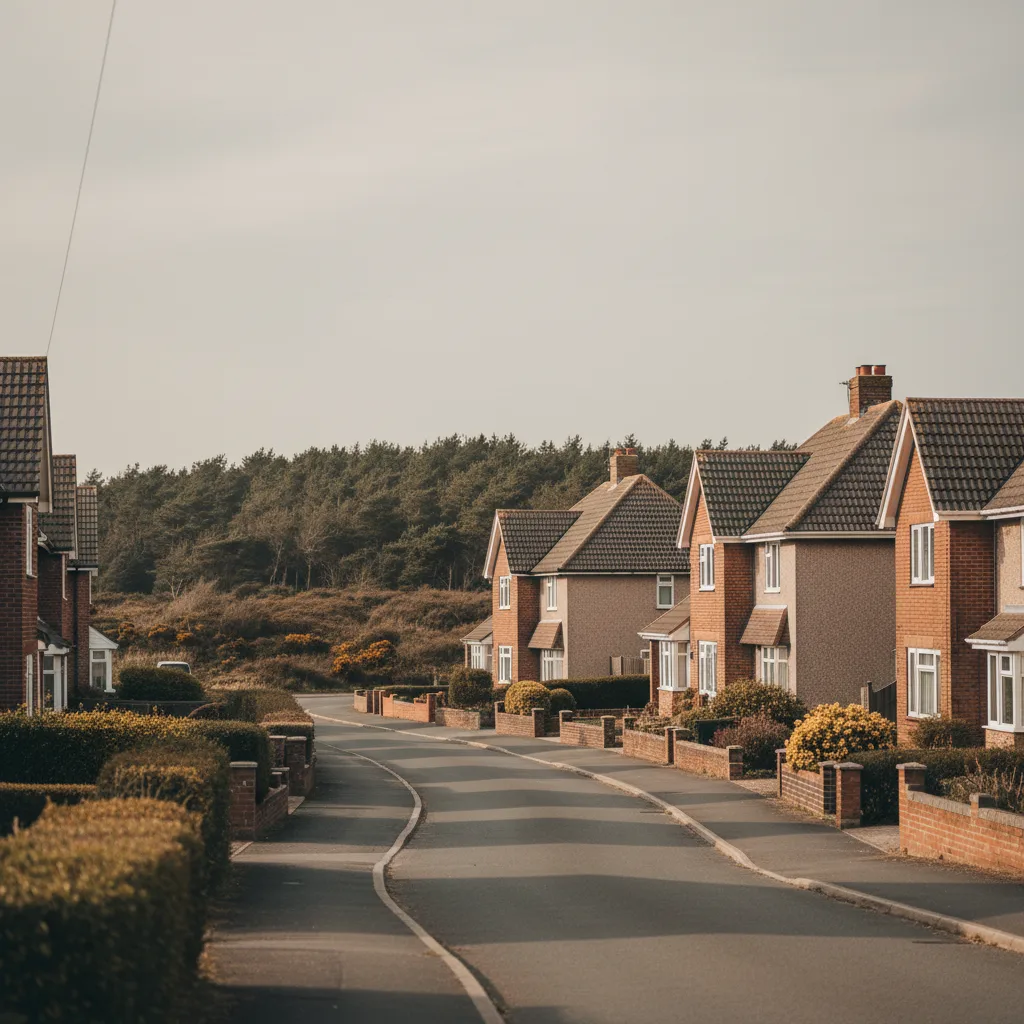
Under a flight path, a rooflight is the thin part of the roof
Hurn is a small place with a large neighbour. The village, the lanes, the heath and forest around it, the Avon in the valley — and Bournemouth Airport and its business park sitting in the middle of it all. Almost every rooflight enquiry we take from an address around here eventually arrives at the same question, usually about five minutes in: will we hear more with a skylight in?
It is the right question and it deserves a straight answer rather than a reassuring one. Yes, other things being equal, a rooflight is the weakest acoustic element in a roof. Everything else up there is a layered construction of tile, membrane, timber, insulation and plasterboard. The rooflight is a sealed glass unit in a slim frame, and sound gets through mass and thickness far less easily than it gets through glass.
The useful yardstick is that a reduction of about ten decibels is heard by most people as roughly half as loud. That is worth holding on to, because it tells you two things at once. It tells you that a few decibels of improvement is a real, audible gain rather than a specification-sheet curiosity — and it tells you that no glazing specification is going to make an aircraft inaudible. Anyone promising the second thing is selling you something. What good specification does here is bring the weak element back up to something closer to the rest of the roof, so the skylight is no longer the thing you notice.
What actually reduces sound through glass
| Measure | Why it works | What it is worth here |
|---|---|---|
| More mass in the glass | Heavier panes are harder to set vibrating, and sound has to move the pane to get through it | The foundation of every acoustic unit. It also costs weight, which the structure has to carry |
| Asymmetric panes | Two panes of different thickness resonate at different frequencies, so neither lets the other’s weak point straight through | One of the cheapest real gains available, and frequently left off a specification because nobody asked for it |
| Acoustic laminated pane | A damping interlayer between two sheets of glass absorbs vibration rather than transmitting it | The single most effective upgrade in a rooflight, and it brings safety and security benefits along with it |
| A wider cavity | Decouples the two panes a little more | Helps, but it is limited by what the frame will take, so it is rarely the main lever in a roof window |
| Trickle ventilators | They are a deliberate hole through the sealed line | Works against you acoustically. Acoustic-rated ventilators exist and should be specified where background ventilation is required |
| The unit being open | There is no sound reduction through an open window, at any price | The honest limit of the whole exercise, and the reason the ventilation strategy has to be decided alongside the glass |
When you ask a supplier about acoustic performance, the number to ask for is the weighted sound reduction index for the whole unit rather than for the glass on its own. Glass figures quoted without the frame are optimistic, and a rooflight is a frame as much as it is a pane.
The trade-off nobody mentions until August
Quiet and cool, pick the strategy before you pick the product
The conflict: a room under a roof gets warm in summer and the obvious remedy is to open something. Open the rooflight and the acoustic specification you paid for stops working completely. Under a flight path that is a genuine dilemma rather than a theoretical one, and it lands in July when the choice has already been made.
The ways out, in the order we usually suggest them: specify solar control glazing so the room gains less heat in the first place; provide a low-level opening on the other side of the room so the ventilation path does not have to be the rooflight; or accept that the unit gets opened in the evening and specify the glass for the hours when it is shut. Mechanical ventilation is the fourth option and it is a different trade’s work.
What we will not do is quote an acoustic unit and say nothing about how the room is going to be ventilated. The operation and ventilation question is covered at more length on the Alderney page, and it applies here with the volume turned up.
Glazing alone will not fix a thin roof
There is a limit to what the window can do for you, and it is set by everything around it. Sound takes the easiest path into a room, and if the roof construction itself is lightweight — a converted loft with a single layer of plasterboard on the slope, or a flat-roofed extension with a thin deck — then upgrading only the glass moves the weak point somewhere else rather than removing it.
That is not an argument against doing it. It is an argument for knowing what you are buying. Where somebody has a genuinely difficult acoustic situation, the honest advice is that the roof build-up, the ceiling and the glazing are one system, and improving one element of three gives you one element’s worth of improvement. We will say that at survey rather than after the invoice, and we will not sell an expensive unit into a construction that cannot make use of it.
Living next to an aerodrome: what is actually checked
A question to ask early, never an outcome we predict
What safeguarding is: an operational airport has safeguarding arrangements, and the planning authority consults the aerodrome on development near it that could affect operations. The things that come up are tall structures and cranes, lighting, anything that might attract birds, and in some circumstances large areas of reflective surface that could throw glare towards a runway approach or a control tower.
What it means for a domestic rooflight: in the overwhelming majority of cases, nothing at all. A roof window sits in the plane of a house roof and adds no height. Where it can become a live question is on a larger or non-domestic building close to the aerodrome, where a substantial area of glazing is proposed, or where plant such as a crane would be needed to place a large unit.
How we handle it: we raise it at survey when the address and the scale of the work make it relevant, and the check goes to BCP Council as the planning authority. Consent and safeguarding responses are assessed on their merits. We will never tell you an outcome is assured, here or anywhere else.
Exposure, plainly
Hurn is inland. Heath and forest on one side, the Avon valley on the other, and Christchurch, its harbour and several miles of land between here and the open sea. We write standard architectural coatings and standard fixings on a Hurn quotation, and the reason goes next to it. There is no marine build-up to buy and nobody here should be sold one.
What the setting does contribute is debris. Properties tucked into the tree line collect leaf litter and needles in the flashing channels and in the courses below a unit, and a blocked drainage path is the thing that turns a sound detail into standing water. It is a maintenance point rather than a specification one — the full canopy argument belongs to the wooded pages such as Canford Cliffs — but it is worth an annual look, and we say so at handover rather than pretending rooflights look after themselves.
Big plots, long drives, and what can get to the roof
Access out here is usually generous and occasionally the whole problem. Most properties around Hurn have room to stand a scaffold, somewhere to park, and no need to carry anything through a hallway — which makes the access line on the quotation one of the cheapest we write. The exception is size and ground. A long lantern or a large flat rooflight arrives on a lorry with a tail lift, and a narrow lane, a soft verge or a gateway with a tight turn decides whether that lorry reaches the house or stops at the road. On low ground near the valley, scaffold founded on saturated ground needs proper spreaders and sometimes a wait for drier weather. Both are ordinary to plan for and expensive to discover on the first morning, so we walk the approach at survey, including where a vehicle turns round.
How the job is put together
- The noise conversation first, because it changes the glass, the frame and sometimes the position — and because it is the reason most people here are ringing.
- The room assessed as a whole: construction of the roof and ceiling, what other openings it has, and how it will be ventilated in summer.
- Roof void inspected, structure and centres measured, and the extra weight of a heavier acoustic unit accounted for in the trimming.
- Specification written down, including the acoustic rating for the whole unit rather than for the glass alone.
- Consents. Building Control through BCP Council or an approved inspector, and where scale or plant makes aerodrome safeguarding relevant, that question raised with BCP before an order rather than after.
- Access and delivery planned along the actual approach to the property.
- Fixed written price after survey, itemised, with the glazing upgrade shown as its own line so you can see exactly what the quiet is costing.
- Installed, weathered, reveal insulated and lined, hose tested and demonstrated before we leave.
What we put our name to
Two things, both in writing
A ten-year workmanship guarantee on our installation, not insurance backed, said plainly because the two are different products. Glass and frame components carry their own manufacturer warranties, handed over at completion.
A fixed written price after survey — from a measured roof, with the acoustic specification stated on the quotation rather than described in conversation. If something unforeseeable appears once the covering is off, work stops, you see it, and the remedy is priced separately.
We install and replace rooflights, skylights, roof windows and lanterns across Hurn and about thirty miles around Poole, and we do not take general roofing work. If the reason you are hesitating about a skylight is what you can already hear from the garden, ring 01202 923272 and start with that — it is a specification problem with a partial answer, and you should hear the word partial from us before you spend anything.
Related reading
Rooflight and Skylight Installation Alderney
The Alderney question is not what it is made of. It is whether it opens Most of the calls we…
Rooflight and Skylight Installation Barton on Sea
Barton on Sea is a cliff top with a clear view of the Isle of Wight and absolutely nothing between…
Rooflight and Skylight Installation Bere Regis
Cob, and why we ask what your walls are made of Cob is earth. Subsoil, water, straw and sometimes chalk…
Rooflight and Skylight Installation Blandford Forum
A town rebuilt all at once, and what that does to roof work Most English towns grew in layers, so…
Rooflight and Skylight Installation Boscombe
In Boscombe, the roof is usually not the shape people think it is Ask someone what their roof looks like…
Rooflight and Skylight Installation Bournemouth
Bournemouth is not one exposure, and neither is its roof stock Bournemouth runs from a clifftop down a set of…