Rooflight and Skylight Installation Sandbanks
Rooflight and skylight installation on the Sandbanks spit, where the severest marine exposure in Poole sets the coating, the fixing grade and the access plan.
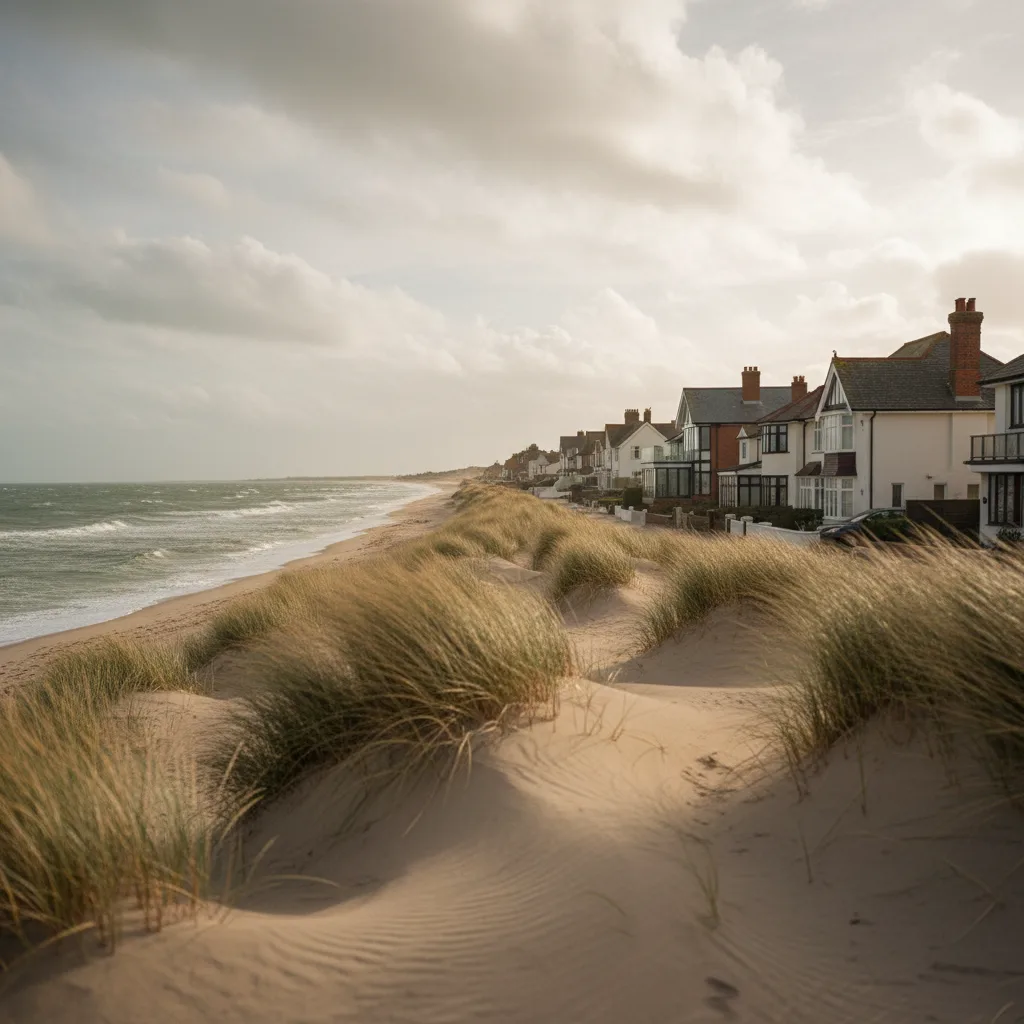
The hardest rooflight exposure in the whole service area
Sandbanks is a sand spit. Poole Harbour sits on one side of it and Poole Bay sits on the other, and at its narrowest the strip of land between them is only a couple of hundred metres across. There is nothing upwind. A south-westerly arriving over open water at the harbour mouth has had no hedge, no ridge and no row of houses to drop its salt load into before it reaches your roof, and that single fact decides almost everything about how a rooflight or skylight has to be specified here.
We say this plainly because the opposite error is just as common. Marine-grade everything is genuinely wasted money four miles inland in Creekmoor. On the spit it is the minimum, and a standard architectural powder coat on a frame facing the harbour mouth will chalk to a dull, powdery bloom within a few seasons. Same firm, same product range, two completely different answers — which is why we name the exposure zone in the survey notes before we name a specification.
Salt does not need spray to reach your roof. Airborne chloride travels inland in suspension in the wind, so a roof on Banks Road never touched by a wave still carries a chloride deposit on every horizontal surface. It concentrates where water sits and dries repeatedly: the bottom of a glazing bar, the lap of a flashing, the head of every fixing. Those are the three places a failed unit on Sandbanks almost always starts.
What actually fails first, and roughly when
People expect the glass to be the weak point. It very rarely is. Sealed units fail on their edge seal rather than their faces, and the things that go before the glass are metal, coating and rubber. Here is the running order we see on the peninsula, and what each one looks like from the ground before anyone gets a ladder out.
| What fails | What you see | Why it happens here | What prevents it |
|---|---|---|---|
| Fixings | Rust tears running down a light-coloured frame, usually within three years | A2 stainless is fine in most of Britain and is not fine in chloride; it pits, then bleeds | A4 (316) stainless throughout, including the ones nobody sees |
| Powder coating | Chalky bloom, colour going flat, then filiform rust creeping under the film from a cut edge | Standard architectural coatings are not tested for this chloride load | A marine or coastal-grade coating specification on a correctly pre-treated extrusion |
| Gaskets and seals | Hardening, shrinkage at the corners, a draught before a drip | Salt crystals in the joint plus constant UV off water on two sides | EPDM rather than the cheaper alternatives, and corner joints bonded not butted |
| Flashing and clips | A stain on the ceiling long before anything is visible outside | Mixed metals in a salt film make a small battery and one of them corrodes | Non-ferrous clips, no mixed-metal contact, sealed cut edges |
| Sealed unit edge seal | Misting between the panes, worst in the morning | Standing water and thermal cycling on an unshaded roof | Warm-edge spacer, a real fall on flat units, and drainage that is actually clear |
None of that is exotic. It is a build-up of ordinary decisions, each costing a little more than the cheap version, and each shown on the quote as its own line rather than buried in a single figure.
The houses on the spit, and what they are asking a skylight to do
Sandbanks housing is unusual for Poole. There is very little Victorian or Edwardian stock — the peninsula was built out through the twentieth century and then substantially rebuilt. Three groups cover most of it: large contemporary replacement houses with flat or very shallow roofs and a lot of glass; interwar and post-war houses extended repeatedly; and apartment blocks, some with communal flat roofs above top-floor flats.
The contemporary houses are where the specification argument matters most, because they ask a rooflight to be large, structural and almost frameless. Wide spans of glass on an exposed roof make wind uplift a calculation rather than a rule of thumb, and on anything above a modest opening we want an engineer’s number for the fixing pattern.
Flats and communal roofs — read this before you order anything
If your flat is on the top floor of a block, the roof above it is very often not yours. It belongs to the freeholder or the management company, and cutting into it needs their written consent as well as Building Control. We have no standing to give that permission and we will not fit without it. Get the consent question answered first; it takes longer than the glazing does.
Access, parking and the summer problem
Sandbanks has a single road in and the same road out. In July and August it carries beach traffic, chain ferry queues and residents all at once, and a delivery lorry with a large glazed unit on it is not a thing you want arriving at two o’clock on a hot Saturday. This is a real scheduling constraint rather than an excuse, so we settle it at survey.
- Delivery window agreed in advance. Early morning, midweek, out of season where the programme allows. If it cannot be, we say so before you commit to a date.
- Unloading point identified. Frontages here are often tight and gated, and a tail-lift needs somewhere legal to stand that is not the carriageway.
- Route to the roof settled. Side access or through the house, and if it is through the house, what gets covered and in what order.
- Scaffold or tower decided on the plot, not from a photo. Sand and made-up ground do not always give a tower a sound base; scaffold on proper sole plates is sometimes the only honest answer.
- Wind watched, and the date moved if it needs to be. Handling a two-metre pane on an exposed flat roof at the harbour mouth in a stiff south-westerly is how people get hurt. We will move a fitting day for wind and tell you why.
Replacing units that were fitted in the nineties and two-thousands
Much of our Sandbanks work is replacement rather than new openings. Glazing fitted here in the 1990s and early 2000s is now fifteen to twenty-five years old, and in this exposure that is a full service life rather than early failure. If the frame coating has gone and the fixings are bleeding, reglazing inside a corroded frame buys two or three years and then you pay for the access again.
| Condition on survey | What we would do | What we would not do |
|---|---|---|
| Misted glass, frame and coating sound | Replace the sealed unit, renew gaskets, upgrade the fixings we can reach to A4 | Sell a whole new rooflight because it is a bigger invoice |
| Coating chalked, fixings bleeding, glass clear | Replace the whole unit to marine specification; the frame is the thing that has failed | Reglaze into a frame that will fail again inside the guarantee period |
| Kerb or upstand soft under an intact covering | Stop, show you, and price the carpentry separately before carrying on | Fix new glazing to structure that will not hold it |
| Whole flat roof at end of life | Say so, and recommend the covering is done first or at the same time | Put a ten-year guarantee on work sitting in a roof with two years left |
Planning, Building Control and the coastal overlays
BCP Council is both the planning authority and the Building Control authority for Sandbanks. Most rooflight and skylight work is permitted development, and almost all of it still needs Building Control, because you are altering roof structure and changing a thermal element. Those are two separate things and they get muddled constantly.
The usual position, and when it changes
Usually: a new opening on an existing roof, or a like-for-like replacement, is permitted development with a Building Control application to BCP Council or an approved inspector. What gets checked is the structure of the altered opening, the thermal performance of the glazing, and safe glazing above a room people stand in.
When it changes: flats and maisonettes have no permitted development rights at all, so a rooflight in a top-floor flat needs a planning application as well as the freeholder’s consent. Beyond that, an Article 4 direction, a listed building, or a condition on an earlier consent that removed permitted development rights will all change the answer. We check your specific address at survey and tell you which route applies. We do not submit planning applications on your behalf.
The practical point is timing rather than difficulty. A Building Control application very rarely holds a job up. Finding out in week three that your flat needed planning permission does.
Questions we get asked on the peninsula
Is marine-grade specification really necessary this close to the water?
Yes, and Sandbanks is the one part of our area where we will not quote the standard build-up even if asked. The chloride load here is the highest we work in. If you want to see the reasoning, we will put the zone and the reason on the quote in writing so you can hold us to it.
Will a skylight make the room unbearable in summer?
It can, if it is specified on U-value alone. On an unshaded roof at the harbour mouth we would normally be looking at a solar-control unit with a g-value around 0.3 to 0.4 rather than clear glass near 0.6. You lose a little visible light and a lot of August heat. We will tell you which way your roof faces and what shades it, if anything.
How long will my roof be open?
For a replacement into a sound existing kerb, one day, opened and closed. For a new opening, the opening is formed and made weathertight the same day and the glazing goes in on a second visit once the kerb has been measured and the unit made. The roof is not left open overnight, and on the spit that is not a nicety.
Do you work on the apartment blocks?
We do, where the freeholder or management company has given written consent and the planning position is settled. We will help you work out what is needed, but we will not start without the paperwork.
Can you quote from photographs?
No. Not here and not anywhere. The exposure zone, the deck build-up, the kerb condition and the access route all have to be seen. The survey is what turns a guess into a fixed written price.
What we put in writing, and what we will not claim
This is a new firm working across Poole and about thirty miles around it. What replaces that is written and checkable.
Two documents, no adjectives
A ten-year workmanship guarantee on our installation. It is a guarantee on our workmanship and it is not insurance backed — we say that plainly because the difference is real and some firms blur it. Glass and frame components carry their own manufacturer warranties, handed over with the paperwork.
A fixed written price after survey. One figure, itemised, with any roof or carpentry repair shown separately so you can see what is glazing and what is not. If something genuinely unforeseeable turns up once the deck is open, we stop, show you and price it before carrying on.
We install and replace rooflights, skylights, roof lanterns and roof windows. We are not a general roofing firm with a glazing sideline, and if your Sandbanks roof needs recovering before anything is glazed into it, the survey will say so rather than quietly glazing over the problem. To ask which exposure zone your address sits in, ring 01202 923272. We will answer that part on the phone. Everything after it needs the roof measured.
Related reading
Rooflight and Skylight Installation Alderney
The Alderney question is not what it is made of. It is whether it opens Most of the calls we…
Rooflight and Skylight Installation Barton on Sea
Barton on Sea is a cliff top with a clear view of the Isle of Wight and absolutely nothing between…
Rooflight and Skylight Installation Bere Regis
Cob, and why we ask what your walls are made of Cob is earth. Subsoil, water, straw and sometimes chalk…
Rooflight and Skylight Installation Blandford Forum
A town rebuilt all at once, and what that does to roof work Most English towns grew in layers, so…
Rooflight and Skylight Installation Boscombe
In Boscombe, the roof is usually not the shape people think it is Ask someone what their roof looks like…
Rooflight and Skylight Installation Bournemouth
Bournemouth is not one exposure, and neither is its roof stock Bournemouth runs from a clifftop down a set of…