What a replacement day looks like from scaffold to making good
An hour-by-hour account of a single-unit replacement, what happens to the room below, and the things we will not do to finish by five.
By the time we arrive to fit, the interesting decisions have all been made. The survey settled the kerb, the unit was made to the measured size, the access was arranged and the weather was checked the evening before. What is left is a sequence, and a good replacement day is one where nothing in that sequence is a surprise.
This is what the day actually contains, written for the person whose kitchen is underneath it. If what you want to know is whether the whole job fits into a day at all, that is a separate question with its own answer; this page assumes it does and tells you how it goes.
Three things that are already true before we arrive
First, the replacement rooflight is on site or arriving that morning, because we do not open a roof around a delivery that has not happened. Second, the access is in place: a tower erected, a scaffold signed off, or the internal route agreed and walked. Third, the forecast has been looked at properly rather than glanced at, and there is a plan for the opening if it turns.
If any of the three is not true, the right decision is to move the day, and moving it costs everyone far less than an open roof and a rising wind.
The morning: protecting the room below
Before anything is unscrewed, the room under the opening is prepared. Worktops boarded, floor sheeted, furniture moved out or covered, and anything fragile taken off shelves in the immediate area. Removing an old unit drops grit, dried sealant, insulation fibres and sometimes decades of dust in a single fall, and it is far easier to catch it than to clean it up afterwards.
The ceiling line around the opening gets a look at this point too, because the reveal is where any internal making good will be needed, and it is worth both of us seeing its condition before the work rather than debating it after.
Hour by hour
- Early. Access checked and handed over, materials up, room below protected, and the old unit examined once more from above in daylight.
- Mid morning. The perimeter is cut, fixings are removed and the old rooflight comes out in one piece if it can, or is broken down carefully if it cannot.
- Late morning. The upstand top is cleared back to sound material, sounded again, and the old bedding removed. This is the point at which anything unexpected shows itself, and we stop and tell you before we carry on.
- Midday. The kerb is prepared: packers set, insulation checked, the top made level and the bedding line set out to an even thickness all round.
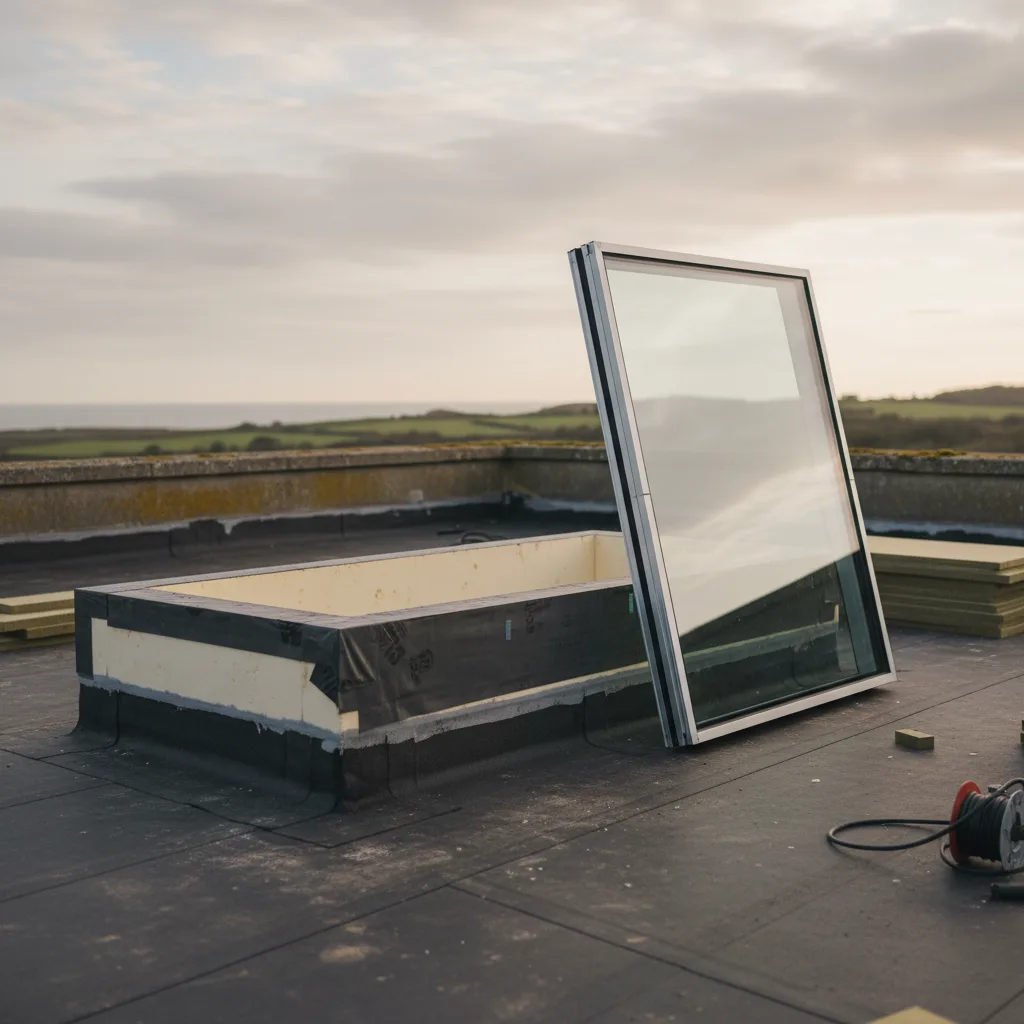
- Early afternoon. The new unit is lifted in, positioned, checked on both diagonals and fixed to the specified pattern rather than pulled down tight.
- Mid afternoon. The covering is dressed and terminated at the upstand in the manner that covering requires, and the perimeter is finished.
- Late afternoon. Water test, clean down, waste away, internal reveal inspected, and the paperwork gone through with whoever is there.
Getting the old one out
The old unit comes out whole wherever possible, because a whole unit is safer to handle and simpler to take away than a broken one. Where it cannot, because the glass is already cracked or the frame has corroded onto its fixings, it is broken down deliberately and in a controlled way, with the opening covered from beneath. Nothing gets dropped through the hole and nothing gets thrown off the roof.
A misted unit is often heavier than it looks, since it may be holding standing water in the cavity, and it will usually leave a run of dirty water down the covering as it lifts. That is expected. It also means the deck around the opening should be checked while it is exposed, which is the only chance anyone gets to look at it.
Bedding the new unit
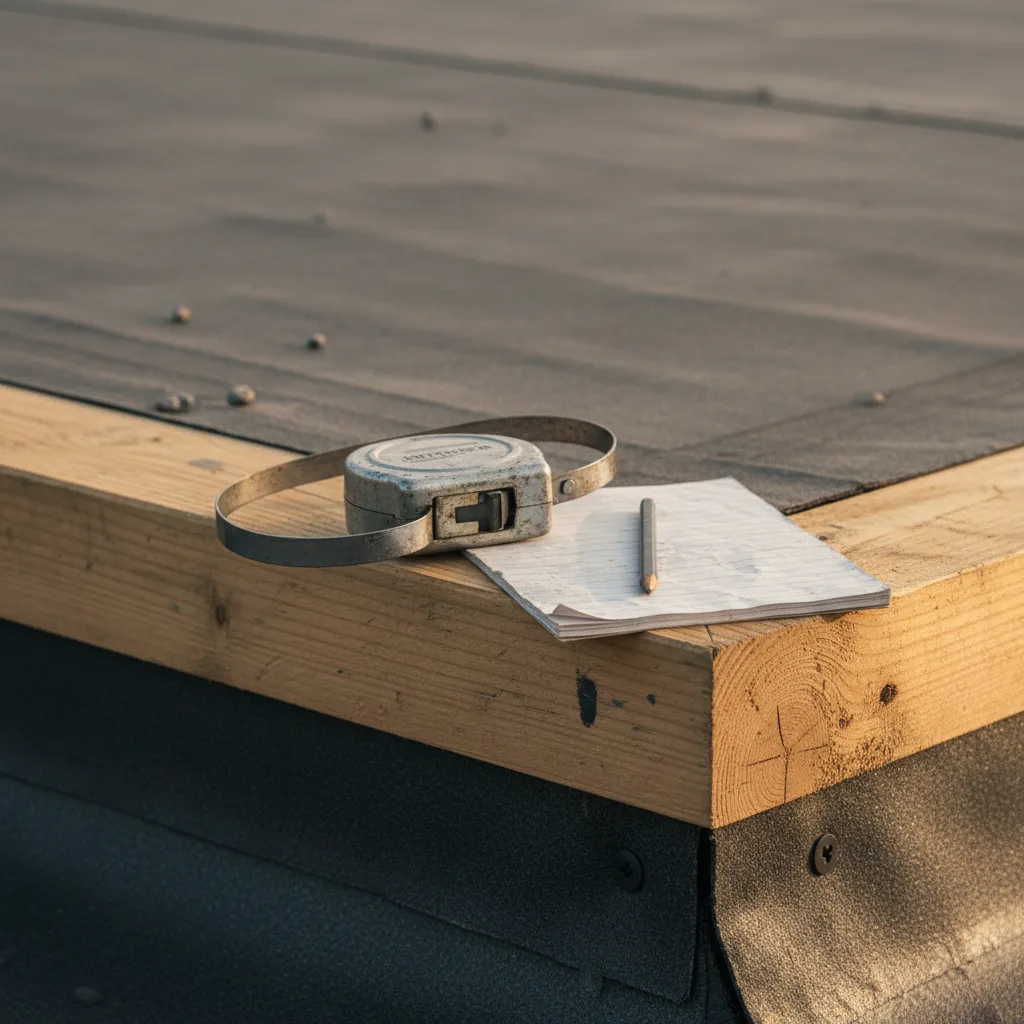
The bedding is the part of the day that decides how long the job lasts, and it is the part that cannot be hurried. The bed has to be continuous, at an even thickness, with the unit set into it rather than lowered onto a skin that has already cured. Fixings go where the manufacturer specifies, at the specified centres, tightened to hold rather than to clamp, because a frame pulled down onto an imperfect kerb is a frame put into twist.
The diagonals are checked before anything is finally tightened, and again afterwards. On an old kerb, that check is what separates a unit that sits true from one that looks right from the ground and is carrying a corner.
The things we will not do to finish by five
Four rules that do not bend for the diary
We will not glaze into rain or a rising wind. Bedding compounds and adhesives need the conditions they were formulated for, and a large unit in gusts is a sail before it is a rooflight.
We will not thicken the bed to fake a level. If the kerb is out, it gets packed properly or it gets re-topped, and either way you are told.
We will not leave a covering detail short. If the covering has to be cut back further than expected, that is a conversation and possibly a second day, not a bead of mastic over the shortfall.
We will not leave the roof open overnight in hope. If the work cannot be completed, the opening is closed and made weathertight before anybody leaves, every time.
Making the covering good
Each covering has its own termination and each is a different craft. What they share is that the water path has to run continuously from the roof surface onto and over the detail, never against a joint that is relying on adhesion alone.
| Covering | How it terminates at the upstand | What goes wrong when it is rushed |
|---|---|---|
| Built-up felt | Bonded and lapped up the face, finished under the perimeter detail | A short lap that lifts at the corner on the first cold night |
| Single ply | Welded up the face and capped, with corners formed rather than folded | A cold weld that looks identical to a good one until it opens |
| Liquid applied | Taken up the angle with reinforcement embedded through the change of plane | Thin film at the angle, which is the one place it has to be thickest |
| GRP | Laminated in with the correct overlap and a formed trim | A dry patch behind the trim, invisible once the trim is on |
Where the covering around the opening is at the end of its own life, we say so on the day with photographs, and it goes on the paperwork as a finding rather than being quietly patched over.
Water testing before anyone packs up
A perimeter that has just been finished gets tested rather than admired. Water is applied to the detail and the underside is watched from inside the room, starting low and working up, so that if something does show, its entry point is known rather than guessed at. It is fifteen minutes and it is the difference between finding a fault while the tools are still on the roof and finding it in November.
Inside, and what making good means
For a straight like-for-like swap on an existing kerb, the inside is usually untouched: the reveal stays as it was and there is nothing to make good beyond cleaning. Where the opening has been disturbed, or the old unit had been leaking and the plasterboard is stained or soft, the reveal has to be cut back, made good and left ready for decoration. Plaster needs time to dry before it takes paint, so decoration is a later job and we say plainly at quotation stage whether decoration is included or not, because that is the single most common misunderstanding in this trade.
The rest of the roof while we are up there
A replacement day is the only time anyone looks closely at the roof around the opening, so we use it. Outlets and gutters get checked for blockage, the fall towards the outlet is looked at, and any standing water is noted and photographed. Under the pines at Branksome Park and Canford Cliffs the finding is almost always debris in the drainage channels and the outlet, which is the local cause of half the perimeter problems we see. Around the harbour and out on the spit at Sandbanks it is more often the fixings and the coating, because salt has been on them continuously. Inland at Broadstone or Creekmoor it is usually the covering’s age and nothing more exotic. None of that is charged for as an inspection, and none of it appears as work without your agreement first.
Handover, and what you are left with
At the end of the day you should have: the old unit and all waste gone, the roof clean, the opening tested, the internal reveal either untouched or made good, photographs of anything found along the way, and the paperwork. The paperwork is the specification of what went in, the Building Regulations position for the work carried out, and the guarantee document. Our installation work carries a ten-year workmanship guarantee, given directly by us, which is not insurance backed, and it is handed over written down rather than promised at the van door.
The price was fixed in writing after the survey, so the invoice is the quotation unless you asked for something additional in the meantime. To talk through a replacement on your own roof, ring 01202 923272 or send photographs of the skylight from inside and from above to 447880284133.
Related reading
Are 1990s rooflights on Poole extensions worth replacing now?
In most cases yes, and usually not for the reason people expect. A 1990s unit that has misted is finished…
Can a leaking rooflight be resealed instead of replaced?
Sometimes, where the leak is at a gasket, a termination or a joint that can genuinely be renewed. But the…
Can a misted rooflight be repaired?
Sometimes, but not in the way most people mean. The misting itself cannot be cured, because the fault is inside…
Can a misted unit be replaced with a larger one?
Yes, and it is often worth doing while the roof is open. But be clear what you are agreeing to:…
Can a rooflight be replaced in one day?
The fitting usually is, yes. One rooflight, on a roof that can be reached, onto a kerb that turns out…
Can an old dome rooflight be swapped for flat glass?
Yes, and it is one of the replacements people are most pleased with afterwards. The work is usually straightforward, because…