Frame corrosion, gasket shrinkage and the leak that follows
A frame is an assembly of coatings, fixings, thermal breaks and gaskets, and the leak that eventually shows is the last event in a long sequence.
The glass gets the blame because it is the part you can see. In a good many of the failures we look at around the harbour, the sealed unit was a casualty rather than the cause: the frame holding it had been quietly coming apart for a decade, and the misting was the announcement rather than the event.
A rooflight frame is not a picture frame. It is a structural assembly of extrusions, corner joints, a thermal break, a coating, a set of fixings and two or three different rubbers, and every one of those ages at its own rate. This guide follows the sequence from the first corrosion to the water on the plasterboard, which is useful mostly because it tells you which failures can be arrested and which are simply the end.
The parts of a frame, and their separate clocks
| Element | Its job | How it ages |
|---|---|---|
| Aluminium extrusion | Carries the load and holds the shape | The metal itself lasts. The coating on it is the part with a life |
| Powder coat or anodising | Keeps the atmosphere off the metal, and is the visible finish | Chalks, fades, and lifts from any cut edge or drilled hole |
| Thermal break | Separates inner and outer extrusions so the inside face stays warm | Embrittles with ultraviolet and heat, and can shear if the frame is over-stressed |
| Corner joints | Hold the frame square and keep the perimeter continuous | The weakest point of almost every frame, and where movement concentrates |
| Gaskets | Bed the glass, exclude water and allow movement | Harden, shrink and pull back from the corners |
| Fixings | Hold the whole thing to the kerb against wind uplift | Corrode, loosen, and enlarge their own holes with each cycle |
Six clocks, none synchronised. It is why a frame can look immaculate from the room below and be finished on the outside.
Where corrosion actually starts
Not in the middle of a face. Aluminium under a sound coating is stable for decades. Corrosion starts wherever the coating has been breached, and on a rooflight that means three places: cut ends where the extrusion was mitred, drilled holes where the fixings went through, and any point where the frame was scratched during handling. From that breach it works sideways under the coating in fine threads, lifting it as it goes, which is why the visible symptom is often a blister or a lifted edge rather than a rusty-looking patch.
Once the coating is lifting, the exposed area grows on its own. Nothing arrests it short of stripping and recoating, which on an installed rooflight frame is rarely realistic.
Galvanic pairs, and the fixing that ate the frame
Put two different metals in contact with salt-laden moisture between them and you have built a small battery. The less noble of the two corrodes to protect the other. On a rooflight the classic pairing is a stainless fixing driven straight through an aluminium frame: the stainless is entirely fine and the aluminium around the hole is what disappears. Steel reinforcement inside a composite frame does the same job from the inside, where it cannot be seen until it swells and splits the section it sits in.
The corrective is not exotic. Correct grade, isolating washers where the specification calls for them, and coated or compatible fasteners. It is a detail that costs almost nothing at installation and cannot be retrofitted afterwards, which is exactly the kind of item that got left out of 1990s work.
Gaskets shrink, and they shrink at the corners
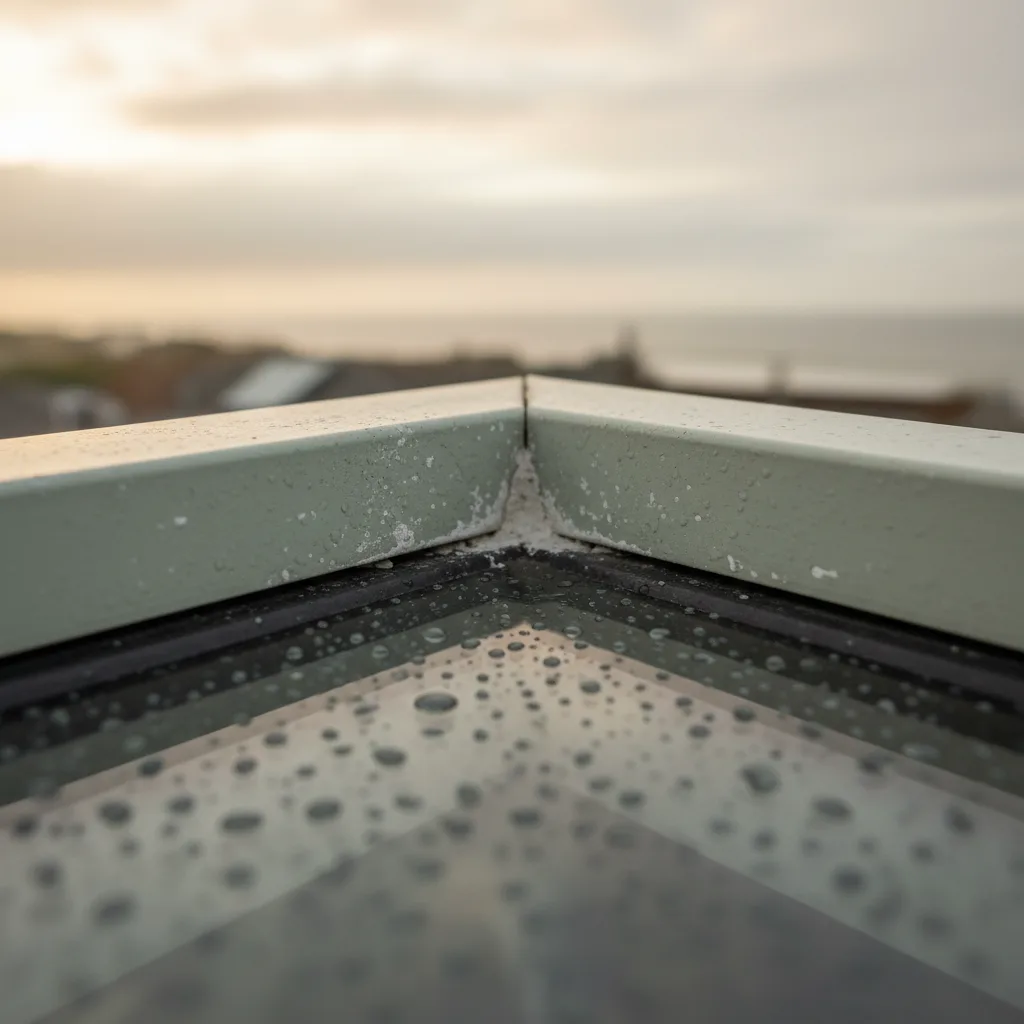
A glazing gasket is an extruded rubber section cut to length and wrapped round the perimeter, and it spends its life being compressed, heated, cooled and rained on. Over years it loses plasticiser, hardens, and gets fractionally shorter. Because the corners are where the section is bent and most highly stressed, that is where the loss shows: a gap appears at each corner while the straight runs still look perfect.
| Gasket material | Typical use | Ageing behaviour |
|---|---|---|
| EPDM | The general-purpose weather gasket on most modern systems | Good ultraviolet and ozone resistance. Hardens slowly and takes a set under permanent compression |
| Silicone | Higher specification overhead and structural glazing | The most stable in sunlight and heat, and correspondingly the more expensive choice |
| Neoprene | Common in older systems | Stiffens and can craze at the surface with long ultraviolet exposure |
| Flexible PVC | Budget and older window-derived sections | Loses plasticiser, shrinks measurably, and is the material behind most visible corner gaps |
A corner gap is worth attention not because water pours through it, but because it breaks the continuity the whole perimeter depends on, and it lets standing water sit against the edge of the sealed unit that must stay dry.
Drained and ventilated, not watertight
Most decent rooflight systems are not designed to keep every drop out at the outer face. They are designed to let the small amount of water that gets past drain back out through weep paths, with the air pressure inside the frame balanced so it is not sucked further in. Understanding that changes how you read a failure.
When a gasket shrinks, more water enters the drainage zone than it was meant to handle. When corrosion products and debris block the weeps, what entered cannot leave. And when a previous installer has run mastic around the outside to cure a drip, the drainage path is sealed shut and the water that does get in has nowhere to go but inwards. That last one is extremely common and it is why an externally sealed frame is a warning sign rather than a repair.
The sequence, from coating to ceiling
- The coating is breached at a cut edge or a fixing hole, usually during manufacture or installation rather than in service.
- Corrosion works under the coating from that point, lifting it and enlarging the exposed area year on year.
- Corrosion products build up in the drainage channel, and the weep paths narrow.
- Meanwhile the gaskets harden and pull back at the corners, so more water enters than the channel was sized for.
- Water now stands in the frame instead of draining, which keeps the edge of the sealed unit permanently wet and brings forward the day it mists.
- Fixings loosen in their enlarged holes, the frame moves fractionally more with each thermal cycle, and the corner joints open.
- Water crosses the perimeter to the inside, usually appearing at a corner of the reveal, often a long way from where it entered.
Telling a frame failure from a glass failure
Misting inside the cavity and water running down a reveal are two separate problems that frequently arrive together, because the frame is what kept the unit dry. The distinction that matters here is the direction of the evidence. Corrosion blisters on the outer frame face, a corner gap you can see daylight through, a weep hole you can put a wire into and find blocked, and a fixing that turns without tightening are all frame findings. They tell you that replacing only the sealed unit puts new glass into the thing that killed the last one.
What can be renewed, and what cannot
The rule, and the exception
The rule. Gaskets are consumables and are renewed as a matter of course whenever a unit is taken out. Weep paths are cleared. Fixings are replaced with the correct grade into a new pattern. None of that is a favour and none of it should appear as an extra.
The exception. Coatings, thermal breaks and corner joints cannot be renewed in place. Where the coating is lifting along an extrusion, where the thermal break has embrittled, or where a corner has opened, the frame has reached the end of its life and the honest answer is a new rooflight rather than new glass in an old frame. We would rather say that once, with the evidence photographed, than sell you a sealed unit and a ten-year guarantee wrapped round somebody else’s corroding aluminium.
Timber and composite frames age differently
A timber frame does not corrode, it decays, and it does so where water sits and cannot dry: the low horizontal, the corner joints, and anywhere the finish has been breached and not maintained. The warning signs are different too, being soft rather than blistered. A composite frame with a timber inner and an aluminium outer carries both failure modes at once, plus the joint between them, and the aluminium usually goes first in a salt environment while the timber goes first inland in a roof that has been leaking.
What the exposure zone does to all of this
Salt does not attack the sealant so much as everything holding the assembly in place. Out on the sand spit at Sandbanks, with water on both sides and no fetch break on the prevailing south-westerly, salt aerosol is on the frame continuously and coatings chalk years earlier than the same product does inland. At the harbour edge at Hamworthy, Lower Parkstone and Upton the load is real but the wind has crossed land first. Up at Canford Cliffs and Branksome Park the dominant problem is not salt at all but pine needles and leaf litter packing the drainage channels solid, which produces the same blocked-weep failure by an entirely different route. And at Broadstone, Creekmoor, Canford Heath or Ferndown the ordinary specification is the right specification; marine-grade fixings four miles inland are an overcharge and we will tell you so.
What we record at survey
The coating condition at the cut ends and every fixing, whether any weep path is blocked, the state of the gasket at all four corners, whether the fixings still tighten, whether the thermal break is intact where it can be seen, and what the drainage channel contains. Those findings decide whether you are being offered a sealed unit, a full rooflight or, occasionally, a clean and a set of gaskets and nothing else. They also decide the cost, which is why we do not quote from a description and do not publish a price.
What you get is a fixed written price after the survey, with any frame findings photographed and attached so you can see what they are based on. Our installation work carries a ten-year workmanship guarantee, given directly by us, which is not insurance backed. If your skylight is weeping at a corner or the frame has started blistering, ring 01202 923272 or send close photographs of the corners to 447880284133.
Related reading
Are 1990s rooflights on Poole extensions worth replacing now?
In most cases yes, and usually not for the reason people expect. A 1990s unit that has misted is finished…
Can a leaking rooflight be resealed instead of replaced?
Sometimes, where the leak is at a gasket, a termination or a joint that can genuinely be renewed. But the…
Can a misted rooflight be repaired?
Sometimes, but not in the way most people mean. The misting itself cannot be cured, because the fault is inside…
Can a misted unit be replaced with a larger one?
Yes, and it is often worth doing while the roof is open. But be clear what you are agreeing to:…
Can a rooflight be replaced in one day?
The fitting usually is, yes. One rooflight, on a roof that can be reached, onto a kerb that turns out…
Can an old dome rooflight be swapped for flat glass?
Yes, and it is one of the replacements people are most pleased with afterwards. The work is usually straightforward, because…