Rooflight and Skylight Installation Corfe Mullen
Rooflight and skylight installation in Corfe Mullen, an inland Stour-side village routinely confused with Corfe Castle, where the specification, the covering and the price are all ordinary.
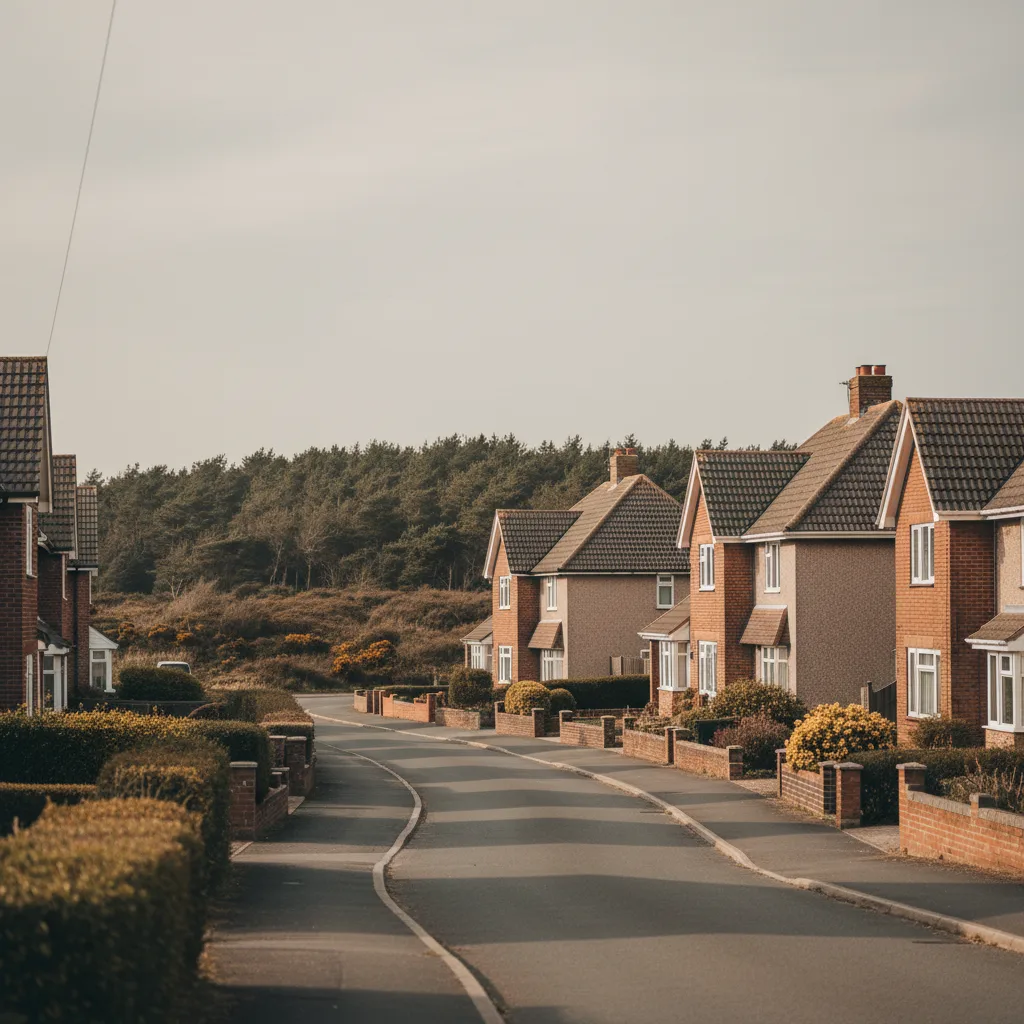
Corfe Mullen is not Corfe Castle, and the difference is most of this page
We get the confusion often enough that it belongs at the top. Two Dorset places share the first half of a name and are around fifteen miles apart by road with the whole of Poole Harbour’s western side between them. For a rooflight or a skylight they could hardly be less alike.
| What decides the job | Corfe Mullen | Corfe Castle |
|---|---|---|
| Setting | Inland village on rising ground between the Stour valley and the heathland ridge | Purbeck village in a gap in the chalk ridge, below the castle ruins |
| Usual roof covering | Concrete interlocking tile on most of the housing, with plain tile and slate | Purbeck stone slate on much of the older stock |
| Flashing | Manufacturer’s engineered kit, off the shelf | Hand-dressed lead, because no kit is made for a stone slate |
| Salt exposure | None worth specifying for | None worth specifying for either, though the wind through the gap is another matter |
| Planning constraint | Ordinary for most addresses | Conservation area, dense listing, National Trust land, national landscape |
| Typical price shape | A standard installation, priced as one | Slower, specialist, and properly more expensive |
If you were sent a quote that reads like the right-hand column for a house in the left-hand column, something has gone wrong. That is the practical reason this table is here rather than a piece of local colour.
The boundary runs right past the village
Corfe Mullen is in the Dorset Council area. Broadstone, next door, is in Bournemouth, Christchurch and Poole. Two neighbouring communities, one short drive apart, applying to two different authorities with different planning portals, different local plan policies and different Building Control teams. There is no landmark that tells you where the line falls, and advice from a neighbour on the wrong side of it is advice about a council that is not yours. We confirm which authority covers your address at survey.
And as everywhere on this side of the harbour, until 2019 the authority here was a different one again. Older guidance you find online frequently names a council that has not existed for years, which is a reason to check rather than to assume.
What the housing stock is, and what it means for the price
Corfe Mullen grew substantially through the twentieth century and is now one of the larger villages in this part of Dorset. There is an older core, and around it a great deal of interwar, post-war and later housing: bungalows and chalet bungalows in quantity, semis and detached houses built in estate phases, and modern infill.
The covering across most of that is concrete interlocking tile. That is the most straightforward roof there is to put a rooflight into. Every manufacturer makes an engineered flashing kit for it, the components are off the shelf, the detail is known and well proven, and on a sound roof the work is a day.
So the honest position on a Corfe Mullen quote is that there is nothing about this village that should add to it. No salt, no marine coating, no specialist covering, no conservation premium on most addresses. A standard job at a standard price, with the survey confirming that rather than finding reasons to inflate it.
Shallow pitch, and the bungalow problem
The measurement that decides which product you can have
Most pitched roof windows are rated from around 15 degrees. Fit one below the pitch the manufacturer certifies and you have voided the warranty that half of your specification was relying on.
Between roughly 10 and 15 degrees, some ranges are approved with a particular underfelt collar or flashing arrangement. That is a named product choice that goes on the quote, not something improvised on the roof.
Below that, the answer is a flat rooflight on a built kerb, with a designed fall of three to five degrees and the upstand carrying the waterproofing at least 150mm above the finished roof surface.
Why it comes up here: Corfe Mullen has a lot of bungalows, a lot of chalet bungalows, and a lot of shallow-pitch and flat-roofed rear additions. Pitch is the first thing we measure, because it is the thing that decides everything after it.
The Stour side, damp and debris
The village sits above the Stour valley to the north, with the heathland ridge towards Upton Heath and Broadstone on the other side. The valley is the local variable worth knowing about, and it has nothing to do with salt.
River valleys hold mist and hold damp. On a north-facing rear slope on the valley side of the village, a rooflight sees less direct sun, dries more slowly and grows algae more readily — that green film that gets reported as a fault and is nearly always biological. Mature trees along the valley and through the older parts of the village add leaf, seed and pollen on top. Neither of those is a specification failure and neither is fixed by a coating upgrade. What helps is pitch, so water runs off, and self-cleaning glass, which needs running water to work and therefore does more on a pitched unit than on a nearly flat one.
The other consequence of a damp, shaded slope is condensation, and it is worth separating from a leak before anyone is called out. Water on the inside face of the glass on a cold still morning with no rain is condensation. Water at the head of the opening during wind-driven rain is a leak. Misting between the panes is a failed sealed unit, which means the glazing is spent rather than the installation being wrong — a common finding on the 1990s and 2000s units now reaching the end of their lives across this village.
Which unit for which room
| The room | What usually suits it | The thing to get right |
|---|---|---|
| Loft conversion in a family house | Pitched roof windows set out against the rafters and the head height | Pitch, rafter trimming, and solar control on a south or west-facing slope |
| Kitchen under a flat-roofed rear extension | A flat rooflight, or a roof lantern where headroom allows | The kerb: height, square, insulated, built and measured before anything is ordered |
| Dark hallway or landing in a bungalow | A single rooflight over the circulation space, often smaller than people expect | Shallow pitch, and whether the ceiling void needs a lined shaft rather than a direct reveal |
| Chalet bungalow bedroom in the roof | Pitched roof windows, sized for escape requirements as well as for daylight | Building Control, because a habitable room in a roof brings escape and thermal requirements with it |
That last row matters more than it looks. Putting a window into a roof is one thing; making a roof space a habitable room is another, and the two get talked about as if they were the same job.
The survey, and what comes out of it
- Pitch, measured on the roof. The number that decides the product.
- Covering identified. Interlocking tile, plain tile, slate or flat deck, and the flashing detail that follows from it.
- Structure checked. Rafter or joist size and spacing, trimming needed, engineer required or not — decided rather than assumed.
- Zone named in writing. Inland, with a standard specification, and no coastal upgrade unless you ask for one as an option.
- Orientation and glazing. Which way the slope faces and what shades it, and therefore the g-value. A north-facing rooflight and a south-facing one are not the same unit.
- Approvals. Dorset Council or an approved inspector for Building Control; planning only where listing, an Article 4 direction or a planning condition brings it in.
- Access. Route to the rear roof, scaffold or tower, and whether the road takes a delivery.
- A fixed written price, itemised, with any roof repair separated out so you can see what is glazing and what is not.
What we promise
Two written things, and nothing borrowed
A ten-year workmanship guarantee on our installation work. It is workmanship and it is not insurance backed — said plainly, every time, because the difference matters. Units and components carry their own manufacturer warranties.
A fixed written price after survey. If soft deck turns up under an intact-looking flat roof covering, we stop, show you and price the repair separately before going on. That is the only thing that changes a fixed price.
The firm is new and holds none of them.
We install and replace rooflights and skylights across Poole and about thirty miles around it. We are not general roofers and we do not want the work. To find out which exposure zone your Corfe Mullen address sits in — and it is very likely to be the inexpensive one — ring 01202 923272.
Related reading
Rooflight and Skylight Installation Alderney
The Alderney question is not what it is made of. It is whether it opens Most of the calls we…
Rooflight and Skylight Installation Barton on Sea
Barton on Sea is a cliff top with a clear view of the Isle of Wight and absolutely nothing between…
Rooflight and Skylight Installation Bere Regis
Cob, and why we ask what your walls are made of Cob is earth. Subsoil, water, straw and sometimes chalk…
Rooflight and Skylight Installation Blandford Forum
A town rebuilt all at once, and what that does to roof work Most English towns grew in layers, so…
Rooflight and Skylight Installation Boscombe
In Boscombe, the roof is usually not the shape people think it is Ask someone what their roof looks like…
Rooflight and Skylight Installation Bournemouth
Bournemouth is not one exposure, and neither is its roof stock Bournemouth runs from a clifftop down a set of…