Rooflight and Skylight Installation Branksome Park
Rooflight and skylight installation in Branksome Park, from 1930s flat roofs and large modern rebuilds to the freeholder consent question in converted villas.
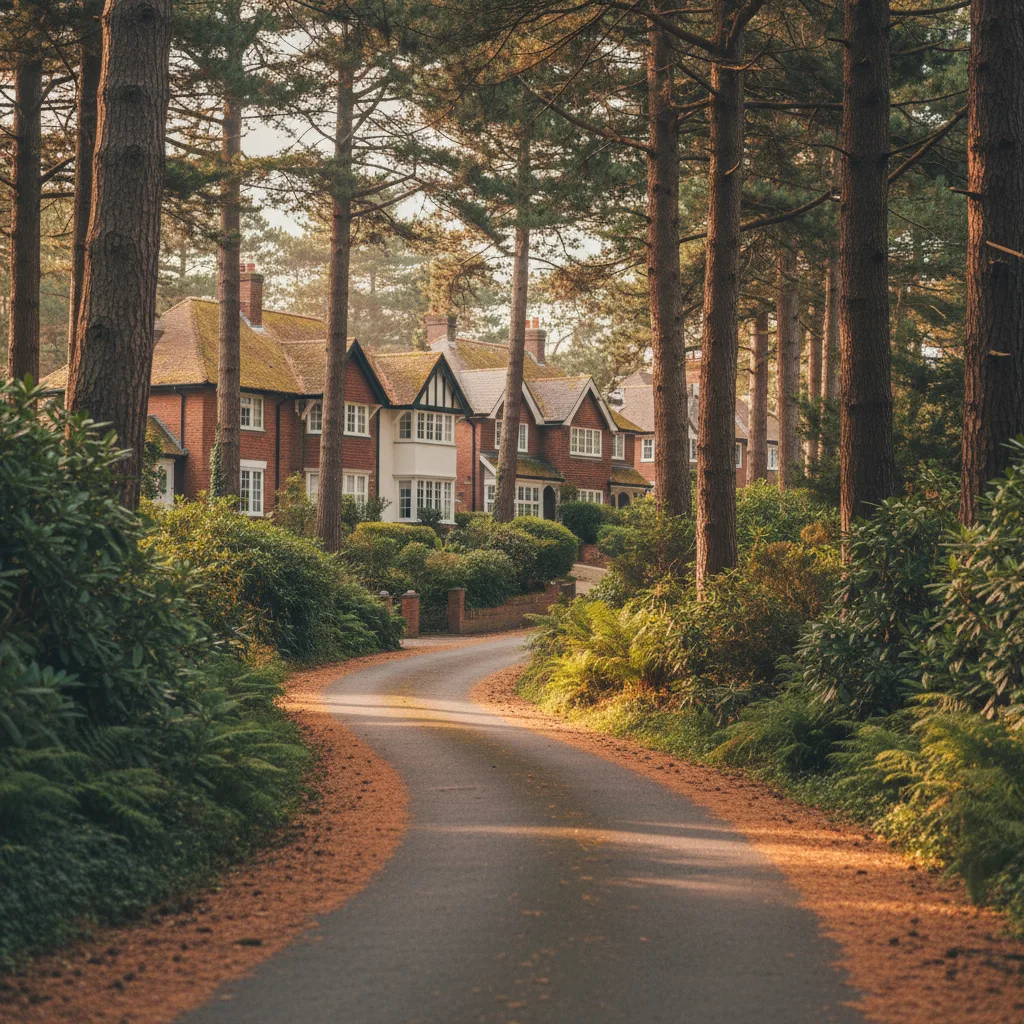
Big plots, big spans, and a canopy that never stops dropping
Branksome Park was laid out in the nineteenth century as a wooded estate of very large plots, and the street pattern has never really been broken up. Wide roads, deep frontages, dense maritime pine and rhododendron, and Branksome Chine cutting down through it to the beach. What that means for a rooflight or skylight is a particular combination you do not get elsewhere in Poole: substantial roofs with long spans, mature protected trees standing right over them, and an access route that usually runs a long way from the kerb to the back of the house.
The sea is close. The exposure is not severe. The rise of the ground and the belt of trees between the houses and the cliff take most of the airborne salt out before it lands, which is why we do not specify the Sandbanks build-up here and will say so in writing rather than letting you pay for protection you do not need.
| Condition | Branksome Park | What it changes |
|---|---|---|
| Airborne salt | Present but filtered by ground rise and a wooded belt | Standard architectural coating, not marine — the saving goes into glass and drainage instead |
| Organic debris | Heavy and year-round: pine needle, resin, rhododendron leaf | Wider drainage channels, reachable outlets, self-cleaning outer pane as standard |
| Roof spans | Often large, on generously built houses and modern replacements | Structural calculation rather than rule of thumb on anything beyond a modest opening |
| Access distance | Long driveways, gated frontages, planting close to the house | Scaffold rather than tower more often; delivery position agreed before the date |
| Tree protection | Extensive, and enforced | The access plan is designed round the canopy; nothing gets pruned to suit us |
Three kinds of Branksome Park roof
The stock divides more sharply here than anywhere else we work, and the three groups want almost nothing in common.
The surviving large villas. Edwardian and interwar houses with steep tiled or slated roofs, cut carpentry, purlins, and loft volumes big enough to have been converted once already. A roof window or a pitched-roof skylight usually goes in between existing rafters with modest trimming. The interesting questions are where the purlin runs, whether a previous conversion left the structure honest, and what head height you actually have at the point you want the glass.
The 1930s modern houses. Branksome Park carries a genuine crop of interwar flat-roofed and low-pitched modernist houses, and they are the most interesting roofs in Poole to work on. Original decks are usually timber, usually overlaid more than once, and often nothing like the specification anybody assumes. We open up and look before pricing, every time.
The replacement houses. Large contemporary rebuilds with deep plans, flat roof areas and a real need for top light in the middle of the building. These are where the big lanterns and the large flat rooflights go, and where wind uplift on a wide unsheltered roof plane stops being theoretical.
Villas divided into flats — the consent problem
A great many of the original Branksome Park houses were converted into flats, and there are purpose-built blocks on former villa plots as well. If you live in one, the roof above your head is very probably not yours to cut into, and this is the single most common reason a Branksome Park enquiry stalls.
Settle this before you settle on a rooflight
Who owns the roof. In most flat leases the structure and the roof are retained by the freeholder or vested in a management company. Written consent from them is needed, and it is a separate thing from Building Control and from planning.
Flats have no permitted development rights. None. So a rooflight in a top-floor flat is a planning application to BCP Council as well, even where the identical work on a house next door would need nothing.
What we will not do. We will not fit on the strength of a verbal assurance that the freeholder is fine with it. We will survey, quote, and hold the job until the consent exists in writing. That is not caution for its own sake; it is whose insurance pays if there is later a dispute.
Debris, drainage and what actually lets water in
Under this canopy, almost every leak we are asked to look at started as a drainage blockage rather than a seal failure. Pine needles and resin knit into a mat in a perimeter channel; the channel stops draining; water stands against a gasket that was designed to shed it, not to hold it back; and after a few freeze cycles it finds a way through. The glass is perfect throughout.
So the design decisions that matter on a Branksome Park roof are unglamorous. Channel width. Where the outlets discharge and whether they can be reached without a tower. Pitch — a steeper slope on a lantern sheds needles that a shallow one collects in the bottom of every pane. And a realistic cleaning interval agreed at handover, because under mature pine that is twice a year and not once every five.
Self-cleaning glass needs rain running off a slope to work at all. It is a hydrophilic coating that lets water sheet rather than bead, carrying loosened dirt with it. On a flat rooflight under a pine canopy, with resin film on the surface and needles sitting in the corner, it performs a fraction as well as the brochure suggests. We still specify it here because it lengthens the interval — but we are not going to pretend it removes the job.
Getting a scaffold to the back of a Branksome Park house
- Walk the route at survey. Long driveways, gates, changes in level and planting close to the elevation all decide whether material can be carried or has to be craned, and there is often no crane position at all on a wooded plot.
- Check the canopy above the standing position. Protected trees are a fixed constraint. Where the branches are decides where the scaffold goes, and pruning to suit the works is a matter for you and BCP Council in advance, not something we will do on the day.
- Protect root zones. Scaffold standards and a loaded delivery concentrate load on ground that is often inside a root protection area. Spreader boards and a sensible standing position cost very little.
- Agree the delivery position in advance. Several roads here are wide but have no legal standing for a long vehicle outside a given frontage; that is better discovered two weeks out than on the morning.
- Keep the roof closed overnight. Openings are formed and made weathertight the same day. On a plot this size a tarpaulin and an optimistic forecast is not a plan.
The wooded-zone specification, written down
| Element | What we specify in Branksome Park | Why not the coastal version |
|---|---|---|
| Frame finish | Standard architectural powder coat on a correctly pre-treated extrusion | Chloride load here does not justify a marine coating; the money does more good in the glass |
| Fixings | A4 stainless on exposed fixings, standard on concealed | Full A4 throughout is a Sandbanks answer to a Sandbanks problem |
| Outer pane | Self-cleaning coating as standard rather than an option | The debris load, not the salt, is what shortens the cleaning interval here |
| Glazing make-up | Toughened outer, laminated inner on anything above head height | Same everywhere — laminated glass holds together above a room people stand in |
| Solar control | Judged from actual canopy cover on the plot, often lighter than you would expect | Heavy tint under heavy shade makes a green, dim room dimmer through winter |
| Drainage | Wider channels, accessible outlets, pitch at the steeper end | This is the Branksome Park upgrade, and it is where the saved coating money goes |
Branksome Park questions
My house is a 1930s flat roof. Can it take a large rooflight?
Often yes, but never on the assumption that the original deck is what somebody says it is. These roofs have usually been overlaid at least once and sometimes three times. We open up a small area and look at the deck and the joists before we price anything, and if the covering is at end of life we will tell you it needs doing first.
I am in a converted flat. Is it worth even asking?
Yes — but start with the lease and the freeholder rather than with us. Once written consent exists and the planning position is clear, the glazing part is straightforward. Without it we cannot start.
Do the trees mean I will not get much light?
Top light performs far better than side light even under canopy, which is exactly why these houses take so well to rooflights. What the canopy changes is the glass specification, and usually in your favour — lighter coatings, less solar control, more visible light.
Will you take a branch off to get your scaffold in?
No. Protected trees are not ours to touch. If a branch genuinely has to come off, that is your application to BCP Council and it happens before we arrive.
Do you do the roof covering as well?
No. We install and replace glazing — rooflights, skylights, lanterns and roof windows. We form and weatherproof the opening and the kerb, and we dress the existing covering into it, but we are not a general roofing firm and we will not pretend to be one to keep a job.
Zoned, costed and guaranteed on paper
Three documents and no claims
The exposure zone, named. The survey states which Poole zone your roof sits in and the build-up that follows, with the reason. In Branksome Park that reason is usually about debris and spans rather than salt, and stating it is how you can tell whether you are being sold the right specification or the dearest one.
A ten-year workmanship guarantee. On our installation work. It is a workmanship guarantee and it is not insurance backed — that distinction matters and we are not going to blur it. Components carry their own manufacturer warranties.
A fixed written price after survey. Itemised, carpentry and roof repair shown separately, and nothing priced from a photograph.
Ring 01202 923272 and we will tell you your exposure zone on the phone. Everything past that needs somebody on the roof with a tape.
Related reading
Rooflight and Skylight Installation Alderney
The Alderney question is not what it is made of. It is whether it opens Most of the calls we…
Rooflight and Skylight Installation Barton on Sea
Barton on Sea is a cliff top with a clear view of the Isle of Wight and absolutely nothing between…
Rooflight and Skylight Installation Bere Regis
Cob, and why we ask what your walls are made of Cob is earth. Subsoil, water, straw and sometimes chalk…
Rooflight and Skylight Installation Blandford Forum
A town rebuilt all at once, and what that does to roof work Most English towns grew in layers, so…
Rooflight and Skylight Installation Boscombe
In Boscombe, the roof is usually not the shape people think it is Ask someone what their roof looks like…
Rooflight and Skylight Installation Bournemouth
Bournemouth is not one exposure, and neither is its roof stock Bournemouth runs from a clifftop down a set of…