Anti slip surfaces and the frit pattern that stays grippy when wet
How wet slip resistance is measured on walk-on glass, why fired ceramic frit outlasts applied coatings, the variables that change a pattern's grip, and what pine debris does to the measured value.
Slip resistance on a walk-on rooflight is not an opinion about texture. It is a measured number, taken with a swinging rubber foot on a wet surface, and every honest conversation about anti-slip glass starts with that measurement rather than with a photograph of a frit pattern.
The reason the measurement matters is that the two obvious ways of judging a surface both fail. Dry glass with a light pattern feels perfectly secure under a hand and is treacherous underfoot in November rain. A heavily textured pane looks safe and can lose grip once it fills with the fine organic film that builds on any flat surface under trees.
What the pendulum actually does
The UK convention for flooring is the pendulum test, run to BS 7976 and the UK Slip Resistance Group guidelines. A weighted arm swings down, a rubber slider mounted on it sweeps across a defined length of the surface, and how far the arm rises on the other side is a measure of how much energy the surface took out of it. More friction, less rise, higher number.
The result is a Pendulum Test Value, and the classification used across UK flooring is straightforward: a wet value of 36 or above is regarded as low slip potential, roughly 25 to 35 is moderate, and below about 25 is high. Polished clear glass, wet, is nowhere near 36 — which is the whole reason a walk-on skylight gets a surface treatment at all.
- Wet, not dry. A dry reading on glass is reassuring and useless. Ask for the wet value.
- Which slider. Two rubbers are used, one standing in for shod feet and one for bare feet. A terrace used barefoot in summer is tested on the soft slider, and the numbers are not interchangeable.
- Which direction. A lined or ribbed finish gives different readings along and across the pattern. A single figure with no direction stated is half an answer.
- On which surface. The reading belongs to the actual treated face, not to the glass family.
- When. A value measured on a clean new sample is the best the pane will ever do.
Frit is fired in, which is why it stays
Ceramic frit is a glass-based ink printed onto the pane and then fused into the surface during the toughening furnace run. It does not sit on the glass; it becomes part of it. That single fact is why frit is the default anti-slip treatment on structural walk-on glass and why applied strips and coatings are not.
A printed pattern cannot peel, lift at its edges or wear off along the walked line, because there is no edge and no film. It can be scratched, in the same way the surrounding glass can be scratched, and after many years on an abrasive site the very top of a proud pattern will dull. What it will not do is disappear in the middle of the route and leave a polished lane through the pattern, which is exactly what an applied coating does.
The rule, and the exception
The rule: slip resistance on a walk-on rooflight is specified as fired ceramic frit or an integral surface texture, chosen at order stage and manufactured into the pane.
The exception: an applied anti-slip treatment on an existing pane, as a temporary measure while a replacement is on order. It is a stopgap with a known life, it should be described as one, and it is not a way of turning a non-trafficked skylight into a walk-on one.
What makes one frit pattern grippier than another
Every walk-on frit is a compromise between grip and view, and the variables that move it are more specific than “dots or stripes”.
| Variable | What it does to wet grip | What it does to the view |
|---|---|---|
| Coverage | The proportion of the surface printed. More coverage, more of the foot landing on texture | The single biggest driver of how much sky the room below keeps |
| Height of the print | A proud pattern breaks the water film. A flat print relies on roughness alone | Barely visible from inside; a proud pattern reads as texture from above |
| Element size | Small close elements suit a heel; large widely spaced ones can be stepped between | Fine patterns read as a haze, coarse ones as a visible grid |
| Spacing and gaps | Water and grit need somewhere to go. A pattern with no gaps holds a film | Wider gaps give clearer sight lines through the pane |
| Pattern direction | Lines perform differently along and across; a dot or square grid is directionless | Lines draw the eye and rarely align with the frame |
| Colour of the ink | None at all | White scatters light and lifts the room below; dark inks read as shadow |
Because coverage drives both grip and daylight, the honest conversation is about which room is underneath. Over a basement kitchen with no other window, every extra percentage point of print is taken directly out of the only daylight that room will ever get. Over a utility area it costs nothing worth arguing about.
Which surface the frit goes on
A sealed walk-on unit has several glass faces, and frit can be printed on more than one of them. Only one position provides slip resistance.
Anti-slip frit must be on the uppermost external face, because that is the surface the shoe touches. Frit printed on an internal face of the laminate, or on a cavity face, is doing something else entirely — shading, privacy, hiding a spacer line — and it will not add a single point to a wet pendulum reading. This is a genuine and common confusion in quotations: “fritted glass” is not the same statement as “anti-slip glass”, and the specification should say which face carries the pattern.
It is also why a mistake here cannot be corrected later. The pattern is fused into the pane during manufacture. If the anti-slip print ends up on the wrong face, the remedy is a new unit, not a site visit.
Etched, blasted and textured: the alternatives and their costs
Frit is not the only integral option, and the others behave differently enough to be worth separating.
| Integral finish | How it earns its grip | The cost it carries |
|---|---|---|
| Ceramic frit | Raised fired pattern breaking the water film | Obscures in proportion to coverage; the pattern is always visible |
| Blasted or sandblasted field | An overall roughened surface across the whole pane | Holds dirt in the roughness, and removes the view entirely |
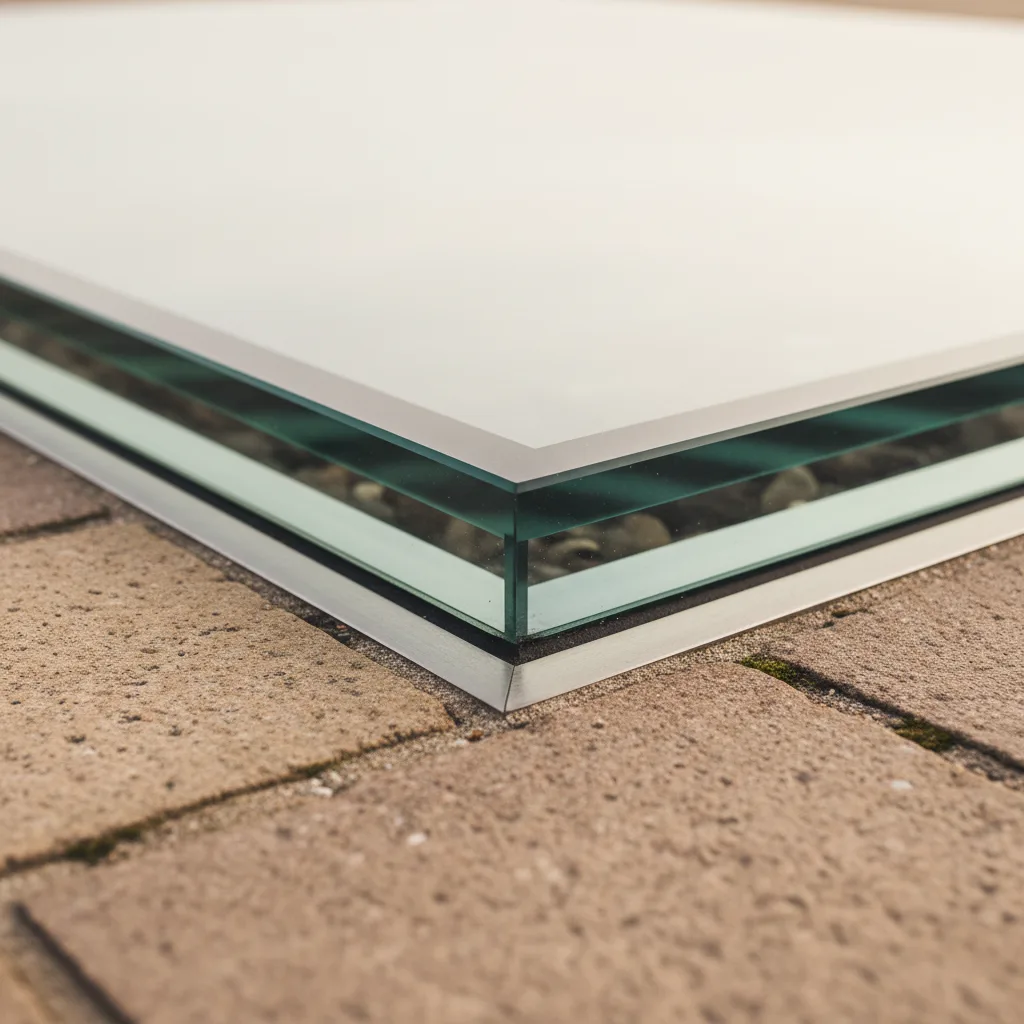
| Acid-etched satin | Very little. It is an obscuring finish, not an anti-slip one | Often mis-sold as anti-slip because it looks matt |
| Rolled or patterned glass | A texture rolled into the surface at float stage | Limited availability in the thicknesses walk-on work needs |
The acid-etched row is the one to hold onto. Satin etch is a good privacy answer and a poor slip answer, and because it feels slightly rough dry it gets described as anti-slip more often than it should. If a quotation offers etched glass as the slip specification, ask for the wet pendulum value and the answer will settle it.
What dirt does to a measured value
A pendulum figure is taken on a clean surface, and no surface outdoors stays clean. Everything that lands on a walk-on rooflight sits in the very texture that provides the grip, and the finer the pattern the more effectively it traps.
Three films matter in this service area. A salt film, which is hygroscopic and stays slightly damp on a humid morning long after the pane looks dry. An algal or biofilm layer, which builds fastest on a surface that is flat, shaded and holding moisture — precisely a walk-on pane under trees. And resin, which is the one that changes the material properties rather than just adding a layer.
Under the pines at Canford Cliffs and Branksome Park, the grip problem arrives before the debris problem. Pine needles mat across a flat surface, hold moisture against it, and the resin they carry bonds the mat into a felt. Lift that off in spring and the frit underneath is filled and slick, with a wet performance well below the figure it was specified to. Tree preservation orders mean the canopy is not going anywhere, and consent from BCP Council to prune is a separate matter from your rooflight — so the answer is a coarser pattern with real gaps, and cleaning on a schedule rather than when it looks bad.
Cleaning a slip surface without destroying it
The routine for anti-slip glass is not the routine for ordinary glazing, for one reason: the grit that abrades a smooth pane gets held in a textured one, and a cloth dragged across it turns into an abrasive pad.
- Flush first, always. Plenty of water before anything touches the surface, so the loose grit leaves rather than being ground in.
- Soft brush, not a pad. A brush reaches into the pattern; a pad bridges it and polishes the high points, which is the part doing the work.
- Warm water and a mild detergent. Nothing solvent-based, nothing abrasive, no wire wool on a biofilm patch.
- Squeegee off, do not leave it to dry. Standing water on a flat pane leaves a mineral film that fills the texture.
- Never a self-cleaning coating. It needs rain running off a falling surface and no abrasion, and a walk-on pane offers neither. On the walked line it is gone within a season.
- Clear the perimeter channel at the same time. The pane and its drainage channel foul together and should be cleaned together.
Bare feet, wet shoes and what the terrace is for
The last variable is the one nobody mentions at specification stage. A terrace off a bedroom used barefoot in August, a route from the gate to the front door crossed in leather soles in January, and a balcony reached through a kitchen in wet socks are three different slip problems with three different sliders in the test.
Barefoot use is the demanding one on a fine frit, because skin follows the contour of a shallow pattern instead of bridging it, and a soft wet foot on a shallow textured surface is a poor combination. Where a walk-on rooflight is genuinely going to be walked barefoot, that belongs on the enquiry, because it changes the pattern rather than the price.
What we specify, and what we ask you to decide
We specify the finish as a named product on the manufacturer’s order with the face it is printed on stated, and we ask the maker for the wet pendulum value and the slider it was measured with. Where a room below has no other daylight, we would rather stand in it with you and look up at a sample than settle coverage from a card.
What we will not do is convert a pattern into a promise about a person’s footing. The value belongs to the manufacturer’s test on a clean surface; what happens on your terrace also depends on the cleaning, the trees and the shoes. Our installation work carries a ten-year workmanship guarantee, stated plainly as not insurance backed, with a fixed written price after survey. Ring 01202 923272 or ask for a survey.
Related reading
Are walk-on rooflights noisy to walk on?
No, not in the way people fear. A properly supported walk-on pane is one of the quieter surfaces to cross…
Are walk-on rooflights slippery when wet?
Clear polished glass is dangerously slippery wet, which is precisely why no walk-on rooflight is supplied with one. The top…
Balustrades, edge protection and where a walk-on panel changes the rules
Most of the difficulty in a walk-on project is not the glass. It is what happens at the edge of…
Can a car be parked on a walk-on rooflight?
Not on a domestic walk-on rooflight, no. Glass that carries vehicles exists, but it is a different product designed to…
Can a Quayside flat have a walk-on rooflight on its terrace?
Often yes, and the reasons it might not are rarely technical. On a Poole quayside flat the deciding factors are…
Can a walk-on rooflight be fitted flush with decking?
Yes, and it is one of the better ways to finish a walk-on rooflight — provided the decking stops short…