Reading a failed unit: what the pattern of misting tells you
Where the misting starts, whether it clears and what it leaves behind identify the failure, which decides what specification should go back into the opening.
A failed sealed unit is not a blank statement. The way the misting sits on the glass, where it starts, whether it clears, and what it leaves behind all describe a particular failure with a particular cause. Reading it properly matters because it changes what goes back into the opening, and because a surprising proportion of “failed rooflights” turn out not to have failed at all.
This guide is a method rather than a list. Work through it in order and you will usually arrive at the right answer before anyone climbs a ladder.
First, look at it three times in one day
A single glance at midday tells you almost nothing. The most useful single piece of evidence is whether the appearance changes with temperature, and that needs three looks.
- First thing, before the sun is on the glass. This is when a cavity failure shows at its worst and when room-side condensation is also at its worst, so it is the least diagnostic moment on its own.
- Mid-morning, once the sun has been on it for an hour. Surface condensation on the room side will have gone. An early-stage cavity failure will be clearing from the middle outwards. An advanced one will not change.
- Late afternoon on a dry day. Anything still visible now is either in the cavity, on the outer surface, or in the material itself.
Then do the only test that settles the question absolutely: wipe the inside of the glass, and if you can safely reach it, the outside. If both surfaces come up clean and the haze is still there, it is between the panes, and nothing done from either side will ever reach it.
The five patterns, and what each one means
| What you are looking at | What it usually means | What it changes about the replacement |
|---|---|---|
| Bloom starting at one corner, spreading inwards | Classic primary seal failure at a corner, where the seal is thinnest and the movement greatest | Nothing unusual. An ordinary end-of-life failure if the unit is old enough |
| A band along the low edge only | Water has been standing on that edge. Either no fall, or a blocked rebate holding water in | The fall and the drainage have to be corrected, or the new unit repeats it |
| Even haze across the whole pane | An advanced failure, or a unit with a very small cavity. The desiccant is long gone | Usually confirms age rather than pointing at a cause |
| Hard tide marks and mineral deposits | Liquid water has been lying in the cavity for seasons and evaporating repeatedly | The glass may be permanently marked. It also dates the failure as years, not months |
| A streaked, oily-looking fog with rainbow edges | Chemical fogging: something in the unit has broken down and deposited on the coating | Points at an incompatibility in the original build-up, which we want to avoid repeating |
Tide marks mean liquid, and liquid means time
There is a meaningful difference between a unit that fogs and clears and a unit with a hard white line across it. Fogging that comes and goes is vapour, and the cavity is only just crossing its dew point on cold mornings. A tide mark means liquid water has been sitting in the bottom of the cavity, evaporating in summer, condensing in winter, and leaving behind whatever was dissolved in it each time.
That matters for two reasons. It dates the failure, usually to several seasons before anybody noticed. And the deposits themselves are frequently permanent: they etch the low-emissivity coating and sometimes the glass, so even if the cavity could be dried out the marks would remain. It is the clearest single argument against the idea that a misted unit can be restored.
Why a unit can fog itself chemically
Occasionally we see a fog that does not look like water: streaky, slightly greasy, sometimes with a faint iridescence. This is generally a compatibility failure. Something in contact with the cavity — an incompatible sealant used at glazing, a setting block of the wrong material, or a plasticiser migrating out of a gasket — has volatilised inside the sealed space and condensed on the inner faces of the glass, usually on the coated surface where it does the most visible damage.
It is worth recognising because it is not an ageing failure. It says something went in at manufacture or at glazing that should not have, and the useful response is to make sure the new unit is glazed with materials the manufacturer has approved rather than whatever is in the van.
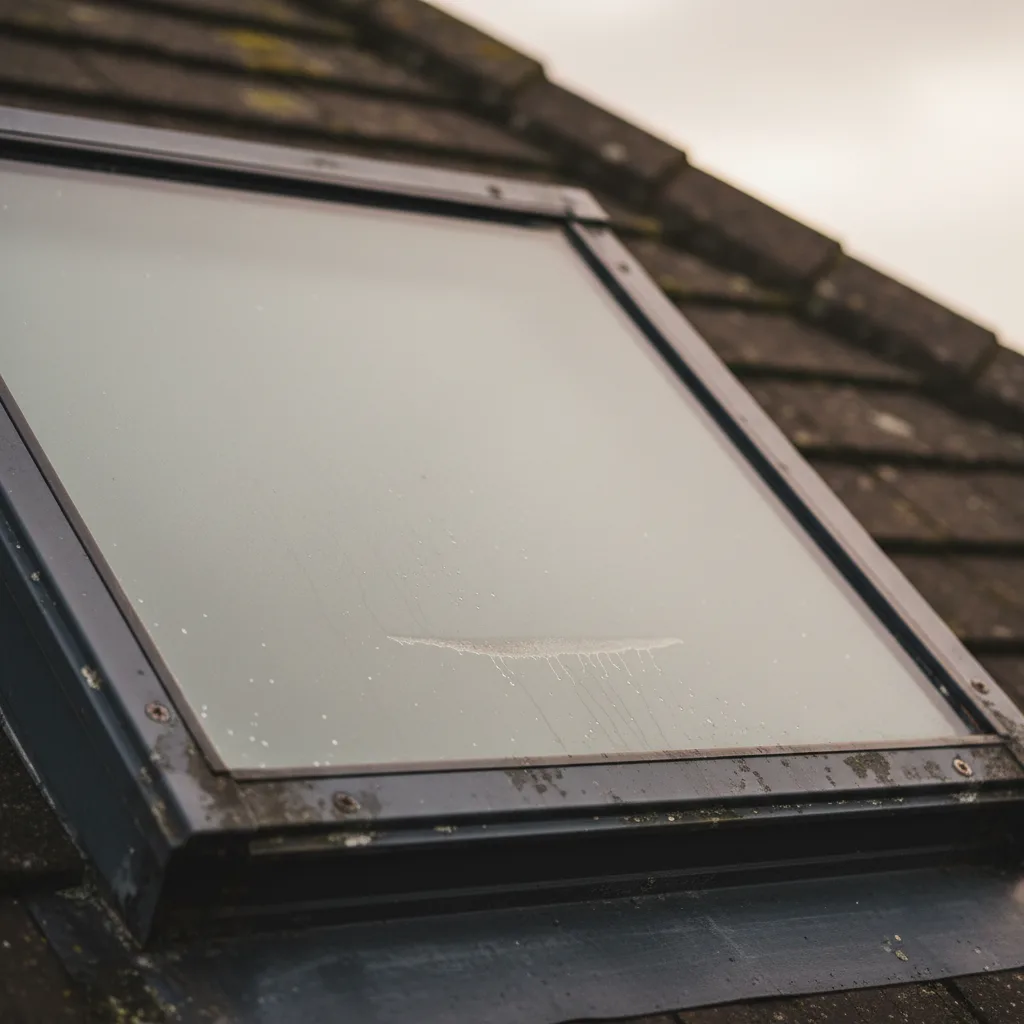
Misting that comes and goes
Two faults look identical for the first winter
Early cavity failure. The unit fogs on cold mornings and clears by lunchtime. The desiccant is nearly saturated but not finished, so the dew point inside the cavity is only just being crossed. It will get worse, gradually, over a year or two, and it will never get better.
Surface condensation. The unit fogs on cold mornings and clears when you wipe it. It is on the room side of the inner pane, it is worst in kitchens, bathrooms and anywhere with a tumble dryer, and it is a humidity and ventilation issue rather than a fault in the skylight at all.
The wipe test separates them in five seconds, and it is the first thing we ask people to do before we come out, because one of those two is not a rooflight problem and we would rather say so on the phone.
What the pattern says about the kerb rather than the glass
Some misting is telling you about the opening rather than the unit. A band of misting at the low edge with staining on the frame below it points at water standing in the rebate, which means the drainage is blocked or the fall is wrong. Misting at one end of a long unit, with the other end perfectly clear for years, usually means the kerb is twisted and the unit has been carrying an uneven load along its perimeter. Misting in one of four otherwise identical units, all fitted the same week, points at that particular position: a valley that drains across it, a parapet that shades it, an outlet that backs up.
When we survey a failed unit we look at all of that before quoting, because replacing the glass without correcting the cause is selling the same failure twice.
Reading the age off the unit itself
Once you have decided the unit has genuinely failed, the next question is whether it failed early or simply finished, and that needs a date. On a flat rooflight or a lantern there are three places to look, none of which involve a manufacturer’s plate.
| Where to look | What is there | What it tells you |
|---|---|---|
| The spacer bar, seen through the glass | Many sealed units carry a date or batch code stamped or printed into the aluminium or polymer spacer | Often an actual manufacturing date, if the edge cover is shallow enough to read it |
| The toughening mark, etched in a corner | A small permanent mark naming the processor and the standard the pane was toughened to | No date, but it identifies who processed the glass and confirms it is toughened rather than annealed |
| A label on the frame or inside the kerb | On flat rooflights, usually on the underside of the frame or on the inner face of the upstand | System, size convention and sometimes a works order number, which is the most useful of the three |
Where none of the three survives, which is common on 1990s work, we read the frame profile, the glazing method, the spacer type and the kerb detail instead and place the unit within a few years. That is accurate enough for the only decision it feeds: whether this failed early for a findable reason, or reached the end of an ordinary life.
What an early failure obliges us to find
Under roughly twelve years, a misted unit failed for a reason, and the reason is nearly always one of four: a window make-up with a polysulphide secondary seal fitted flat under full ultraviolet; edge cover shortened to suit a slim frame; no genuine fall, so the low edge stood in water; or a plain aluminium spacer driving a cold perimeter that condensed and kept the edge wet from the inside.
All four are correctable in the replacement, and none of them is corrected by simply buying the same thing again. If a quote for a ten-year-old failed skylight does not mention which of those it was, the quote has not looked.
Photographing it so it can be read from here
- The whole rooflight from inside, square on, with the room lights off and daylight behind it, so the extent of the misting reads.
- A close photograph of each corner from inside, which is where a seal failure starts and where tide marks collect.
- The low edge along its length, as flat an angle as you can manage, to show whether the misting is a band or a bloom.
- Anything visible through the glass at the spacer, using the flash, which sometimes catches a stamped code.
- The frame from outside if it can be done safely from a window or a landing, showing the fixing heads and the corners. Never go onto a roof for a photograph.
- One shot of the ceiling around the opening, because staining there changes the conversation entirely.
Send those to 447880284133 or ring 01202 923272, and we will tell you what we think we are looking at before anyone books a survey. The survey is what produces a fixed written price, and our installation carries a ten-year workmanship guarantee given directly by us, which is not insurance backed.
Related reading
Are 1990s rooflights on Poole extensions worth replacing now?
In most cases yes, and usually not for the reason people expect. A 1990s unit that has misted is finished…
Can a leaking rooflight be resealed instead of replaced?
Sometimes, where the leak is at a gasket, a termination or a joint that can genuinely be renewed. But the…
Can a misted rooflight be repaired?
Sometimes, but not in the way most people mean. The misting itself cannot be cured, because the fault is inside…
Can a misted unit be replaced with a larger one?
Yes, and it is often worth doing while the roof is open. But be clear what you are agreeing to:…
Can a rooflight be replaced in one day?
The fitting usually is, yes. One rooflight, on a roof that can be reached, onto a kerb that turns out…
Can an old dome rooflight be swapped for flat glass?
Yes, and it is one of the replacements people are most pleased with afterwards. The work is usually straightforward, because…