Fixed, hinged and pop-up units on a low pitch deck
What each type of flat roof unit is for, why a parallel-opening pop-up suits an exposed roof, and how to decide before the size is chosen.
Start with whether it needs to open at all
On a pitched roof the answer is usually yes, because a roof window in a loft room is doing two jobs and ventilation is one of them. On a flat roof it is a genuine question, and a surprising number of people who paid for an opening flat skylight have used it twice.
The reason is geometry. A flat roof rooflight sits above head height in a room you walk through rather than sleep in, it is reached by a pole or a switch rather than a hand, and the room below it usually has a door and a window doing the ventilating already. Meanwhile the opening mechanism adds cost, adds moving parts in the weather, adds a second weather line at the sash, and takes the frame from something sealed once to something that must seal repeatedly.
None of that means do not do it. It means the reason should be a real one — hot air out of a top-lit kitchen, a route onto a roof terrace, a bathroom that needs to dump moisture, a building regulation asking for it — and not simply that opening sounded better than fixed.
The four arrangements, and what each one is for
| Type | How it moves | What it is genuinely good for | What it costs you |
|---|---|---|---|
| Fixed | It does not | Daylight, the best sealed detail, the slimmest sightline, the largest panes | No ventilation, no access |
| Hinged, side-opening | Swings up from one edge on rams or a chain | Purge ventilation, and dumping hot air fast from a top-lit room | A sash sail area in wind, a second weather line, and a rain sensor to think about |
| Pop-up (parallel opening) | The whole pane lifts level on four points, leaving a gap all round | Trickle and background ventilation that works whichever way the wind is blowing | Limited opening distance, so no access and modest purge rates |
| Access hatch | Opens far enough to climb through, usually with a stay and a grab point | Getting onto a flat roof or terrace safely and lawfully | A heavier frame, a deeper kerb, and a different conversation about safety at the opening |
Those four are not a spectrum with more opening at one end. They are four different products solving four different problems, and the commonest specification error we see is an access-sized hinged unit bought to solve a ventilation problem that a pop-up would have solved better and cheaper.
What a pop-up actually does
A parallel-opening or pop-up unit lifts the entire glazed pane straight up, keeping it level, so instead of one large gap on one side you get a narrow continuous gap around all four edges. That sounds like a minor difference and is not.
Air moves through the gap on whichever side has the pressure, which means the unit ventilates regardless of wind direction — useful on a roof where the wind swings between south-west off the water and north-east down the harbour. The pane stays level, so it presents almost no sail area and catches far less in a gust. And because the gap is narrow and shielded by the pane sitting above it, driving rain has a harder time getting in than it does through a sash standing open at forty degrees.
The trade-off is volume. A pop-up is a background and purge ventilator, not a hatch and not a way of turning a kitchen into a courtyard. If the intention is to shift a lot of hot air very quickly on the one afternoon a year it matters, a hinged unit moves more.
Water, when the unit is open and when it has just closed
The rule, and the exception that catches people out
The rule: an opening unit on a flat roof needs its kerb detailed for a unit that is sometimes open, not only for one that is closed. That means the upstand height is measured with the same discipline as on a fixed unit, and the drainage around it is designed to take water away from the opening edge rather than past it.
The exception nobody mentions: the moment a wet sash closes, every drop on its outer face has to go somewhere, and on a shallow-pitch unit that somewhere is the gasket line. Good units have a drained and vented rebate that takes that water back out. Cheap ones rely on the seal alone, and the seal is the one component guaranteed to age. If you are being quoted for an opening flat rooflight, ask what happens to water sitting in the rebate — the answer tells you which of the two you are being sold.
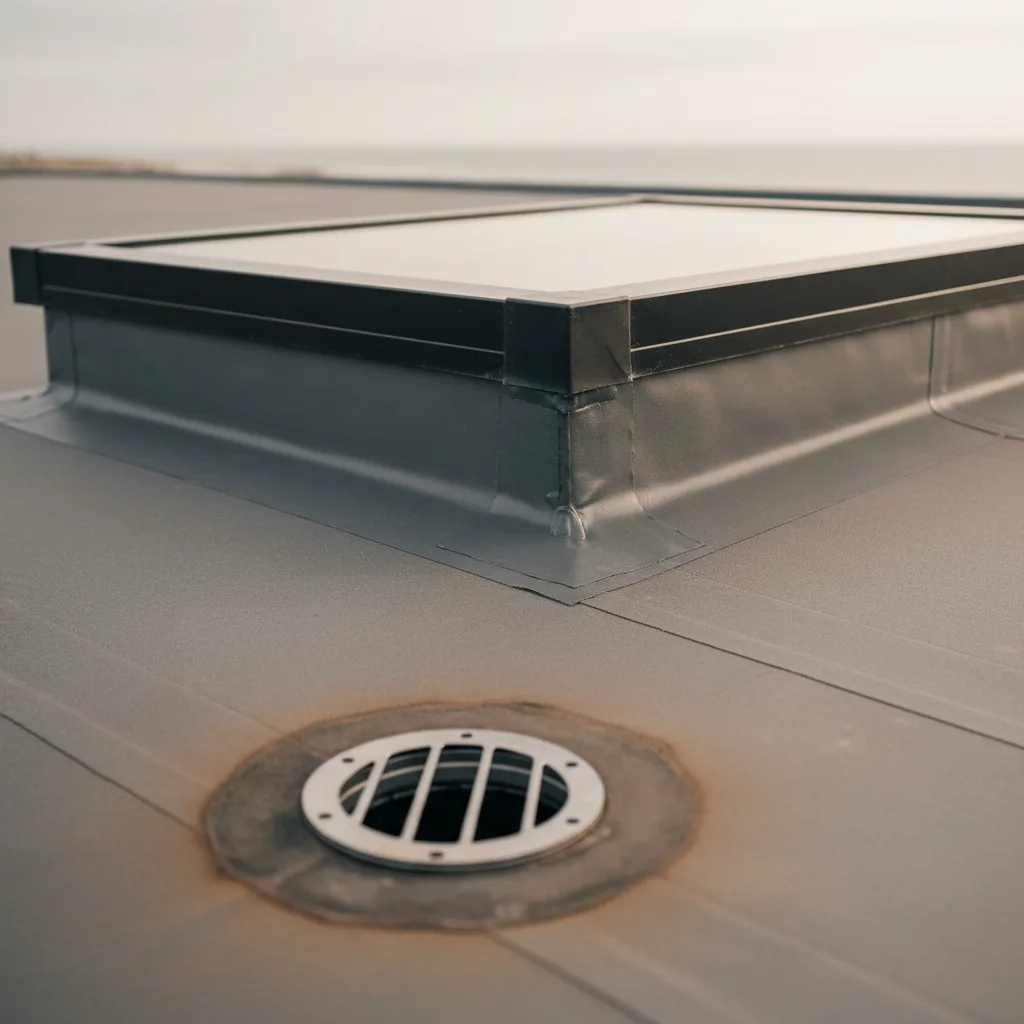
An access hatch is a different product wearing a similar shape
If the purpose is to get a person onto the roof — a terrace, a maintenance route, a green roof that needs tending — the unit stops being glazing and starts being a door that happens to be horizontal. It opens far enough to pass through, it holds itself open against wind, it has to be operable from below by someone standing on a ladder or a fixed stair, and it has to be safe to leave open.
That changes the kerb as well. An access opening is usually taller, because the guarding around a roof terrace and the threshold at the hatch have to work together, and because a person stepping out wants a lip to step over rather than a flush edge to trip on. It also changes the glass conversation: if the pane can be walked on rather than merely looked through, that is a walk-on specification and a separate subject with its own page on this site.
Choosing between them, in the order the decisions actually arrive
- Name the purpose in one sentence. Daylight; background ventilation; fast purge; roof access. Each points at a different unit, and trying to buy two at once usually produces a compromise on both.
- Check the room below. Height to the glass, what else ventilates the room, and whether anyone can realistically reach the unit without a pole they will lose within a year.
- Check the roof above. Fall direction, where water collects, and whether an open sash will be standing in the path of run-off from a higher roof.
- Check the exposure. An opening unit on the spit at Sandbanks is a different risk from the same unit in Broadstone, because a gust that catches a raised sash puts a load into the hinges and the kerb.
- Decide manual or powered. Above about two and a half metres a manual pole stops being charming; below it, a pole is one fewer thing to go wrong.
- Then pick the size, because opening mechanisms have size limits that fixed units do not, and discovering that after choosing the pane is the wrong order.
Wind and a raised sash on this coastline
An open sash is a sail, and where you stand decides how big a problem that is. Out at the harbour mouth the wind arrives off open water on both sides with no fetch break, and a hinged unit standing open in a rising south-westerly puts a load into hinges, rams and the kerb fixings that a fixed pane never sees. That is an argument for a pop-up rather than a hinged unit on the spit, and for a wind sensor if hinged it must be. Four miles inland at Creekmoor the same sash is unremarkable. The loading itself, and the fixings that answer it, are set out in our wind uplift guide.
Ventilation, and where regulations get involved
Two separate strands of the building regulations can bring an opening rooflight into a project. The first is ordinary ventilation: a habitable room, a kitchen or a bathroom has ventilation requirements, and a flat roof unit can form part of how those are met — particularly in a single-storey extension where the new space sits well back from any external wall.
The second is smoke ventilation, which turns up where a stairwell or a corridor needs a means of clearing smoke, and which is met by a powered unit with a dedicated control system rather than by an ordinary opening skylight with a switch. These are not interchangeable products and one cannot be substituted for the other on site. Which, if either, applies to your project is a question for whoever is running the Building Control application, and we would rather you asked them early than found out at completion.
What wears, and how often it needs attention
| Component | What eventually goes wrong | What keeps it working |
|---|---|---|
| Perimeter gasket | Compression set, so it stops springing back and starts letting draughts past | Keeping grit off the seal face; it is abrasion, not age, that finishes most of them |
| Hinges and stays | Corrosion and play, worst on the coast and worst on the hinge that sits in run-off | Correct metallurgy for the exposure zone, and rinsing rather than scrubbing |
| Electric actuator | Rarely fails outright; more often loses its travel setting or its link to the control | Operating it through its full travel a few times a year, even in winter |
| Rain sensor | Dirt film on the sensor face makes it either over-trigger or stop triggering | Wiping the sensor when the glass is cleaned |
| Drainage rebate | Silts up with pine needles and grit, then holds water against the seal | Clearing it at the same time as the kerb perimeter |
Controls, power and where that conversation goes
Once a unit is powered, a set of decisions follows that has nothing to do with roofing: where the cable is run and when, whether the switch is hard-wired or wireless, what happens in a power cut, whether a rain sensor closes it automatically, and whether it should talk to anything else in the house. All of that is better decided before the ceiling closes, because retro-fitting a cable to a rooflight in a finished plasterboard reveal is a destructive job.
We keep the detail of that on our electric rooflight pages rather than repeating it here. The one point worth making on a flat roof specifically: run the cable to the kerb even if you are fitting a manual unit today, provided it costs you almost nothing while the roof is open. It is the cheapest option you will ever buy.
What the quote will say
Stated plainly
A fixed written price after survey, naming the unit type — fixed, hinged, parallel-opening or access — and the reason that type suits what you said you wanted the rooflight to do.
A ten-year workmanship guarantee on our installation. It is a workmanship guarantee and it is not insurance backed. Moving parts carry the manufacturer’s own warranty, which is theirs and not ours, and we will point at it rather than blur the two together.
An honest recommendation to buy less where a fixed unit does what you actually need. We would rather fit a fixed pane you are happy with than an opening one you resent every time the sensor shuts it.
If you are deciding between fixed and opening on a flat roof anywhere from Upton to Swanage, ring 01202 923272 and tell us what you want the unit to do. That is usually a two-minute conversation and it settles the product.
Related reading
Broadstone and Creekmoor roofs where standard specification is right
Standard specification is the right answer here, and we will say so Most of this site argues that a flat…
Can a flat rooflight be fitted from inside?
Effectively no — not the part that keeps water out. A flat roof rooflight is weathered by dressing the roof…
Can a flat rooflight be fitted to a shed or outbuilding roof?
Yes, and it is usually the simplest work we do Yes. A flat rooflight goes into a garage, workshop, garden…
Can a flat rooflight be retro-fitted to an existing flat roof?
Yes — retro-fitting into an existing flat roof is the majority of this work, not the exception. What decides whether…
Can I fit a flat rooflight to a felt roof?
Yes, and felt is one of the more forgiving coverings to detail Yes. A flat rooflight can be fitted to…
Can two flat rooflights be fitted side by side?
Yes, and it is a common arrangement — but the interesting part is not the two units, it is the…