Rooflight and Skylight Installation Portland
Rooflight and skylight installation on Portland, the most exposed place in our whole service area and the one roof in Dorset we will not quote a standard build-up for.
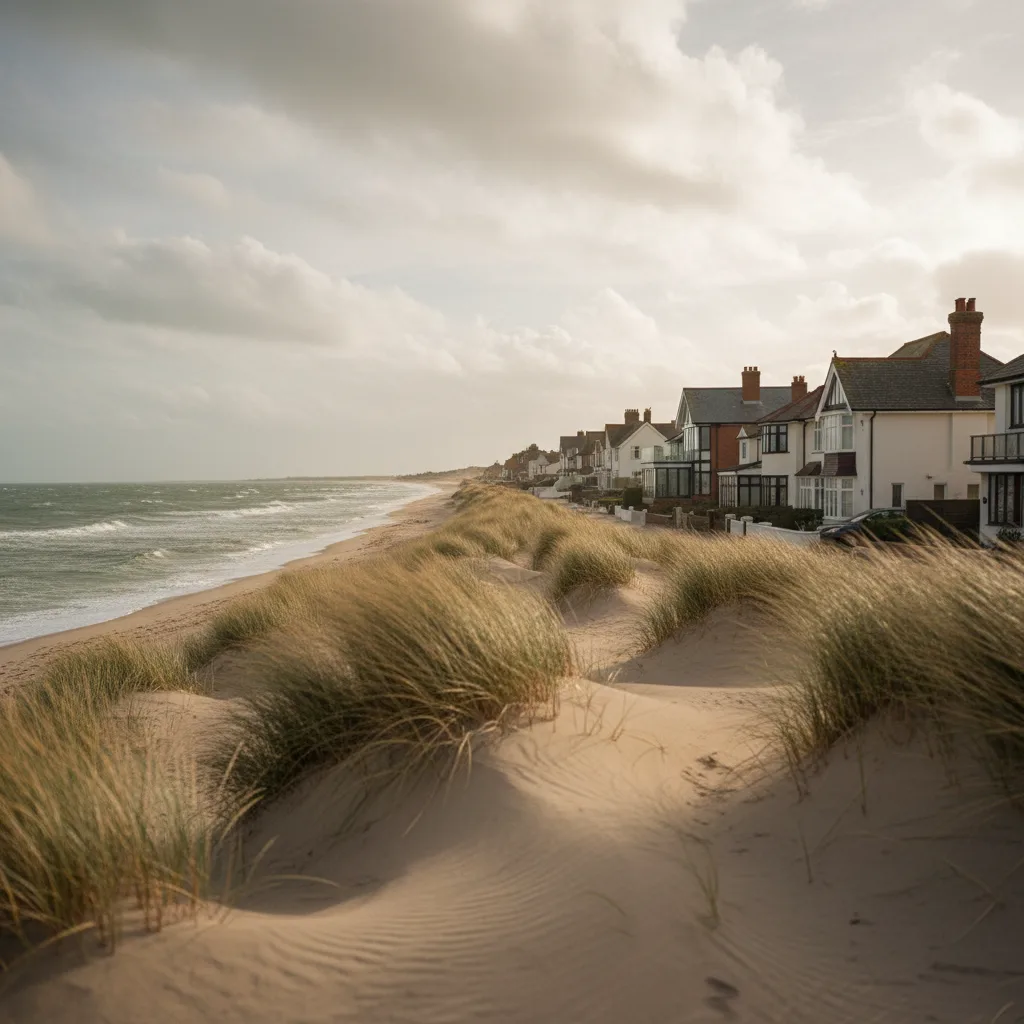
The most exposed place we work, by a distance
Portland is a tied island. Four miles of limestone joined to the mainland by Chesil Beach and the causeway, rising out of the sea to a height that gives it no shelter from anything. It is almost treeless, because trees do not thrive in that wind. It faces the English Channel on three sides. There is nothing between a house on Tophill and the open sea except the edge of the cliff.
Everything this firm says about inland Dorset runs backwards here. On an inland page we tell people that a marine specification is an overcharge and that the honest answer is an ordinary frame fixed better than average. On Portland the honest answer is the opposite: the hardest build-up we sell, and we will not quote anything less even if you ask us to. Both statements come from the same rule. The exposure decides the specification, and here the exposure is extreme.
Three loads at once, and they need different answers
Most places we work have one significant design case. Portland has three simultaneously, and firms that treat them as a single thing called “coastal” get at least one of them wrong.
| The load | What it does | What answers it |
|---|---|---|
| Airborne salt | Pits and seizes fixings, stains frames, chalks standard coatings, accelerates corrosion at every joint between dissimilar metals | A named marine-grade coating system, A4 stainless throughout including concealed fixings, and non-ferrous clips and fasteners |
| Wind uplift | Tries to lift the unit and its flashings off the roof. The force arrives at the fixings, not at the glass | A fixing schedule from a calculated uplift figure, tighter centres, and fixings landing in sound structure rather than in deck material |
| Wind-driven rain | Drives water horizontally, and even upward, into laps and joints that would shed it perfectly well anywhere else | Generous upstands, deeper laps, drainage paths that work under pressure rather than only under gravity, and no reliance on sealant as a primary defence |
| All three together | The combination is what actually fails installations here, not any one of them alone | Specifying for all three at once and saying so on the quote, item by item |
The third of those is the one most often missed. A detail that relies on water running downhill is fine in Broadstone and optimistic on Portland Bill in February.
What we specify here, and what we refuse
The one place we will not sell you the cheaper option
We will not fit a standard powder-coated frame on Portland, even at the customer’s request. It will chalk and fade within a few seasons and we would be back looking at it. Selling that would be taking money for something we know will disappoint.
We will not use ordinary fixings anywhere, visible or concealed. The concealed ones are the ones that seize, stain and fail first, and nobody ever inspects them until something has gone wrong.
We will not rely on sealant to make a detail work. Sealant is a secondary line. Anything that needs it to keep water out on this island will leak eventually, and usually in the first real gale.
We will price the uplift properly rather than using a fixing pattern that works on the mainland. On a large unit in this exposure that means more fixings, tighter centres and sound timber to land them in, and sometimes it means a smaller unit than you first wanted.
And we will tell you when the honest answer is no. A very large rooflight in a fully exposed Portland position may not be the right thing to build at all, and we would rather say so at survey than take the order.
Portland stone, and the buildings made of it
The island is one great bed of limestone, quarried here for centuries and sent out to build much of London, St Paul’s Cathedral among it. That stone is also what the island itself is built from: ashlar and rubble walls, boundary walls, whole villages in a single material, and in places roofs of stone slate rather than tile or slate.
For roof glazing the walls matter less than people expect and the covering matters enormously. A Welsh slate or a modern tile takes a proprietary flashing kit matched to it, which is straightforward work. A stone slate covering does not: those are thick, irregular limestone pieces laid in diminishing courses, and no manufacturer’s kit is made for them. The weathering has to be hand-dressed lead formed to the slates actually being re-laid, which is slower, dearer and the only method that works. We will tell you at survey which of those two jobs your roof is.
The other stone consideration is what the wind does to a building with no shelter. Pointing, render and bedding all take a beating on this island, and a roof that has lost mortar around a chimney or a verge is already letting water in before anyone adds an opening. We look at the condition of the covering as a whole, and we will say plainly if something needs a roofer before it needs us.
Underhill, Tophill, and the island’s own gradient
Even here, exposure is not uniform. The island divides into Underhill, the lower ground around Fortuneswell, Chiswell and Castletown, and Tophill, the plateau carrying Easton, Weston, Southwell and the Bill.
Tophill is high, open and takes the wind from every direction with nothing to break it. This is the hardest exposure in our entire service area, harder than Sandbanks, because Sandbanks at least has the harbour behind it.
Underhill has the cliff above it and some shelter from certain directions, but it is closer to the water and Chiswell in particular has a long and well-documented history with the sea coming over Chesil Beach.
What that changes: the wind uplift calculation and the exposure of a particular slope, rather than the corrosion specification. The marine build-up applies across the island. The fixing schedule is worked out roof by roof.
Working on the island
- Weather windows are real and they are short. We do not open a covering on Portland into a forecast we do not like, and we would rather move a date than have a roof open when the wind gets up. You should be suspicious of anyone who promises otherwise.
- Scaffold designed for the exposure. Sheeting on an exposed Portland scaffold is a sail, and it is either specified and tied for the conditions or left off entirely. Ties, bases and loading are not a formality here.
- One road on and off. Deliveries, vehicle sizes and timings all work around the causeway and the roads up the hill. A large glass delivery is planned rather than assumed.
- Everything checked against the specification on arrival. On a marine job the fixings and the coating reference are verified against the delivery note, because a single ordinary screw undermines the whole build-up.
- Narrow streets and terraces. In Fortuneswell and the older parts, scaffold on the frontage stands on the highway and needs a licence from Dorset Council, with a lead time.
- Opened and closed within the working day, hose tested at a pressure that means something in this exposure, and never left overnight.
Heritage, the coast, and consent
Dorset Council, and a coastline with a world designation
Dorset Council is the authority for planning, conservation and Building Control. Not BCP.
The coast here forms part of the Jurassic Coast World Heritage Site, and the island carries conservation areas, listed buildings and a quarrying landscape with its own recognised significance. That does not stop domestic work, and it does mean the visual effect of what is proposed carries weight.
On an ordinary house, rooflight work is usually permitted development provided it projects no more than 150mm beyond the roof plane and does not sit above the highest part of the roof. In a conservation area, on a listed building, or where permitted development rights have been removed, assume you need to ask.
Listed building consent is separate from planning permission and covers the whole building, including the rear.
Consent is never assured. Applications are decided on their individual merits. We will tell you which designations attach to your address and what tends to sit well within them. We do not submit applications for you and we will not predict a decision.
Portland questions
Can I have the cheaper specification to save money?
Not from us, not here. On Portland a standard build-up is not a saving, it is a shorter interval before the next invoice. We would rather lose the job than fit something we expect to fail.
Is a big rooflight possible in this wind?
Often, but the size has to be justified by the fixing design rather than chosen from a brochure. In a fully exposed position we may recommend a smaller unit, or two units, rather than one large one, and we will explain why in writing.
My roof is stone slate. Does that change things?
Considerably. No proprietary flashing kit fits a stone slate covering, so the weathering is hand-dressed lead formed to the slates being re-laid. It takes longer, it costs more, and it is the only method that works.
How far are you from Portland?
It is the furthest point in the area we work from Poole, and we will be honest about that. The price follows the roof rather than the postcode, but scheduling is grouped, so survey and installation dates may be offered on particular days rather than at short notice.
The written part
A ten-year workmanship guarantee on our installation. It covers workmanship, and it is not insurance backed, said in those words rather than left to be inferred. Units, glass and components carry their own manufacturer warranties.
A fixed written price after survey, itemised, naming the coating system, the fixing specification, the lead or flashing method for your actual covering, and any structural design. The exposure zone is on it too, and for Portland it reads exposed coast, which is the hardest line we write anywhere.
The firm is new. We install and replace rooflights, skylights, roof windows, roof lanterns and sun tunnels across Poole and about thirty miles of Dorset, and Portland sits at the far edge of that. To arrange a survey, ring 01202 923272.
Related reading
Rooflight and Skylight Installation Alderney
The Alderney question is not what it is made of. It is whether it opens Most of the calls we…
Rooflight and Skylight Installation Barton on Sea
Barton on Sea is a cliff top with a clear view of the Isle of Wight and absolutely nothing between…
Rooflight and Skylight Installation Bere Regis
Cob, and why we ask what your walls are made of Cob is earth. Subsoil, water, straw and sometimes chalk…
Rooflight and Skylight Installation Blandford Forum
A town rebuilt all at once, and what that does to roof work Most English towns grew in layers, so…
Rooflight and Skylight Installation Boscombe
In Boscombe, the roof is usually not the shape people think it is Ask someone what their roof looks like…
Rooflight and Skylight Installation Bournemouth
Bournemouth is not one exposure, and neither is its roof stock Bournemouth runs from a clifftop down a set of…