Servicing a VELUX: hinges, filters and the sash that will not stay up
Most VELUX faults are maintenance rather than failure, and a sash that drops is almost always a worn or contaminated friction hinge rather than a window at the end of its life.
A roof window has four moving parts and three consumable ones. Almost everything that goes wrong with one is on that list, and almost none of it means the window has failed.
The reason this matters is that the alternative diagnosis is expensive. A sash that will not stay up, a pivot that has gone stiff, a whistle in a gale and a run of water along the bottom bar all get reported to us as a broken skylight. In the great majority of cases the unit is fine and has simply not been touched since the day it went in. A roof window is a mechanism, which is the one way it differs from a fixed rooflight, and mechanisms want looking at. The manufacturer publishes maintenance intervals for exactly this reason, and nobody reads them, because the window is above head height and out of the daily field of view.
Start with the symptom, not the component
| What you are seeing | The usual cause | What it takes to put right |
|---|---|---|
| Sash drops shut, or creeps closed | Friction in the pivot hinge has reduced, through wear, contamination or over-lubrication | Clean and adjust the hinge; replace the friction components if adjustment has run out |
| Sash stiff to turn | Dirt and salt crystals in the hinge track, or a sash that has swollen | Clean the track, check for water ingress into the sash timber |
| Draught along the top when closed | Gasket compressed flat, or the ventilation flap not latching | Replace the gasket; check and clean the flap and its catch |
| Whistle or rattle in wind | Flap catch worn, or the sash no longer pulling down evenly on both sides | Adjust the closing mechanism so both sides compress the gasket equally |
| Dust and smells coming in | The air filter in the ventilation flap is blocked | Remove, wash, dry, refit. It is designed to be taken out |
| Water along the bottom bar | Condensation, or a blocked drainage channel in the sash | Different remedies entirely; this one gets diagnosed before anything is done |
The sash that will not stay up
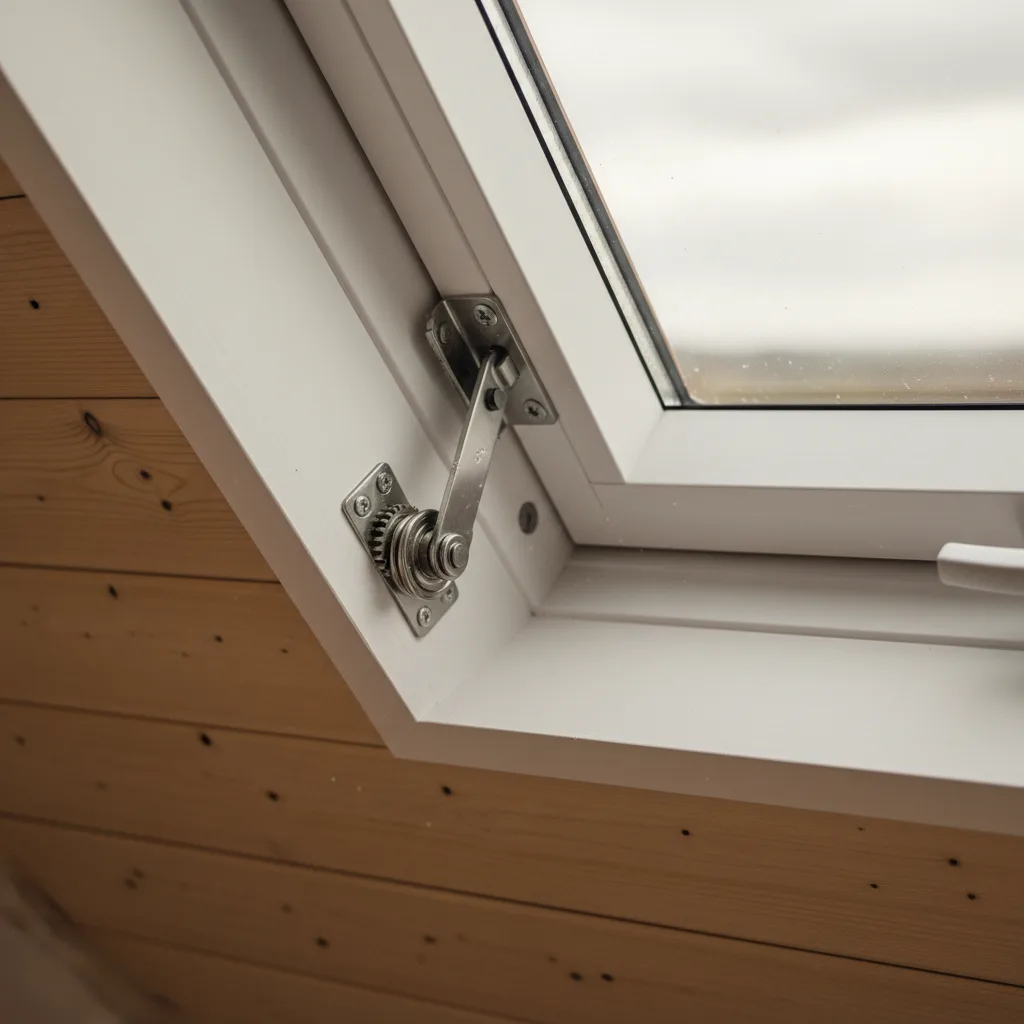
This is the single most reported fault, and it is worth understanding because the explanation is reassuring. A centre-pivot sash is held at whatever angle you leave it by friction in the hinge, not by a catch. There is no spring and no stay. The hinge is engineered to hold the weight of the sash with a margin, and over years that margin gets eaten by three things: wear in the friction surfaces, contamination from dust and salt, and, perversely, lubrication.
The third is the one people cause themselves. A sash that has gone stiff gets a spray of household lubricant, feels wonderful for a fortnight, and then will not hold at all, because the friction it relied on has been washed out of the mechanism. The friction pad is not a bearing and it is not supposed to be slippery.
What to do, in order
First, clean. The hinge track and the friction area get wiped free of grit, dust and, near the water, salt crystal. On a great many windows the problem stops here.
Second, adjust. Most generations provide an adjustment at the hinge to restore friction. It is a small movement and it is set against the actual weight of your sash, which is heavier on a larger unit and heavier again with a triple-glazed pane.
Third, replace the parts. When adjustment has reached its limit the friction components are a spare part, not a new window. What makes this a job rather than a task is that it is done at height, on an open sash, at whatever pitch your roof happens to be.
What not to do: do not oil it. If it has already been oiled, say so, because the cleaning needed afterwards is more thorough than the routine version.
The filter nobody knows is there
The ventilation flap at the top of the sash contains a washable air filter. It lets the window provide background ventilation with the sash closed and locked, which is how most people actually use one, and it is the reason a closed roof window still does something useful on a still summer night.
Blocked, it stops ventilating, and the flap starts being left open instead. That is how driving rain gets in through a window that is nominally shut. The filter comes out by hand, washes in warm water, dries and goes back. Once a year inland; twice a year on the coast and under trees, where it loads faster with salt and pollen.
Gaskets, and the draught that is not a failure
The weather seal around a sash is a compressible gasket, and compressible things stop being compressible. After fifteen or twenty years of being squashed shut, the gasket takes a set and no longer springs back to fill the gap. The window closes, the handle locks, and cold air comes through anyway.
Gaskets are a replaceable part on most generations, and replacing one is a far better answer than a new unit for a window that is otherwise sound. The tell is a draught that is even along one edge rather than concentrated at a corner; a corner draught more often means the sash is not pulling down square.
Drainage: the part that is invisible and decides everything
There is a drainage path built into the bottom of the sash and frame, designed to take any water that gets past the outer seal and return it to the outside. It works perfectly until something fills it. On this coast the two things that fill it are salt crystal build-up and organic debris, and in the wooded belt across Canford Cliffs and Branksome Park the pine needle load makes that a year-round issue rather than an autumn one.
A blocked drainage channel presents as water appearing at the bottom of the window in heavy rain. It reads exactly like a leak and it is not one. Clearing it takes minutes; diagnosing it correctly is the part that saves a homeowner from a replacement they did not need.
A dropping sash on a large unit is a safety matter, not just an annoyance. A 78 by 140 glazed sash swinging shut under its own weight while someone is leaning through the opening is a real hazard, and it is a stronger argument for getting it seen to than the inconvenience is. Where small children use the room, a restrictor is a sensible addition at the same visit.
How often, and where you are
Maintenance intervals are not one number across our service area, and we would rather give you the real one than a flat annual figure that is wrong at both ends.
| Where the house is | Sensible interval | What drives it |
|---|---|---|
| Sandbanks, Studland, Mudeford | Twice a year | Salt-laden wind with no fetch break; salt crystal in hinges, tracks and drainage |
| Canford Cliffs, Branksome Park | Twice a year | Continuous pine needle and resin load fouling drainage and filters |
| Hamworthy, Lower Parkstone, Southbourne | Annually | Salt present but broken by land before it arrives |
| Broadstone, Creekmoor, Canford Heath, Wimborne | Annually, and honestly every couple of years is fine | Sheltered, low airborne load. Recommending more here would be selling you visits you do not need |
The routine itself
- Rotate the sash to the cleaning position and engage the barrel bolt or catch before touching anything else.
- Wash both glass faces and the gasket with plain water and a soft cloth, then dry the gasket rather than leaving it wet.
- Take out the ventilation filter, wash it, dry it fully and refit it.
- Clear the drainage channel at the bottom of the sash and frame with a soft brush. Nothing sharp.
- Wipe the hinge tracks and friction areas clean. Do not lubricate.
- Check the closing action on both sides and adjust so the gasket compresses evenly.
- On a lacquered pine unit, look at the bottom rail and the sash corners for opened grain, and plan a recoat before it greys.
- From outside or from the cleaning position, check the flashing apron and the tile course below it for lifted edges or displaced tiles.
When servicing stops being the answer
Three findings move the conversation to replacement rather than maintenance: a sealed unit that has misted, timber that has gone soft rather than merely weathered, and a generation of unit for which the friction and gasket parts are no longer obtainable. The last one is a real limit on very old windows and it is the reason we check the age plate before quoting any service work.
We are an independent installer and hold no accreditation or approved status with VELUX or any other manufacturer; what we offer is our own ten-year workmanship guarantee, given directly and not insurance backed, and a fixed price in writing after a survey. If a window in Poole or anywhere in the surrounding area has stopped behaving, call 01202 923272 and describe the symptom from the table above. Most of the time it is the hinge, and most of the time it is fixable.
Related reading
Can a VELUX be converted from manual to electric?
Usually yes, if the unit is from roughly the last twenty years. A retro-fit kit replaces the top control bar…
Can a VELUX be fitted to a flat roof?
Not as it comes. A standard pitched-roof unit needs a slope of roughly fifteen degrees or more to shed water…
Can a VELUX be fitted to a roof with solar panels?
Yes, but it stops being a roofing question and becomes a clearance and sequencing one. A flashing needs a clear…
Can a VELUX be replaced with the same size unit?
Usually yes. The standard size grid has been stable for decades, so a like-for-like frame is normally available, but “same…
Can a VELUX window be repaired?
Yes, more often than not. Glass, gaskets, filters, handles, friction components and flashings are all replaceable on their own. The…
Can I fit a blind to an old VELUX window?
Usually yes, provided you can read the size and type codes off the data plate. Manufacturer blinds are made to…